Edit
Sweden’s Kristersson vacates PM office following narrow election defeat
The centre-left opposition has won 176 seats against 173 for the governing bloc, but faces difficult talks over a new coalition
Sweden is heading towards a change of government after Prime Minister Ulf Kristersson formally asked to be relieved of his duties on Thursday, following the completion of the parliamentary vote count that gave the centre-left opposition a narrow majority.
Kristersson’s resignation does not mean that his government immediately leaves office. Under Sweden’s parliamentary system, he and his ministers remain in their posts as a caretaker government until a new government has been formed and taken office. Kristersson said he would continue to take responsibility for governing the country during the transition.
The four opposition parties led by Social Democrat Magdalena Andersson will hold 176 of the Riksdag’s 349 seats, compared with 173 for the four parties that have governed under Kristersson. The three-seat majority gives Andersson the first opportunity to try to form a government, but does not resolve the difficult negotiations needed to turn the parliamentary majority into a functioning governing coalition.
Kristersson formally submitted his request to step down to parliamentary Speaker Andreas Norlén, saying the Speaker would now lead the next steps towards forming a new government.
“It is completely natural that there is a parliamentary majority that does not want the blue-yellow government we were elected to,” Kristersson told TV4.
“I will continue to govern as a transitional government. I will take full responsibility for Sweden in every way possible. No one should believe anything else,” he said.
The Speaker will now consult the party leaders before proposing a candidate for prime minister. The Riksdag can vote on a new prime minister from 29 September at the earliest.
Andersson, who previously served as prime minister from 2021 to 2022, has already invited the leaders of the other three opposition parties – the Left Party (V), the Green Party and the Centre Party (C) – for initial talks on forming a government.
In her victory speech, she said Swedish voters had “voted for a new direction for our country, voted for unity and against division”. She said she wanted to lead Sweden in “a new spirit of cooperation” and highlighted the climate, schools, healthcare, elderly care and immigration policy among the areas where she wanted to pursue change.
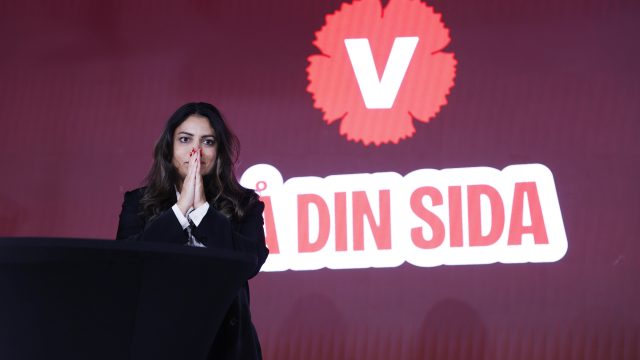
But the four parties that make up the opposition majority have significant differences, particularly over the role of the Left Party in a future government.
Sweden’s centre-left bloc leads close election against right-wing government
The Centre Party has said it will not support a government in which the Left Party holds ministerial posts. The Left Party, meanwhile, has demanded representation in the cabinet. Andersson has previously ruled out allowing the Left Party to join a Social Democrat-led government, while still needing its parliamentary support.
Kristersson pointed to the contradiction during an interview with SVT.
“I can only assess what has been said in the election campaign and then there are rock-solid red lines. V demands to sit in a Social Democratic-led government while C demands that V should not sit in that government, so it sounds complicated,” he said.
He added that “someone will have to change” for an alternative government to be formed.
The Centre Party could also become important if Andersson fails to put together a government. Kristersson has said he is prepared to explore options for parliamentary support among non-socialist parties, while Centre Party leader Elisabeth Thand Ringqvist has opposed a government dependent on the Sweden Democrats.
“We were clear that we went into the election with the position that extremist political forces should not dominate government,” she said.
For now, however, the initiative lies with the parliamentary Speaker. The new Riksdag is due to convene on 28 September, with a prime ministerial candidate able to be proposed from 29 September at the earliest.
Sweden has experienced lengthy government-formation processes before. After the 2022 election, it took 37 days to form a government, while the political deadlock following the 2018 election lasted 134 days.
Andersson, 59, was Sweden’s first woman prime minister and previously served as finance minister for seven years. Her Social Democrats remain the country’s largest party, with 28% of the vote, although this is among their weakest results in more than a century.
The election also marks a change in the trajectory of the Sweden Democrats. After years of expanding their electoral support and increasing influence over the centre-right, the party has recorded its first parliamentary election decline, while the opposition has secured a narrow majority in the Riksdag.
Sources: svt.se, BGNES, Guardian
Caption: Swedish Prime Minister Ulf Kristersson (R) of the Moderate Party leaves the official residence, Sager House, a day after the Swedish general election in Stockholm, Sweden, 14 September 2026. Sweden’s general election held on 13 September to elect members of the Riksdag as well as representatives in regional and municipal elections has been deemed too close to call, with indications showing the center-left opposition in a narrow lead over the right-wing government as vote counting continues. EPA/CLAUDIO BRESCIANI
Updated: September 17, 2026 - 19:40