Edit
Sweden heads for tight election as right-wing bloc narrows opposition lead
The far-right Sweden Democrats, which has around 20% support and is now the second-largest force, is seeking to enter government for the first time
Sweden’s ruling right-wing bloc has narrowed the gap with the centre-left opposition ahead of Sunday’s general election, although the latest polling still puts the opposition in the lead.
A Novus poll published on Monday by broadcaster TV4 showed the four centre-left parties on 50.3% of voter support, compared with 47.9% for the three-party government and its parliamentary ally, the anti-immigration Sweden Democrats.
Sweden’s government, led by Ulf Kristersson, is made up of three centre-right parties – the Moderates, Christian Democrats and Liberals. The anti-immigration Sweden Democrats support the government in parliament without formally being part of it. Together, the four parties make up the broader right-wing bloc. Opposing them are four centre-left parties led by the Social Democrats of former prime minister Magdalena Andersson.
The 2.4-point gap is only 0.2 percentage points smaller than in Novus’ previous survey, suggesting that the right has made only limited progress in the final days of the campaign.
The more significant movement is among the Liberals, the junior party in the governing coalition. Their support rose to 4.3% from 3.3%, taking them back above Sweden’s 4% parliamentary threshold.
That result could prove important for the government bloc. The Liberals currently hold 16 seats, and falling below the threshold would have put those seats at risk and made it harder for the right-wing parties to retain their parliamentary position.
Novus surveyed 2,888 voters between 1 and 5 September.
The latest figures nevertheless represent a substantial change from some earlier polling. Three weeks ago, a poll by another agency put the centre-left 10 percentage points ahead – a lead political scientists at the time considered extremely difficult to overcome before election day.
Since then, however, the gap has narrowed. Three polls conducted in the past week have put the four centre-left parties at around 50% and the four parties on the right at approximately 47%.
Sweden, Novus poll:
S-S&D: 27% (+1)
SD-ECR: 20% (-1)
M-EPP: 18% (+1)
V-LEFT: 8%
MP-G/EFA: 8%
C-RE: 8%
KD-EPP: 6% (-1)
L-RE: 4% (+1)+/- vs. 24-30 August 2026
Fieldwork: 01-05 September 2026
Sample size: 2,888➤ https://t.co/5XI9Get6LP pic.twitter.com/qKAElDXZkI
— Europe Elects (@EuropeElects) September 7, 2026
Crime and welfare dominate campaign
The campaign has focused heavily on healthcare, welfare and household costs, alongside concerns about security.
Kristersson’s right-wing bloc has made crime and immigration central to its campaign, building on the issues that helped bring it to power in 2022.
Sweden has experienced years of shootings and bombings linked to organised crime networks. But Teorell said these issues had become less prominent on voters’ agendas as crime and petrol prices fell.
The centre-left, meanwhile, has pledged higher taxes on banks and high-income earners to finance greater investment in healthcare and schools and support households facing rising costs and growing economic inequality.
Social Democrat leader Magdalena Andersson has presented the election as a choice over the direction of Swedish society, including whether the country should move towards a government dominated by the Sweden Democrats.
The far-right party, which has around 20% support and is now Sweden’s second-largest political force, is seeking to enter government for the first time.
Sweden Democrats seek government role
The Sweden Democrats have played a decisive role in Swedish politics since the 2022 election, when Kristersson became prime minister after his centre-right coalition reached an agreement with the party.
The deal gave the Sweden Democrats significant influence over government policy, particularly on immigration and crime, in exchange for parliamentary support.
Kristersson has now promised the party cabinet posts if he is re-elected, including responsibility for migration.
Sweden Democrats leader Jimmie Åkesson has said his party should control several key portfolios, although he is not seeking to become prime minister this time. He has said he would instead aim for the post in 2030 or later.
With immigration sharply reduced, the party has increasingly focused on what it calls “re-migration” – policies intended to encourage immigrants to leave Sweden.
In June 2025, the party published a report examining its origins and past links to fascist and Nazi organisations, as well as xenophobic and antisemitic views among some early members. Åkesson apologised on behalf of the party while continuing to promote its nationalist agenda.
Security offers little room for political divergence
Security has taken on greater importance since Russia’s full-scale invasion of Ukraine in 2022 led Sweden to abandon decades of military non-alignment and join NATO.
The country has since increased defence spending and strengthened civil preparedness. It has also accused Moscow of cyberattacks, disinformation and intelligence operations, as well as involvement in incidents involving drones and aircraft over the Baltic.
There is broad agreement between the government and opposition on NATO and defence policy, meaning a change of government is unlikely to bring major changes in those areas, Teorell said.
The main differences would instead be economic, with a centre-left government expected to raise taxes and increase investment in the welfare system.
The final result could also lead to difficult negotiations over government formation. The centre-left bloc remains ahead in the polls but consists of four parties with ideological differences, while the right depends on the Sweden Democrats and the Liberals to maintain its parliamentary strength.
Sources: Reuters, Euronews
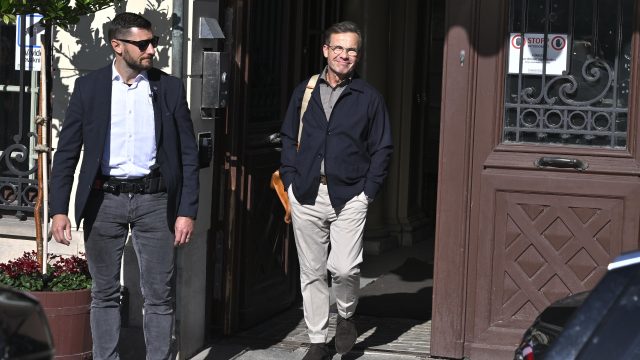
Caption: Sweden’s Moderate Party leader and Prime Minister Ulf Kristersson (C) speaks during a press conference at the party’s office in Malmo, Sweden, 05 September 2026. Sweden will hold general elections on 13 September to elect members of its parliament, the Riksdag. EPA/JOHAN NILSSON
Updated: September 9, 2026 - 05:41