Edit
Student protesters in Belgrade demand snap elections, present reform agenda
The protests reflect growing public discontent in Serbia over alleged corruption, selective law enforcement, and the government’s handling of institutions
Thousands of students and citizens gathered at Slavija Square on Saturday evening in one of the largest recent demonstrations in the Serbian capital, calling for immediate parliamentary elections and an end to what they describe as a corrupt and authoritarian regime.
The rally, organised by students who have been blockading universities since early May, concluded around 8 p.m. Speakers outlined parts of a student-led political program covering the judiciary, healthcare, education, agriculture, culture, and other key sectors. Organizers said the gathering marked a shift from campus protests to a broader national movement.
Core demand: new elections
Student speakers repeatedly emphasized their central demand: that the authorities call early elections. Andrej Tanko, a student at the Faculty of Electrical Engineering, told the crowd that the upcoming vote represents a historic opportunity to deliver on the students’ promise of “honest government, freedom, and a dignified life.”
“We may not have all the answers at every moment, but we have teams of experts in economics, healthcare, agriculture, energy, education, ecology, and other fields who know how to implement a plan for Serbia’s recovery,” Tanko said. He announced that students would begin contacting citizens via email on Sunday to organize training for election monitoring, pledging to have observers at every polling station across the country.
The crowd chanted “Students are winning” and adopted the new slogan “Serbia, you and I,” expanding from the earlier campus-focused “Slavija, you and I.”
Criticism of the authorities
Psychology student Lena said the students’ demands had become the demands of all citizens. Since May 5, protesters have called for elections, but the government has so far refused.
“Institutions have not been doing their job for years,” she said. “The prosecution fails to punish those involved in corruption and crime. This regime governs with police officers, criminals, and prime ministers sitting at the same table.” She asked the crowd: “Are we for Serbia or for the mafia?”
Prosecutor Bojana Savović described the current situation as “anarchy” rather than a functioning state. “Bombs, extortions, and mafia-style showdowns – this is not a state,” she said. She called for the equal application of laws and institutional courage from judges and prosecutors.
Broader reform vision
Several academics and professionals presented policy ideas:
- Education: Professor Radomir Sajičić of the Faculty of Chemistry criticized the appointment of politically loyal school directors and the creation of new, government-backed faculties. He pledged to strengthen existing universities and attract Serbian experts working abroad.
- Culture and Arts: Mirjana Nikolić, Rector of the University of Arts, said the government fears “a raised student index at the end of a theater performance or concert.” She described the protesters as “patriots defending their state” and stressed that free media, culture, and education must be the foundation of any future society.
- Healthcare: Doctor Ilija Srdanović called for decentralization, stronger local clinics and general hospitals, and greater investment in medical staff rather than buildings and expensive equipment.
- Labor and Economy: Retired union leader Jugoslav Ristić highlighted the plight of workers under a policy of cheap labor, saying many Serbians “work but cannot live from their wages.” He promised changes to labor laws that would prioritize domestic workers over foreign investors.
- Agriculture: Professor Aleksandar Sedlar from the University of Novi Sad urged a revival of rural life and recognition of farmers as key economic partners, not social cases. He strongly opposed the Rio Tinto lithium mining project, leading the crowd in chants of “Won’t dig!”
A teacher from Čajetina, Marija Vulović, told the audience that the fight was not limited to Belgrade’s centre but represented the majority of Serbia. “The whole of Serbia is fighting for freedom,” she said. “An index [student ID] will defeat a party membership card.”
Actor Aleksandar Srećković, known as Kubura, praised the students as the bravest segment of society and described the movement as a struggle for national survival.
The event ended with twelve students reciting the poem Drveni mač (“Wooden Sword”) by Ljubomir Simović, a symbolic call to resist oppression with determination.
Organizers reported tens of thousands of attendees arriving from various parts of Belgrade. Traffic around Slavija Square remained blocked late into the evening. Students say they will continue both blockades and outreach to citizens until elections are called.
The original article in Serbian by EUalive’s partner BETA can be found here.
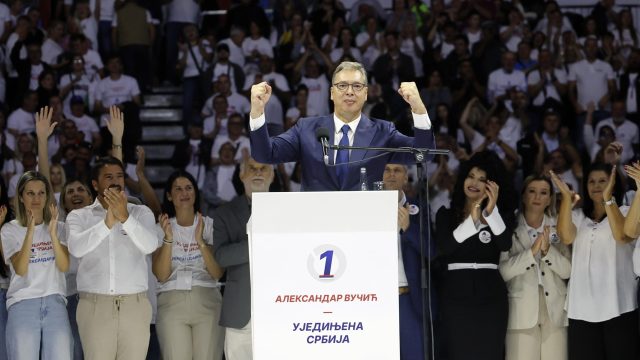
Caption: Protesters gather for a mass student-led anti-government rally in Belgrade, Serbia, 23 May 2026. Thousands gathered to ramp up pressure on the government and demand early parliamentary elections. The political movement originally erupted across the country following the November 2024 canopy collapse at the Novi Sad railway station that killed 16 people. EPA/ANDREJ CUKIC
Updated: May 24, 2026 - 06:24