 Edit
Slovenian ministers resign over fatal assault amid Roma tensions
The incident is a stark reminder of the fragile balance between justice, integration, and social cohesion
In a dramatic escalation of Slovenia’s ongoing debates over public safety and ethnic integration, Prime Minister Robert Golob accepted the resignations of Justice Minister Andreja Katič and Interior Minister Boštjan Poklukar on 26 October, following the death of a 48-year-old local man in Novo Mesto.
The victim, identified as Aleš Šutar, a respected community member and father, succumbed to injuries from a brutal beating outside the Patriot bar early on 25 October. The incident has ignited fierce public outrage, reignited long-simmering ethnic tensions with the Roma minority, and prompted calls for sweeping government reforms.
The fatal assault: a father’s deadly intervention
According to police reports and eyewitness accounts, Šutar rushed to the bar on Rozmanova Street around 2:30 a.m. after receiving a distressed call from his son, who claimed he was being threatened by a group of young men from the local Roma community.
Upon arrival, Šutar was savagely attacked, reportedly by a single 21-year-old assailant – a previously convicted individual described as a “returnee” from abroad – though investigators are probing potential involvement of others.
The victim suffered severe head trauma and was rushed to the hospital in critical condition, where he died hours later.
Authorities emphasized that an earlier police visit to the bar – about two hours prior – was unrelated to the assault and involved a separate disturbance.
The suspect remains in custody, and the case is being treated as a homicide. The bar’s management, which hosted an event organized by an external contractor with compliant security protocols, issued a statement of condolences, expressing solidarity with Šutar’s family and the Novo Mesto community.
Ministers’ resignations: a gesture of accountability
Addressing reporters after an emergency cabinet meeting, Golob confirmed the resignations, stating, “The ministers are aware of their responsibility. They offered their resignations, and I have accepted both. I will inform the National Assembly tomorrow.”
He extended heartfelt condolences to Šutar’s loved ones, describing the event as “a terrible tragedy” that left the nation gripped by “sadness, anger, and even fear.”
Katič framed her departure as an act of “objective responsibility” to help de-escalate rising tensions, adding, “Everyone must think about their own responsibility. It’s me.”
Poklukar echoed this, condemning “any violence in society” as “completely unacceptable” and underscoring his commitment to accountability.
Reports suggest Katič moved swiftly to resign, while Poklukar initially hesitated before agreeing.
Golob rejected opposition demands—led by Slovenian Democratic Party (SDS) leader Janez Janša—for his own resignation or that of the entire government, calling it “an escape from responsibility.”
Instead, he vowed to transform the grief into action: “People have the right to safety. This right was not realized yesterday, and this is unacceptable.”
He urged political leaders to avoid “exploiting the tragedy to spread hatred or division,” calling on citizens to channel pain into “solidarity with the victim’s family.”
Broader context: escalating Roma-Slovene tensions in Dolenjska
Novo Mesto, Slovenia’s seventh-largest city and a cultural hub in the Lower Carniola region, has long grappled with ethnic frictions, particularly in its southeastern Žabjak (also known as Brezje) Roma settlement.
Home to around 2% of Slovenia’s population (approximately 4,000-5,000 Roma nationwide), the community faces systemic marginalization despite protections under the 2007 Roma Community Act, including high unemployment, informal housing, limited education access, and stereotypes linking them to petty crime and violence.
This assault is not isolated. Over the past year, the area has seen a surge in reported incidents: stabbings and stone-throwing at utility workers in Žabjak (June and August 2025), a shooting and arson in the Šmihel Roma settlement (September 2024), and earlier meetings between local officials and ministers to address the “Roma issue.”
Residents, including Mayor Gregor Macedoni, have voiced frustration over perceived government inaction, with Macedoni stating the attack “proves the Roma problem… is worsening.”
Roma advocates, however, warn against blanket generalizations, noting that many in the community—like young mothers in Brezje—seek integration through education and dialogue but face prejudice.
Analysts view the event as a flashpoint for Slovenia’s stalled Roma integration efforts, where government investments in jobs and schooling have yielded slow results amid mutual distrust.
Coalition partners have demanded a “decisive response” without incitement, while President Nataša Pirc Musar called for an extraordinary National Assembly session.
Government response: immediate security boost and legislative promises
In the aftermath, Golob dispatched additional police units to Novo Mesto, including reinforcements from across Slovenia and potentially a special anti-organized crime task force.
He and the outgoing ministers visited the city on26 October to engage with locals and review on-site measures.
Looking ahead, Golob announced an accelerated “package of legislative amendments” to be drafted in the coming days—measures he described as unprecedented in Slovenia, aimed at enhancing security and addressing root causes in vulnerable communities.
While details remain under wraps, they are expected to target faster prosecutions, community policing, and social programs. Labor Minister Luka Mesec stressed this must be “the first and last time” such violence occurs, criticizing delays in the judiciary.
Community mourning and calls for change
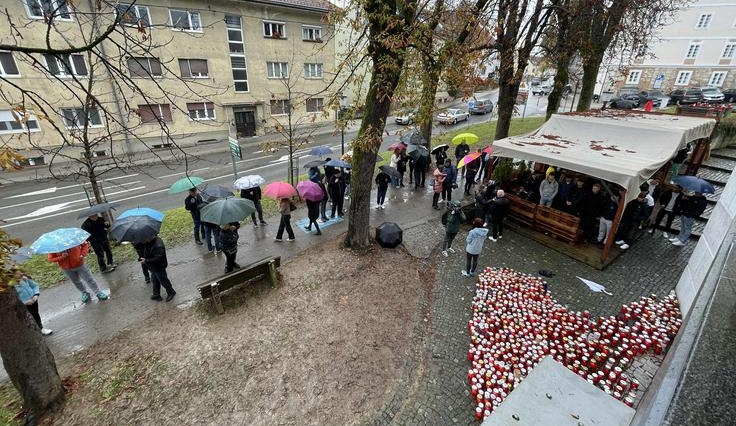
Novo Mesto plunged into grief on 26 October, with residents lighting candles outside the Patriot bar and gathering in silent vigils for Šutar, hailed as a “socially active” figure.
Mayor Macedoni convened an extraordinary municipal council session for 28 October, urging a symbolic rally on the Main Square to press the state for “systemic changes.”
Municipal associations echoed demands for urgent resolutions, blending sorrow with resolve to prevent further tragedy.
Caption: Citizens of Novo Mesto gather in front of the Patriot bar and lit candles in memory of the deceased. [Siol.net]
Updated: October 27, 2025 - 07:08


