Edit
Slovak parliament ousts environment minister after coalition partner breaks ranks
Fico’s narrow majority is now in doubt, with a January snap election among the options as the 2027 budget deadline approaches
On 29 September 2026 Slovakia’s National Council voted to dismiss Deputy Prime Minister and Environment Minister Tomáš Taraba. The motion passed 77–0, with 73 members absent. The decisive votes came from the Slovak National Party (SNS), a junior partner in Prime Minister Robert Fico’s coalition, which sided with the opposition. Fico immediately called a meeting of Smer-SD’s leadership for 30 September to decide the government’s next steps and again raised the possibility of a January snap election.
The vote turned a months-long internal feud into an open parliamentary rupture. The three-party government of Smer-SD, Hlas-SD (Voice) and SNS had been governing with a razor-thin majority of 78 seats in the 150-seat chamber, dependent on a handful of loyal independents. Taraba’s dismissal and expected return to parliament as an independent, together with two or three allied MPs, would leave the coalition with at most 75 reliable votes.
The coalition itself was assembled after the 30 September 2023 election. Smer-SD won 42 seats, Hlas-SD 27 and SNS 10, giving the three parties an initial 79-seat majority. Fico returned as prime minister for a fourth time at the head of a leftist-nationalist government that has kept close energy ties with Russia and frequently clashed with EU partners. The majority later narrowed after several Hlas-SD MPs left the party caucus and became independents; Fico retained their support by offering one of them a ministerial post. That earlier personnel episode already showed how fragile the arithmetic had become.
The present crisis centres on control of the Environment Ministry. SNS chairman Andrej Danko had demanded Taraba’s replacement for months, accusing him of shutting the party out of ministry decisions and tenders. In May the three men agreed that Taraba would resign by 30 September if he failed to reconcile with SNS. Fico, who valued Taraba’s work on industrial and energy files, first submitted a dismissal request to President Peter Pellegrini and then withdrew it on 28 September, arguing that the move itself endangered the parliamentary majority. Danko responded by promising to vote with the opposition until Taraba was removed—an occurrence last seen in modern Slovak politics in 1993. Taraba, originally elected on the SNS list in 2023 after earlier stints with other nationalist groupings, refused to resign and signalled he would vote independently once back in parliament.
Several paths are now open. One is that Fico tries to reconstruct a working majority with the remaining coalition partners and whatever independents he can still attract. Another is that he resigns and, with Pellegrini’s agreement, installs a caretaker or technocratic cabinet to run the country until the regular election due in September 2027. A third is an early election in January 2027. That would require a constitutional law shortening the parliamentary term and therefore a three-fifths majority of all 150 deputies (90 votes). Smer-SD has said it would join opposition parties to reach that threshold if necessary; Hlas-SD and SNS have so far refused. Polls suggest neither junior partner would fare well in an early vote—SNS is widely expected to fall below the 5 percent threshold—while Smer-SD remains competitive but would likely need new partners such as the far-right Republika to govern again.
The calendar adds pressure. The government must submit the 2027 budget by 15 October and have it approved by the end of December. Failure would force Slovakia onto a provisional budget that limits monthly spending to one-twelfth of 2026 outlays, undercutting promised energy-price freezes and growth measures. Whatever course Fico chooses after today’s party meeting, the 29 September vote has already made the government’s ability to legislate and to finish its term far more uncertain than it was a week ago.
This article draws on reporting by Spectator.sme
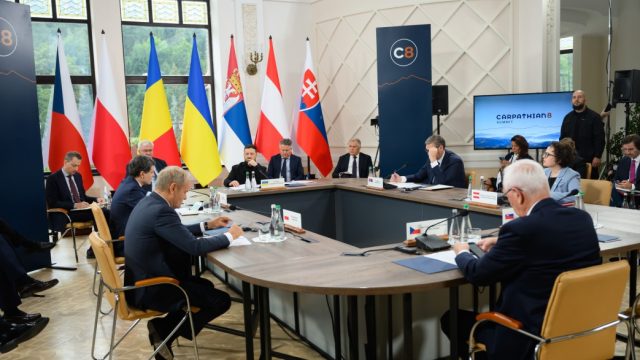
Caption: Tomáš Taraba, Deputy Prime Minister and Minister for the Environment of Slovakia, 4 November 2025 [Council Newsroom]
Updated: September 30, 2026 - 08:14