Edit
Seven-nation army to deter Trump from taking Greenland?
As of 16 January, the countries that have sent military personnel are France, Germany, Sweden, Norway, Finland, UK, Netherland
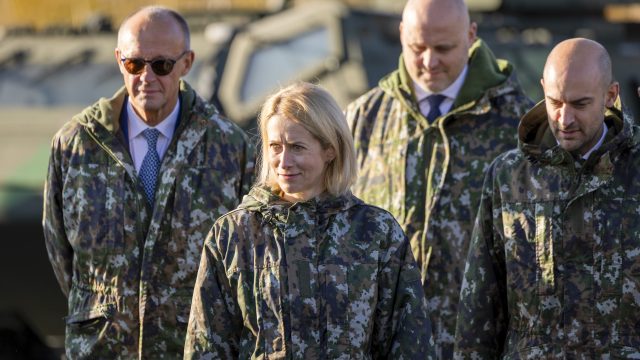
European military presence in Greenland is expanding – modest in scale, but heavy with political meaning, as Denmark mobilises allied support in response to mounting U.S. pressure over the strategically vital Arctic island.
Several NATO allies deploy small numbers of military personnel to the Arctic island amid mounting tensions over U.S. ambitions to assert control there. Officially framed as participation in Danish-led exercises, the deployments carry clear political weight, underscoring European support for Denmark’s sovereignty and signalling that security in the Arctic will be handled collectively within NATO.
The deployment of European troops in Greenland has no impact on Trump’s plans to take control of the Arctic island from Denmark, the White House said on Thursday. “I don’t think troops in Europe impact the president’s decision-making process, nor does it impact his goal of the acquisition of Greenland at all,” Press Secretary Karoline Leavitt told journalists.
Denmark’s defence minister, Troels Lund Poulsen, told journalists in Copenhagen on Thursday he did not have a final figure for the envisaged expanded NATO presence in Greenland. “But it is clear that we now will be able to plan for a larger and more permanent presence throughout 2026 and that is crucial to show that security in the Arctic is not only for the Kingdom of Denmark, it is for all of NATO.”
French President Emmanuel Macron announced on 15 January that French troops, alongside other European forces, were already on their way to Greenland. “The first French military units have already set off. Others will follow,” Macron said, with the French Ministry of Defence confirming the move to Le Monde. According to the newspaper, Paris agreed on 14 January, at Denmark’s request and in coordination with several NATO allies, to mobilise a small military unit for deployment.
French authorities stressed that the mission is limited in scope and linked to allied exercises under the Danish-led Arctic Endurance framework. Macron later reiterated that France’s role is tied to joint exercises organised by Denmark. However, Le Monde noted that Paris is keen to avoid escalation with Washington, suggesting the deployment is primarily a strategic signal of political support for Danish sovereignty over Greenland rather than a step towards confrontation.
France is not acting alone. Swedish, Norwegian and German personnel have also arrived on the island as part of preparations for multinational exercises under Danish auspices. Swedish Prime Minister Ulf Kristersson confirmed that officers from the Swedish Armed Forces had joined a group of allied representatives following an official request from Copenhagen. Norwegian Defence Minister Tore Sandvik said Oslo was sending two military personnel to assess options for deeper cooperation with allies in the Arctic, adding that dialogue within NATO on strengthening regional security was ongoing. German media reported that Berlin had also sent soldiers, with CNN citing a figure of 13.
These arrivals coincided with an urgent deployment of advanced Danish units to Nuuk. Danish public broadcaster reports said Copenhagen and the Greenlandic government had decided to increase the military presence in response to repeated statements by U.S. President Donald Trump, who has openly asserted that control of Greenland is vital for U.S. national security.
In late 2024, Trump described Greenland as “absolutely essential” to U.S. security interests. Greenland’s Prime Minister at the time, Mute Egede, responded by stating unequivocally that the island was not for sale. The rhetoric intensified in early January 2025, when Trump publicly refused to rule out military or economic pressure to establish U.S. control over Greenland and the Panama Canal, openly calling Greenland’s “annexation” inevitable. He later justified his position on defence grounds.
The statements triggered strong reactions across Europe. Danish Prime Minister Mette Frederiksen described the rhetoric as unacceptable between allies and warned that a U.S. invasion of Greenland would effectively mark the end of NATO. Greenlandic Prime Minister Jens-Fredrik Nielsen said that linking the island to military intervention was deeply disrespectful.
At the international level, Germany, France, the United Kingdom, Poland, Italy, Spain and Denmark issued a joint statement stressing that security in the region must be ensured collectively within NATO. Danish Foreign Minister Lars Løkke Rasmussen announced on 14 January that Denmark had allocated additional funding for armaments to strengthen Greenland’s potential defence.
Further European involvement followed. Dutch Defence Minister Ruben Brekelmans said the Netherlands was sending one military officer to Greenland for joint reconnaissance and intelligence work with allies, aimed at preparing future exercises. Based on these assessments, NATO member states could consider a larger operation, provisionally referred to as Arctic Sentry. Brekelmans said his government viewed the initiative positively, emphasising that Arctic security, including Greenland, is of strategic importance to all NATO members.
The United Kingdom and Finland have also announced participation in the mission.
The European military deployment to Greenland sent two messages to the U.S. administration, Marc Jacobsen, an associate professor at the Royal Danish Defence College, told Reuters. “One is to deter, is to show that ‘if you decide to do something militarily, we’re ready to defend Greenland’,” he said. “And the other purpose is to say: ‘Well, we take your critique seriously, we increase our presence, take care of our sovereignty, and improve surveillance over Greenland’.”
Greenland, the world’s largest island, is an autonomous territory within the Kingdom of Denmark. Rich in mineral resources and hosting strategically significant facilities, including U.S. installations, it has increasingly become a focal point of geopolitical competition. As European deployments continue to grow, officials in Copenhagen and across NATO insist that the defence and protection of Greenland is not a bilateral issue, but a shared responsibility – and a test of alliance unity in the Arctic.
In a high-stakes diplomatic encounter on Wednesday, Vice President JD Vance hosted a pivotal meeting in Washington with Secretary of State Marco Rubio and foreign ministers from Denmark and Greenland, aiming to advance the Trump administration’s ambitious plan to acquire the Arctic territory. The discussions, held amid mounting international tension, ended in impasse, underscoring the United States’ unyielding resolve to secure Greenland – no matter the diplomatic fallout.
Deadlock in D.C.: Vance-led talks on Greenland acquisition yield no ground
U.S. rhetoric spills over into Iceland
As tensions around Greenland intensified, U.S. rhetoric triggered a parallel diplomatic backlash in Iceland after Donald Trump’s nominee for ambassador to Reykjavík, former congressman Billy Long, reportedly joked that the country could become the “52nd U.S. state”. The remarks, first reported by Politico, prompted swift reactions in Iceland, with the foreign ministry seeking clarification from the U.S. embassy and more than 3,200 people signing a petition urging the government to reject Long’s nomination. Long later apologised, insisting the comments were made in jest amid similar jokes about Greenland.
Sources: European Pravda, Suspilne, Guardian, Reuters, BGNES
Caption: People take part during a demonstration under the slogan ‘Greenland is for Greenlanders’ in front of the US embassy in Copenhagen, Denmark, on 14 January 2026. EPA/Thomas Traasdahl
Updated: January 16, 2026 - 05:40