 Edit
Serbia’s delicate dance: Vučić’s Ukraine visit highlights a precarious balancing act
Serbia’s enigmatic foreign defies simple categorisation and demands a closer look
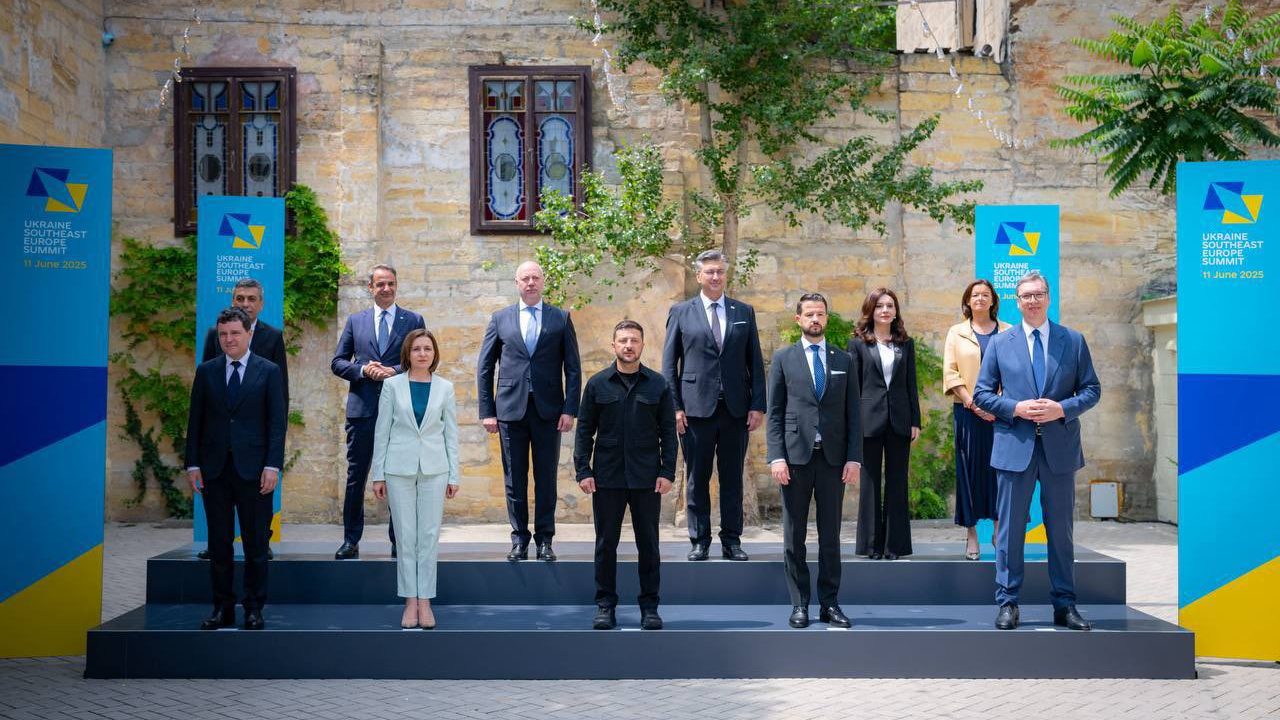
On 11 June, Serbian President Aleksandar Vučić made a historic trip to Odesa, Ukraine, marking his first visit to the war-torn country during his 12-year tenure as Serbia’s leader.
The one-day visit to attend the Ukraine-Southeastern Europe Summit, hosted in a city recently battered by Russian drone and missile attacks, underscores the complex and often contradictory position Serbia occupies in the Russia-Ukraine conflict.
While Vučić’s presence signals a gesture of engagement with Ukraine, it also highlights Serbia’s intricate balancing act between its historical ties to Russia, its European Union aspirations, and its controversial role as an arms supplier to Kyiv. This visit, as reported by Reuters, offers a window into Serbia’s enigmatic foreign policy, which defies simple categorisation and demands a closer look at the motivations and pressures shaping Belgrade’s stance.
A Moscow-friendly leader in Odesa
Vučić’s trip to Odesa, a Black Sea port city symbolising Ukraine’s resilience, is a bold move for a leader often described as Moscow-friendly. Serbia’s deep cultural, religious, and economic ties with Russia are well-documented. Russia remains Serbia’s primary gas supplier through the TurkStream pipeline, and Gazprom and Gazprom Neft hold majority ownership of Serbia’s sole oil refinery, NIS.
These economic dependencies, coupled with shared Slavic and Orthodox Christian heritage, have historically aligned Belgrade with Moscow. Yet, Vučić’s decision to attend a summit with leaders from 12 Southeastern European nations in Ukraine suggests a willingness to engage with Kyiv on a public stage, a move that risks straining relations with Russia.
This visit is not Vučić’s first interaction with Ukrainian leadership. He has met Ukrainian President Volodymyr Zelenskyy at least three times since Russia’s full-scale invasion began in 2022, with their 2023 Athens meeting described as “open, honest, and fruitful” by both leaders. These encounters, alongside Serbia’s consistent support for Ukraine’s territorial integrity at the United Nations, indicate a level of diplomatic alignment with Kyiv that contrasts sharply with Belgrade’s refusal to join Western sanctions against Russia.
The arms allegations
Perhaps the most contentious aspect of Serbia’s position is its alleged role as a supplier of arms and ammunition to Ukraine, a claim that complicates its proclaimed neutrality. In late May 2025, Russia’s SVR foreign intelligence service accused Serbian defence manufacturers of “a stab in the back,” alleging that Belgrade was funneling weapons to Ukraine through intermediaries in NATO countries like Czechia, Poland, and Bulgaria.
Vučić swiftly denied these allegations, asserting that Serbia’s defence industry “works only for Serbia” and announcing a joint investigation with Russia to probe the claims.
However, earlier reports add weight to the accusations. Leaked Pentagon documents from April 2023 suggested Serbia had agreed to supply or had already sent arms to Ukraine, a claim Vučić dismissed by stating that Serbian weapons might have reached the battlefield via third countries. The Serbian defence industry, employing 24,000 people and producing Soviet-style weaponry compatible with both Russian and Ukrainian arsenals, is a vital economic sector. Its exports, often facilitated through intermediaries, have reportedly bolstered Ukraine’s military efforts, with some estimates suggesting Serbia has provided more military assistance than many NATO states.
This covert support, if true, places Serbia in a precarious position: publicly neutral and Moscow-friendly, yet indirectly aiding Ukraine’s defence against Russia.
Vučić’s response to these allegations reflects his broader strategy of deflection and pragmatism. By forming a working group with Russian partners to investigate, he sought, according to pundits, to placate Moscow while maintaining plausible deniability. This approach allows Serbia to sustain its economic lifeline – arms exports – while avoiding direct confrontation with either Russia or the West.
The EU aspiration and the Kosovo conundrum
Serbia’s ambition to join the European Union adds another layer of complexity. Vučić has repeatedly affirmed Belgrade’s commitment to EU integration, as evidenced by his May 2025 meeting with European Council President Antonio Costa, where he pledged to accelerate reforms to open more EU negotiation chapters. Yet, Serbia’s refusal to align with EU sanctions against Russia – a key requirement for membership – has drawn criticism from Brussels. The European Parliament’s May 2025 resolution condemned Serbia’s non-compliance with EU foreign policy, particularly after Vučić’s high-profile visit to Moscow for a Victory Day parade, where he met Russian President Vladimir Putin and Chinese President Xi Jinping.
The Kosovo issue further entwines Serbia’s Ukraine policy with its EU aspirations. Belgrade recognises Ukraine’s territorial integrity, including territories annexed by Russia since 2014, a stance reciprocated by Kyiv’s refusal to recognize Kosovo’s 2008 independence. This mutual non-recognition forms a diplomatic bond between Serbia and Ukraine, rooted in their respective territorial disputes. Vučić has leveraged this alignment to bolster Serbia’s position on Kosovo, particularly in opposing its admission to international bodies like the Council of Europe. However, Serbia’s EU candidacy requires progress on normalising relations with Kosovo, a condition that clashes with its Moscow-friendly posture, as Russia supports Serbia’s opposition to Kosovo’s independence at the UN.
A balancing act under pressure
Vučić’s Odesa visit is emblematic of Serbia’s tightrope walk in a polarised geopolitical landscape. At home, Vučić faces growing anti-government protests sparked by a deadly train station collapse in Novi Sad in November 2024, with students and trade unions demanding accountability and democratic reforms. These domestic pressures amplify the need for Vučić to project stability and international relevance, which his Ukraine visit is possibly aimed to achieve by signalling openness to regional cooperation and EU alignment.
Serbia’s foreign policy under Vučić is often criticised as “sitting on two chairs” – a phrase Croatian Foreign Minister Gordan Grlić-Radman used in 2024 to describe Vučić’s balancing act between Russia and the EU. Yet, this characterisation oversimplifies a strategy driven by necessity. Serbia’s economic dependence on Russian energy, its historical affinity with Moscow, and its EU ambitions create a trilemma that Vučić handles with pragmatic opportunism.
Sources: Reuters, Radio Free Europe/Radio Liberty, The Kyiv Independent, edited by g.g.
Caption: Serbian President Aleksandar Vučić, last on the righ, at the Ukraine-Southeast Europe summit. @front_ukrainian on X
Updated: June 12, 2025 - 04:05