Edit
Serbian students present all 250 candidates on the Student List; Professor Srdanović tops the slate
The Student List, which grew out of the “Students in Blockade” movement, is widely seen as the main challenger to the ruling SNS
The electoral list “Student List – Students Win” today presented all 250 candidates for Serbia’s National Assembly. First on the list is Ilija Srdanović, a cardiologist and professor at the Faculty of Medicine in Novi Sad.
Serbia will hold early parliamentary elections on 25 October 2026 after President Aleksandar Vučić dissolved the 250-seat National Assembly. The vote was originally not due until late 2027; Vučić called it early, citing “huge turbulences” after nearly two years of student-led anti-corruption protests that began after the November 2024 collapse of the Novi Sad railway station canopy, which killed 16 people.
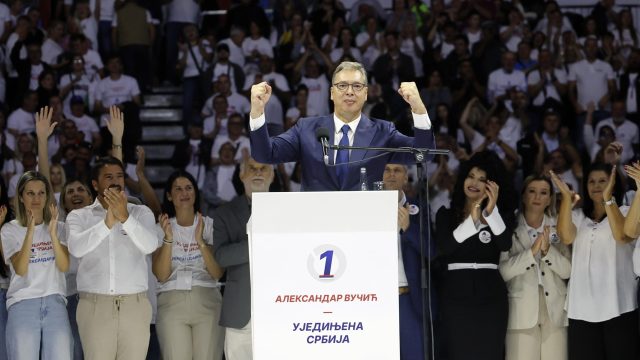
Vučić cannot run for a third presidential term. He has said he will instead head the ruling Serbian Progressive Party (SNS) list and seek the post of prime minister, aiming to keep control of government after leaving the presidency. A separate early presidential election is expected later.
The Student List, which grew out of the “Students in Blockade” movement, is widely seen as the main challenger to the SNS. Several opposition parties (including the Democratic Party and the Green-Left Front) have chosen not to run their own slates and are backing the students. Polls earlier in 2026 showed the Student List competitive with, and in some surveys ahead of, the SNS among decided voters. Vučić has dismissed the list as being steered by veteran opposition figures; the students reject that and present the slate as the product of plenums rather than party bargaining.
The list, published on the student site blokade.org, includes professors, doctors, artists, activists, entrepreneurs and people from across Serbia. Immediately after Srdanović come Katarina Stanković, Željko Hubač, Aleksandar Cvetković, Katarina Šćepanović, Adem Mavrić, Miloš Jevtić, Tihomir Stanić, Tatjana Paunović, Milina Marić and Vesna Srećković.
They are followed by Aleksandar N. Nešković, Marija Bjelobrk, Lidija Dimitrijević, Slobodan Vukosavić, Marija Vulović, Zlatko Kokanović, Sara Valentik, Dragana Đorđević, Predrag Mrđa, Oliver Tošković, Mitar Krstić, Milana Pisarić and many others.
Better-known names include former basketball star Dejan Bodiroga, former National Bank of Serbia governor Dejan Šoškić, engineer Zoran Đajić, professors Jovo Bakić and Aleksandar Baucal, University of Arts rector Mirjana Nikolić, and academician Radomir Saičić. Also on the list are lawyer Sarah El Sarag, architect Miljan Salata, conservator Estela Radonjić Živkov, athlete Mihail Dudaš, former footballer Mirko Poledica and musician Feđa Dimović.
In a statement accompanying the names, the students said the candidates are people of different ages, professions, experiences and life stories chosen to represent them in parliament.
“They come from different parts of Serbia, from large cities and smaller communities, from classrooms, clinics, offices, workshops, cultural institutions and other places where one sees every day how this country functions when institutions do their job — and what happens when they stop doing it,” the statement said.
They added that they did not look for people who would look best on a billboard, or those who have spent years knowing how to negotiate a place on an electoral list, but for people they believe can enter institutions, do their work responsibly and not forget why they are there.
“The candidates were not chosen by party leaders, nor did someone compile a list in one room and announce it to the others. They were chosen by students through a decision-making process we built over more than a year of blockades, plenums, conversations and joint work. That process was not always fast, nor simple.”
Direct democracy rarely is, they said: it means conversation, disagreement, arguments, returning to decisions, and responsibility toward those who take part.
“That is precisely why it was important that the electoral list be created this way. If we say we want a different political system, there is little point in taking the first step toward it by copying the model we are fighting against.”
There is no personality cult on the list, they said, and therefore no single person whose name is meant to overshadow everyone else.
“We are not looking for a new leader around whom another personality cult would be built. We are presenting people entrusted with carrying into the institutions part of the struggle we have waged on the streets over the past year.”
They do not expect the candidates to be flawless or to have an answer to every question.
“We expect much simpler — but in this country, clearly much harder — things: that they be accountable for what they do, that they listen to the people they represent, that they explain their decisions, and that they understand that a parliamentary seat is not a reward, a privilege or the start of a political career.”
A parliamentary seat is a public job, they stressed. The mandate belongs to the citizens, and whoever receives it must know to whom they are accountable.
“These are the people we have chosen to do that job.”
The article in Serbian by EUalive’s partner BETA can be found here.
Caption: Students carry boxes of signatures in support of the ‘Student List – Students Win’ during a march to the Republic Electoral Commission (RIK), in Belgrade, Serbia, 14 September 2026. ‘Student List – Students Win’ is an independent citizens’ group emerging from the student-led anti-corruption blockade movement, aiming to challenge the ruling Serbian Progressive Party (SNS) in Serbia’s snap parliamentary election on 25 October 2026. EPA/ANDREJ CUKIC
Updated: September 15, 2026 - 07:57