Edit
Serbian ruling party leadership unanimously names Vučić candidate for Prime Minister
President accuses foreign intelligence of driving Serbia’s student unrest
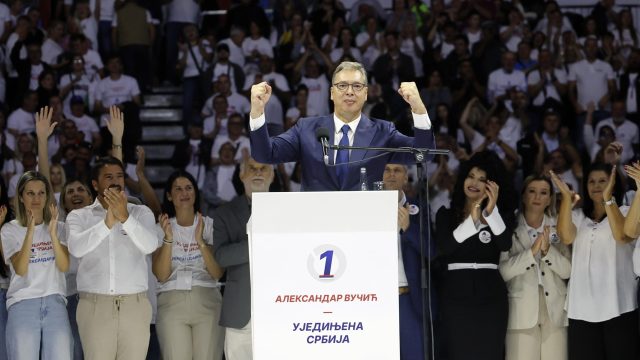
Members of the Main Board of the Serbian Progressive Party (SNS) unanimously decided today in Niš that President Aleksandar Vučić will be the party’s candidate for prime minister, as well as the list-holder and first name on its ticket “Aleksandar Vučić – United Serbia.”
Thanking the board for the honor, Vučić said no party looks after national and state interests more responsibly than the SNS, while also claiming that foreign services have a large influence on events in Serbia.
“When people seek change they are not looking for those who destroyed factories, those who organise road blockades every day. They want change so there is no arrogance among representatives of the authorities. People want representatives of the authorities in every place to listen to them when they have problems,” Vučić said at the start of his address.
SNS president Miloš Vučević announced the decision: the party will contest the forthcoming elections under the list “Aleksandar Vučić – United Serbia,” with Vučić as list-holder, first on the list, and candidate for prime minister. He called on party members to prepare to collect signatures and declared that the campaign was beginning.
Vučić described the nomination as a great honor and said one of the main reasons was that no other party more responsibly protects Serbia’s national and state interests. He said the list would include prominent scientist Stojan Radenović as well as young people and students selected for knowledge, morals, and diligence. He argued that a future government should be fast and efficient, consisting of a prime minister and 12 ministers rather than “thirty or more,” and that he had already prepared a draft law on ministries and government that he would present after resigning as president. He also proposed that future ministers hold ministry collegium meetings at least twice a month outside Belgrade.
He said the SNS would accept election results whatever they were and was prepared to go into opposition if necessary. He acknowledged past mistakes while arguing the party had changed Serbia for the better over 18 years. On the November 2024 Novi Sad railway station canopy collapse, he said responsibility must exist and the real culprits must be punished, but that the state had responded “within the limits of the possible” and that he had no control over prosecutors and courts.
The meeting at the National Theatre in Niš took place amid a protest by students involved in ongoing blockades, citizens, and supporters; police prevented the crowd from approaching the building. Vučić has said he will resign the presidency after completing scheduled state duties and foreign visits, then campaign. Snap parliamentary elections are to be held on 25 October.
Background: Electoral conditions and media dominance
Serbia holds competitive multiparty elections, but international observers and democracy-monitoring organizations have repeatedly found that they take place in an uneven environment shaped by the long dominance of Vučić and the SNS, which has governed since 2012. Vučić served as prime minister from 2014 to 2017 and has been president since 2017; critics and analysts describe a system in which the presidency, party, government, and large parts of the state apparatus are tightly fused despite the president’s formally limited constitutional role. Freedom House rates Serbia “Partly Free” (53/100 in its 2026 Freedom in the World report, down from 56), and the V-Dem Institute has classified it as an electoral autocracy. The Bertelsmann Transformation Index has likewise recorded deterioration in electoral conditions, rule of law, and media freedom.
OSCE/ODIHR missions covering recent parliamentary and local elections have typically found voting itself reasonably well administered but concluded that the president’s decisive involvement, the ruling party’s systemic advantages, media bias, pressure on public-sector employees, and misuse of public resources created “unjust conditions” and limited voters’ genuine choice. Recurring problems include blurring of the line between state and party, abuse of incumbency (including coverage of official events), weak or captured oversight bodies, and incomplete implementation of earlier ODIHR and Venice Commission recommendations on voter lists, campaign finance, and impartial administration. Frequent snap elections have themselves been criticized as a tool that keeps the opposition off-balance and erodes confidence in institutions.
Media control is central to that advantage. The Centre for Media Pluralism and Media Freedom’s 2026 monitor put Serbia at high risk (74 percent overall), with political independence scoring 81 percent risk. Pro-government national television stations and tabloids dominate the landscape; public broadcaster RTS and many commercial outlets give disproportionate, often uncritical coverage to Vučić and the SNS.
Serbia’s Vučić dominates pro-government tabloids: 1,172 front-page appearances in 2025, all positive
The electronic media regulator REM has long been described as captured; after awarding national frequencies to pro-government stations it delayed a fifth license that could have gone to a more critical outlet. State advertising, public-enterprise contracts, Telekom Srbija’s market power, and politically aligned ownership changes have further squeezed independent outlets. Critical channels such as N1 and Nova S have faced distribution pressure, hostile rhetoric from the president (including “pure terrorism” remarks), SLAPP suits, and ownership turbulence. Independent journalists report threats, attacks, and self-censorship. In election periods, national broadcasters have historically allocated the large majority of political airtime to the ruling camp.
These patterns form the backdrop to the current campaign. Student-led protests that began after the Novi Sad tragedy have lasted more than a year and a half, accusing the government of corruption, impunity, and authoritarian practices. Vučić and the SNS routinely attribute unrest to “foreign services” and opposition actors who “destroy factories” or block roads – the same framing he used in Niš. Whether the forthcoming vote narrows or widens the documented gap between formal multiparty competition and a level playing field will depend on media access, use of state resources, pressure on voters, and whether long-standing observer recommendations are finally implemented.
Analysis: If Vučić calls elections, it means he plans to stay in power longer
The article in Serbian by EUalive’s partner Beta can be found here.
Caption: President Aleksandar Vučić in Niš, the banner reads “Welcome, President!” {Credit: Beta Photo/Office of the President of Serbia]
Updated: September 6, 2026 - 07:52