Edit
Serbian authorities escalate crackdown on independent journalism and critical voices
As a partner of the BETA News Agency, EUalive strongly condemns the harassment of Vojkan Kostić and the broader campaign against independent journalists and analysts in Serbia
In a sharp deterioration of press freedom and rule of law in Serbia, police have summoned the editor-in-chief of the independent BETA News Agency for questioning on serious state security charges — while he was reporting live from a controversial raid.
The move has triggered strong condemnations and raised fresh alarms about systematic intimidation of journalists and analysts who challenge official narratives.
Police target BETA editor during live coverage
On Monday, officers served Vojkan Kostić, editor-in-chief of BETA, with a summons to appear at the Criminal Police Administration in New Belgrade. The summons relates to pre-investigative proceedings into the alleged crime of “preparing actions against the constitutional order and security of Serbia.” Kostić received the document on the spot while covering the police search of the home of military analyst Aleksandar Radić in Belgrade’s Vračar municipality. No concrete evidence or explanation was provided linking his journalistic work to the offense.
Police treated reporters at the scene harshly, refusing to answer questions, demanding they leave, and threatening them with detention as “accessories” to the same crime. Pro-government media had announced the raid before Radić even arrived home, while the acting prosecutor denied leaking the information. The incident fits a pattern of using state institutions to silence coverage of sensitive cases.
Linked to sonic weapon scandal and broader repression
The raid on Radić’s home (and reportedly that of his former wife) stems from his public statements about the alleged use of a “sonic weapon” (sound cannon) against student protesters on 15 March 2025. Radić told BETA that the truth about the incident will only emerge after a change of government, accusing authorities of damage-control propaganda amid pressure from the UN and European Court of Human Rights. The Higher Public Prosecutor’s Office has threatened prosecutions against anyone spreading the “sound cannon” narrative.
Opposition Freedom and Justice Party vice-president Marinika Tepić described the search as “personal revenge” by President Aleksandar Vučić, accusing him of misusing police and prosecutors against critics while shielding alleged corruption linked to the ruling family.
Parallel campaign against journalist Dinko Gruhonjić
The pressure on BETA coincides with continued harassment of prominent journalist and professor Dinko Gruhonjić. On the night of 20-21 June, masked individuals vandalized the car of his son David in Novi Sad. The Helsinki Committee for Human Rights in Serbia condemned it as a “politically and ideologically motivated act of intimidation,” part of years-long targeting, smear campaigns, hate speech, and death threats amplified by pro-government media. The European Federation of Journalists (EFJ) joined the condemnation, holding institutions and the ruling regime directly responsible.
President Vučić publicly condemned the vandalism but distanced himself by saying he thinks “the worst” of Gruhonjić’s ideas, while calling for calm and repeating denials of the sonic weapon allegations.
These events unfold as Belgrade University leadership prepares protests against government-proposed changes to higher education laws, widely seen as an attempt to neutralize student-led opposition and tighten control over public universities.
EUalive calls for immediate action
As a partner of the BETA News Agency, EUalive strongly condemns the harassment of Vojkan Kostić and the broader campaign against independent journalists and analysts in Serbia. Summoning editors on state security charges for doing their job, leaking raids to friendly media, and tolerating violence against journalists’ families represent a dangerous slide toward authoritarianism.
We urge Serbian authorities to drop all politically motivated proceedings, ensure full transparency, and protect press freedom in line with European standards. The EU and international partners must respond firmly – Serbia’s democratic backsliding cannot be ignored while it seeks closer integration. Independent journalism and critical inquiry are not threats to state security; they are the foundation of any genuine democracy.
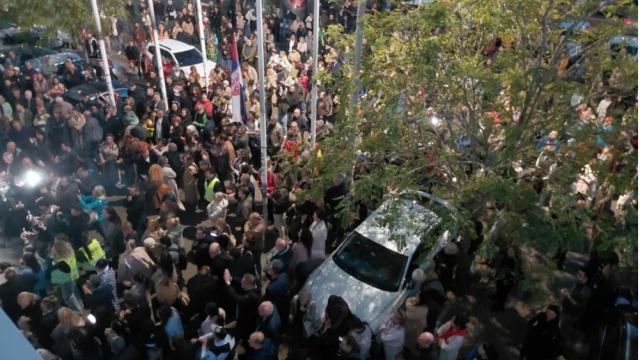
Caption: Vojkan Kostić, editor-in-chief of BETA, upon his release from police custody [BETA]
Updated: June 23, 2026 - 06:45