Edit
Serbia: Vučić hints at snap polls – on his terms
The Serbian President has accelerated changes within the police, dismissing senior officials and appointing loyalists
What is behind Serbian President Aleksandar Vučić’s announcement that early elections could be held and that he could resign before the end of his term? EUalive’s partner in Serbia Beta provides insight.
Vučić has hinted that citizens may head to the polls as early as next spring, despite months of insisting there would be no elections before December 2026. The move comes amid sweeping changes in the police, which the opposition sees as an attempt to secure loyalty within the state apparatus ahead of a potentially turbulent campaign period.
On 12 September, Vučić said there were two possible dates for the next elections – April or May 2026, or December of the same year, adding that he preferred the latter. Nevertheless, government actions – including price-cutting measures, pension hikes, pressure on independent media, and reshuffles in the police – suggest preparations for an earlier vote.
More significant than the timing, however, is Vučić’s announcement that he could resign before the end of his presidential term, which runs until May 2027, to trigger simultaneous presidential and parliamentary elections.
“I would resign somewhat earlier, so that we can all go to the polls together,” he said, arguing that voters should judge the government’s performance based on salaries and pensions.
Vučić cannot run for president again but would almost certainly lead the ruling bloc as its prime ministerial candidate. By heading the parliamentary list, he could help boost the chances of the coalition’s presidential hopeful, analysts note.
The president is also counting on divisions within the opposition, which remains split between student movements, right-wing nationalists, and pro-European civic groups, making agreement on a joint presidential candidate unlikely.
Police reshuffles
In parallel, Vučić has accelerated changes within the police, dismissing senior officials and appointing loyalists. Opposition media and NGOs warn this is aimed at ensuring tighter control of the security apparatus.
The most visible move was the dismissal of Spasoje Vulević, commander of the Special Anti-Terrorist Unit (SAJ). Weekly Radar reported that the purge extends to the Criminal Police Directorate, including the Department for the Fight Against Organised Crime, which could be tasked with a harsher response to demonstrators.
Candidates tipped to replace Vulević include Colonel Igor Zmirić, described by critics as a proven loyalist and organiser of recent mass arrests, and Ivan Ristić, a former “red beret” linked to violent incidents at earlier protests.
The reshuffle also affects the Gendarmerie, the country’s 3,000-strong paramilitary force. Entry requirements have been loosened, allowing candidates with past convictions or alleged links to organised crime to rejoin the ranks, according to opposition sources.
Tear gas controversy
The changes come amid accusations that police used banned CN gas against protesters in Novi Sad on 5 September. Students at the city’s Faculty of Sciences said independent lab tests confirmed traces of the highly toxic substance, banned since the 1970s. The Interior Ministry denied the claim, insisting police do not possess CN gas, though videos circulating online appeared to show officers themselves suffering ill effects.
Alongside the police overhaul, the government has proposed amendments to the Criminal Code that would make road blockades a criminal offence punishable by up to one year in prison. The draft, currently under public consultation, would classify all protest blockades as criminal acts, even if they pose no danger to life or property.
Civil society organisations warn the measure is designed to deter demonstrations, particularly student-led blockades that have become a symbol of resistance since the collapse of the concrete canopy at Novi Sad’s main train station.
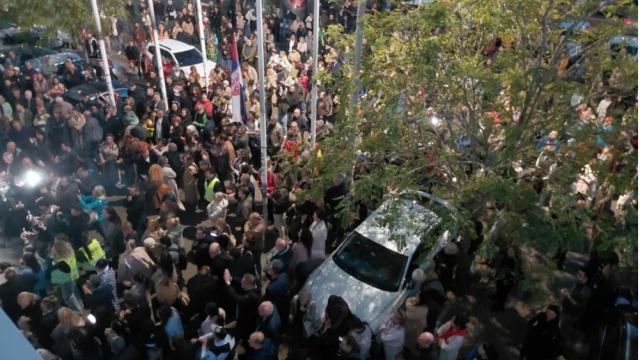
Caption: A woman holds a banner reading ‘Glorious Revolution’ during a protest against police brutality in Belgrade, Serbia, 8 September 2025. The protest was organized by university students during ongoing protests following the collapse of the Novi Sad railway station canopy on 01 November 2024, which killed 16 people, and has since grown into demands for early elections. EPA/ANDREJ CUKIC
Updated: September 18, 2025 - 16:41