Edit
Serbia after the vote – the real battle lies ahead
Dismantling Vučić’s system will test the Student Ticket far more than winning the election ever did
The Student Ticket’s victory in Serbia’s parliamentary elections was only the first step in the struggle to build a democratic, well-governed state based on the rule of law. One possible outcome of the uncertain struggle ahead, which carries the risk of escalating into physical confrontations, is Aleksandar Vučić’s return to power. The likelihood of Vučić’s comeback hinges on the new government’s ability to dismantle his system and keep the country from sliding into political instability and economic decline.
The road into the unknown
With the victory of the Student Ticket comes considerable uncertainty. One of the key questions is who will make the decisions – or rather, whether the role of the students ends with the formation of a new cabinet, or whether they will seek to oversee the actions of the ministers and members of parliament whose names appeared on their list of candidates. If they do, it is unclear whether they will be able to do so in practice. According to the most prominent representatives of the students’ list, it is the MPs, rather than student assemblies, who will select candidates for Serbia’s head of government and ministers. How the MPs will make those choices remains unclear, as it is unrealistic to expect 141 people to reach decisions unanimously.
One of the greatest challenges will be protecting the Student Ticket’s unity. The student movement is diverse, as are the Student Ticket’s MPs, making differentiation very likely sooner or later. The glue holding them together is their opposition to Vučić, but that cannot bind them forever. Nor will the student movement be able to function in the long term without a leader. There is therefore a real possibility that the Student Ticket’s MPs will split into several political parties or movements with distinct ideological identities, which would also put them at odds with one another. This is precisely the key difference between this year’s political changes in Serbia and Hungary, where a single, cohesive party took power.
Another important unanswered question is whether the new government will seek to remain in office for one year or four. In other words, will its sole objective be to create the conditions for free and fair elections in which voters can choose among competing political platforms, or will it seek to govern the country for a longer period? In the latter case, it would inevitably have to formulate policies on Kosovo, European integration, Russia and relations with neighboring countries, including the issue of war crimes committed in the 1990s. Even if its term were limited to one year, as previously speculated in opposition circles, the government would not be able to avoid making foreign policy decisions altogether. The gas agreement with Russia expires on 31 December, while the future of the Oil Industry of Serbia (NIS) also remains unresolved. The new government will also have to take a position on Expo 2027, the international specialized exhibition scheduled to open in Belgrade in less than seven months.
The exorbitant expectations the public has of the Student Ticket will put additional pressure on the new government. Citizens will expect it to restore order across numerous sectors that have been damaged in various ways over the past 14 years. Yet this formidable task will largely fall to people with no political experience, raising legitimate doubts about their ability to carry it out. A particular problem is that the new government will not be made up of established political parties with statutes, elected governing bodies, platforms and ideologies. Facing it, meanwhile, will be a powerful, strictly hierarchical opponent backed by an army of 100 MPs.
Dismantling Vučić’s system
The new government faces the difficult task of maintaining economic stability while thoroughly reforming state institutions. A diverse, leaderless movement with few politically experienced figures has promised to eradicate corruption, free the media and establish the rule of law. Building stable democratic institutions will be considerably more difficult than securing the hard-fought electoral victory over Vučić, because corruption has become deeply entrenched in every sphere of Serbian society following decades of politically motivated hiring, clientelism and inadequate institutional oversight.
Even though “armed” with strong legitimacy to make changes, the new government will face numerous obstacles and challenges along the way. The first could be instability while society is transitioning to a new government. The presidential election campaign, likely to overlap with negotiations leading to a new cabinet, may prolong the period even further. Another danger is that Vučić may put to good use the institutions he still controls, heavily populated by his loyalists. The new government is almost certain to encounter resistance from these holdovers within the state apparatus, expected to obstruct reforms.
The students have set their sights on sweeping reforms and systemic change, while the citizens who backed them expect state institutions to be freed from political control, a relentless crackdown on corruption and the prosecution of everyone who has broken the law. Reforms of the judiciary and security apparatus will be instrumental to achieving those goals, but they will be neither simple nor without danger, as Vučić has installed people in the police and intelligence services who will stop at nothing. One of the toughest challenges will be fighting organized crime, which will require a thorough purge of the police ranks.
Another challenge for the new government will be the impatience of those who voted for the Student Ticket and the risk of their disillusionment. They are waiting for many regime figures and loyalists to be arrested, Vučić in the first place. They also want all of them who broke the law to be lustrated (the Students Will Win platform includes a lustration law). These efforts should also involve a review of a host of contracts and business deals, including those related to Expo 2027 and the construction of the national stadium, as well as those connected to major state-owned enterprises such as the electric power utility (EPS). Given the magnitude of lucrative deals, resistance and obstruction by those whose interests are at stake should be expected. Conversely, if the new government fails to deliver, it will face a sharp decline in public support, potentially opening the door to Vučić’s return to power.
Vučić’s resistance
Not long after the polls were closed, Vučić was the first to announce the results, admitting he had lost the elections, contrary to the widespread belief that he would never do so under any circumstances. His decision appears to have been a responsible, important move, but the fact remains that he had little choice, given the Student Ticket’s overwhelming margin of victory. Moreover, there are indications that Vučić originally had an entirely different plan—to keep power by force. Several hours before the polls closed, the pro-government tent encampment outside the Presidency of Serbia, better known as Ćacilend, had been filled with criminals and police. Their likely role was to clash with citizens who would have taken to the streets had Vučić declared victory following a close result. That scenario was thwarted by the sweeping victory of the students’ candidates. Ćacilend was evacuated as soon as Vučić learned he had lost, and later that evening the Student Ticket’s supporters took over what they called the “symbol of Serbia’s occupation,” putting the final stamp on their electoral triumph.
Vučić’s statements since the election suggest that he is far from defeated and that losing the vote does not necessarily spell the end of his political career. He insists that he will lead a powerful opposition, but that this will be only a temporary arrangement and that he has no intention of waiting long to return to power. In doing so, he is trying to prevent his supporters from abandoning him. Those messages are also likely aimed at his loyalists within the state apparatus, whom he wants to retain in order to preserve his institutional power and his ability to exert pressure on the new government.
Vučić currently poses the greatest threat to stability in the country because he still controls the security apparatus and commands substantial financial resources, yet is behaving as though he were already in opposition. Vučić seized on the storming of Informer television by angry citizens on 26 October to issue a threatening warning that members and supporters of the Serbian Progressive Party would “have to organize themselves” – effectively forming their own paramilitary-style squads of enforcers – if state authorities refused to protect them from the election winners’ “revolutionary terror.” What makes that statement particularly troubling is that Vučić still commands all state institutions, meaning that any failure on their part to intervene could only mean one thing—that he had ordered them not to act.
The storming of Informer, as well as a subsequent attempted attack on Pink television, appear to have been orchestrated by Vučić, or rather by the intelligence service he still controls, although genuine supporters of the Student Ticket also took part, unaware that they were being manipulated. Testifying to this is the presence at Informer of activist Dijana Hrka, who blames Vučić for her son’s death in the collapse of a concrete canopy at the Novi Sad railway station. The Student Ticket’s supporters did harass and humiliate Informer owner Dragan Vučićević, but they did not physically harm him, and the following day he resumed broadcasting Vučić’s propaganda on the channel.
It takes little persuasion to get angry citizens to storm Informer, given that Vučićević routinely branded students Ustaše and terrorists, urging police to beat and arrest them during protests. He had also threatened Hrka in the past, warning that she would lose her other child as well if she did not stop attacking Vučić. Vučić used this staged spectacle to accuse the new government and students of violence against political opponents and to portray members of the Serbian Progressive Party as being under threat, seeking to rally his voter base and prevent an exodus of party members. It remains to be seen whether the claims Vučić has been repeating for months – that citizens would remember his rule as a “golden age” – were merely an attempt to intimidate voters during the election campaign, or perhaps also a warning of the instability he intends to foment if he loses power.
The original article by EUalive’s partner BETA can be found here.
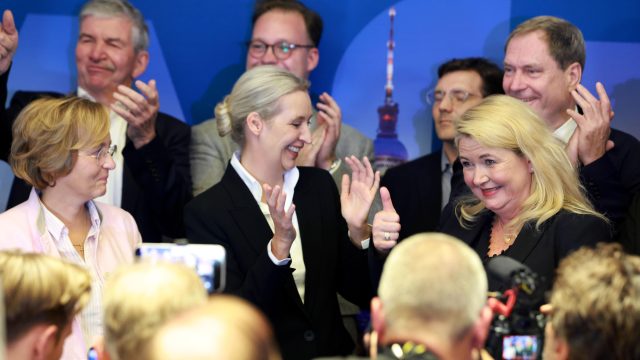
Caption: Supporters of the ‘Student List’ celebrate after the parliamentary elections in Belgrade, Serbia, 25 October 2026. Roughly 6.5 million eligible voters were called to the polls in a snap parliamentary election to choose lawmakers for a four-year term. EPA/MARKO DJOKOVIC
Updated: October 29, 2026 - 07:53