 Edit
EditSánchez under siege as corruption scandals close in on Spain’s ruling Socialists
The Gómez case is only one element of a much wider network of investigations involving Sánchez’s relatives, former ministers and senior political allies
Spain’s political landscape entered a new period of turbulence after a Madrid judge ordered Begoña Gómez, the wife of Prime Minister Pedro Sánchez, to stand trial on corruption-related charges, intensifying a series of scandals that have increasingly overshadowed the Socialist leader’s government.
Judge Juan Carlos Peinado ruled that Gómez must face trial on charges including influence peddling, misuse of public funds, corruption in business dealings and embezzlement. The judge also ordered her to surrender her passport, barred her from leaving Spain and required her to report regularly to court.
The decision represents the most serious legal challenge yet to Sánchez’s political authority since he came to power in 2018 promising to restore public trust after corruption scandals engulfed the conservative People’s Party (PP).
Gómez has consistently denied any wrongdoing and has appealed the ruling. Sánchez, who has not been accused in any of the ongoing investigations, has repeatedly described the case as politically motivated and part of a broader campaign against his family and government.
The case stems from allegations that Gómez used her position as the prime minister’s wife to advance professional projects and secure advantages in her academic and institutional activities. The investigation was originally triggered by a complaint filed by Manos Limpias, a self-described trade union with links to Spain’s far right.
For Sánchez and the governing Spanish Socialist Workers’ Party (PSOE), however, the legal merits of the case have become inseparable from a broader political battle over the independence of the judiciary, the role of opposition forces and the growing polarisation of Spanish politics.
Government officials reacted angrily to the latest court decision, accusing Judge Peinado of conducting a politically charged investigation. Tensions escalated further after the judge suggested that police officers assigned to protect Gómez could potentially assist her in leaving the country if she wished to evade justice.
The comments triggered an unusual backlash from police unions, which accused the judge of undermining the integrity of public servants. Spain’s General Council of the Judiciary subsequently launched disciplinary proceedings against Peinado over the remarks, adding another layer of controversy to an already highly politicised case.
Relations between Sánchez’s government and parts of the judiciary have become increasingly strained. The prime minister has repeatedly described the investigation into his wife as politically motivated and has questioned the impartiality of some members of the judiciary, while government officials have criticised Judge Juan Carlos Peinado’s handling of the case.
Yet while the government portrays the investigations as politically motivated, the accumulation of legal troubles surrounding figures linked to the Socialist Party has become increasingly difficult to dismiss as mere opposition pressure.
The Gómez case is only one element of a much wider network of investigations involving Sánchez’s relatives, former ministers and senior political allies.
His brother, David Sánchez, faces accusations of influence peddling linked to a public appointment, allegations he denies.
Meanwhile, former Socialist prime minister José Luis Rodríguez Zapatero has also found himself under judicial scrutiny over separate influence-peddling allegations, although he has strongly rejected all accusations.
Ábalos conviction deepens pressure on PSOE
The pressure on Sánchez intensified further after Spain’s Supreme Court sentenced former transport minister José Luis Ábalos, once considered one of the prime minister’s closest confidants, to 24 years in prison on corruption charges.
Ábalos, long regarded as one of the architects of Sánchez’s rise within the Socialist Party, was found guilty of participating in a criminal organisation, corruption, influence peddling and misappropriation of public funds.
His former adviser Koldo García received a 19-year prison sentence in the same case, while businessman Víctor de Aldama was sentenced to four years and six months, although the implementation of his sentence was suspended due to his cooperation with investigators.
Prosecutors argued that the defendants received kickbacks in exchange for awarding multimillion-euro public contracts for sanitary equipment during the COVID-19 pandemic.
During the proceedings, De Aldama claimed that Sánchez himself had overseen the wider network and that the PSOE had benefited financially from the scheme. The prime minister has firmly rejected those allegations and denied any connection between the accused individuals and party finances.
The conviction of Ábalos is particularly damaging because of his former status within the Socialist leadership. Before becoming transport minister, he served as the party’s powerful organisational secretary and played a central role in consolidating Sánchez’s authority within PSOE.
His downfall therefore strikes at one of the most influential figures associated with the prime minister’s political project.
The growing list of investigations has provided fresh ammunition to opposition leader Alberto Núñez Feijóo and the centre-right Partido Popular (PP), which argue that Sánchez’s government has lost political legitimacy and should call early elections.
Opinion polls suggest that the PP would emerge as the largest party if Spaniards were to vote today, potentially opening the door to a governing alliance with the far-right Vox party.
For now, Sánchez remains protected by Spain’s parliamentary arithmetic. Despite growing pressure, the fragmented nature of the legislature makes it difficult for the opposition to assemble an alternative governing majority.
However, the combination of judicial investigations, coalition tensions and declining public confidence is steadily narrowing the prime minister’s room for manoeuvre.
With Spain not due to hold general elections until August 2027, the immediate threat to Sánchez comes less from the electoral calendar than from the mounting political and judicial pressure surrounding his government and its allies.
Sources: Guardian, CNN, Reuters, BGNES
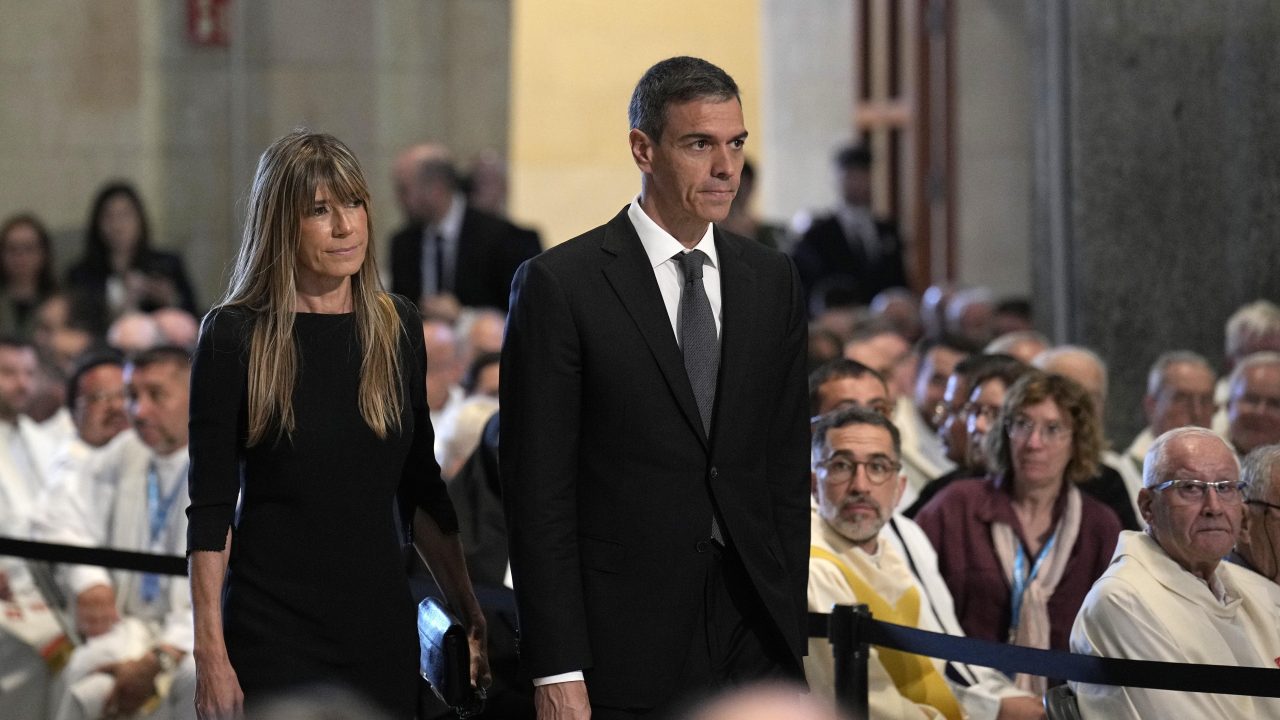
Caption: Spanish Prime Minister Pedro Sanchez (R) and his wife Begona Gomez (L) arrive to attend the mass officiated by Pope Leo XIV in the Sagrada Familia basilica in Barcelona, northeastern Spain, 10 June 2026. Pope Leo XIV is visiting Spain from 6 to 12 June 2026, with stops in Madrid, Barcelona, and the Canary Islands. EPA/ALEJANDRO GARCIA
Updated: June 23, 2026 - 05:38