Edit
Russia’s uneasy dependence on China and the logic of the U.S.-Russia pivot
Are we witnessing a ‘reverse Nixon’ approach: improving terms with Moscow to weaken its dependence on Beijing?
The war in Ukraine has consumed headlines for years, yet a quieter and potentially more consequential drama is unfolding in what looks at first sight as energy corridors and resource talks between Moscow and Beijing.
Ukrainian voices, including veteran Mykhailo Rohoza, have argued that the Kremlin is weighing the costs of permanent subordination to China and examining alternatives. Public communications and reporting increasingly suggest they may not be entirely wrong. The larger realignment – Russia weighing whether it can afford to remain China’s junior resource supplier – could render the current fighting a secondary chapter in a broader strategic adjustment.
Trump has spoken openly about the need to “un-unite” Russia and China. In an October 2024 interview he stated that “the one thing you never want to happen is you never want Russia and China uniting,” adding that he believed he could separate them. Secretary of State Marco Rubio has framed the risk more bluntly: allowing Russia to become China’s permanent junior partner would leave two nuclear powers aligned against the United States.
These statements are not isolated rhetoric. Analysts across outlets from the Wall Street Journal to Carnegie and the Atlantic have described a “reverse Nixon” approach – improving terms with Moscow to weaken its dependence on Beijing, the mirror image of the 1970s opening to China that exploited the Sino-Soviet split. Whether this succeeds is contested, but the intent is public.
The material basis for Russian discomfort is visible in energy negotiations. China already receives Russian pipeline gas via Power of Siberia at steep discounts – recently reported around $248 per thousand cubic meters versus higher prices paid by other customers, with one analysis putting the discount near 56 percent relative to some foreign buyers. Talks on the larger Power of Siberia 2 (also referenced in later reporting as Power of Baikal) have repeatedly stalled over price. Beijing has pressed for terms approaching Russia’s heavily subsidized domestic rate (figures near $50 per thousand cubic meters have circulated in reporting), levels analysts say would make the project uneconomic for Gazprom.
Russian officials continue to express hope for year-end commercial progress, yet the asymmetry is clear: Moscow needs the volumes after losing most of its European market; China does not need them on terms that fully satisfy Russian requirements. Russian commentators and some elite voices have noted the imbalance – raw materials and energy flowing one way, manufactured goods, technology, and capital the other – while Chinese commercial interest expands in the Far East, Arctic routes, and resource projects.
This is not evidence of an imminent rupture. Trade remains large, China is the dominant buyer of Russian oil, and both governments publicly emphasize strategic partnership. Yet the pattern matches longstanding Russian unease about becoming a permanent appendage, a junior partner of a bigger power that could overtake Russia first economically, and next politically.
Trump’s recent energy gestures – such as the reported diesel waiver – fit the same logic of reopening channels while testing whether Moscow will accept a less exclusive Chinese relationship. The Russian war in Ukraine becomes a detail. Proposals for a trilateral Trump-Putin-Xi meeting on Ukraine (floated around the APEC summit in Shenzhen, excluding Kyiv) underscore that the three capitals are already discussing the war in a format that treats it as one item among larger power arrangements.
An intensified U.S.-Russia partnership – built on sanctions relief, joint resource development in the Arctic and Siberia, and selective reintegration of American energy and mining firms – would sharply reduce Moscow’s dependence on Beijing as its primary buyer, technology supplier, and financial lifeline. Facing the prospect of a less captive Russian partner, China would have strong incentives to deepen engagement with the European Union: securing the EU’s vast consumer market, high-end industrial inputs, and regulatory cooperation to offset any erosion in its preferential access to Russian hydrocarbons and minerals.
The reverse dynamic holds as well: any measurable EU-China accommodation on trade, rare earths, or green technology would leave Russia more exposed to Chinese commercial leverage and thereby increase the attractiveness of U.S. offers of capital, technology, and market access.
This triangular pressure is coherent, yet geopolitically odd. A substantial share of Russian territory, population, and economic potential lies on the European continent; once the Ukraine war ends and credible security arrangements are in place, the natural long-term economic and infrastructural partner for the EU is Russia itself – through pipelines, rail, and resource trade – rather than a distant Pacific power or an exclusively Atlantic alignment. Present politics have inverted that continental logic, but the underlying geography has not changed.
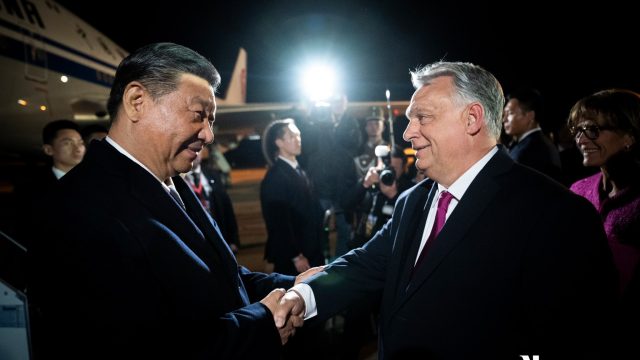
Caption: U.S. President Donald Trump and Chinese President Xi Jinping in front of the National Archives in Washington, DC, USA, 25 September 2026. EPA/JIM LO SCALZO / POOL
Updated: October 28, 2026 - 10:34