 Edit
Russia’s frozen assets stalemate: EU countries will need to individually commit billions of euros
The Prime Minister of Belgium, the host country of Euroclear, insists: no collective confiscation without collective peril
As European leaders grapple with harnessing €210 billion in immobilized Russian funds to bankroll Ukraine’s war effort, Belgian Prime Minister Bart de Wever has demanded ironclad guarantees from fellow member states. Without them, he warns, the scheme could saddle his country with a ruinous refund bill to Moscow, turning a bold anti-aggression move into a Brussels-sized boomerang.
How Belgium is blocking Europe’s bid to unlock frozen Russian assets for Ukraine
The stakes couldn’t be higher. Since Moscow’s full-scale invasion in February 2022, the West has frozen roughly €300 billion in Russian central bank reserves, with €210 billion parked in the EU – €185 billion at Euroclear, the Belgian-based clearinghouse that holds the lion’s share, and €25 billion scattered in private bank accounts. The G7’s June 2024 agreement envisioned channelling profits from these assets – estimated at €3-5 billion annually – into loans for Kyiv, not outright seizures that might violate international law or invite retaliation. But with Ukraine facing a €71.7 billion budget black hole in 2026 alone, urgency has morphed into audacity: EU finance ministers are now eyeing the principal itself for a €165 billion loan package.
EU countries will need to individually commit billions of euros to guarantee as much as €210 billion in urgently needed loans to Ukraine, the Commission has proposed. Under the blueprint, leaked to Politico, the funds would flow in six tranches, earmarked for €115 billion in Ukrainian defence over five years, €50 billion for budgetary support, and €45 billion to service a parallel G7 loan. Oversight would be rigorous – European Commission audits, spending trackers, and anti-corruption clauses – to assuage fears of graft. Yet the plan’s Achilles’ heel lies in Euroclear’s vulnerability: If Russia prevails in court or geopolitical winds shift, the firm could be compelled to repay the assets, exposing guarantors to massive liabilities.
Enter Belgium, the reluctant host. De Wever, a Flemish nationalist whose N-VA party clinched power in June’s elections on a platform of fiscal prudence, has balked at the asymmetry. “Why should Belgium bear the brunt?” he fumed after a 6 December summit in Berlin, where EU peers mulled the proposal ahead of a full leaders’ debate on 18 December. According to documents seen by Politico, the backstop shares – proportional to each country’s economic heft – would hit Germany hardest at €52 billion (about 25% of the total), followed by France at €34 billion, Italy at €23 billion, and Spain at €15 billion. Smaller states like the Netherlands (€12 billion), Poland (€10 billion), and Sweden (€8 billion) would chip in accordingly, with minnows like Malta and Cyprus at mere millions.
But De Wever’s ire stems from a deeper dread: opt-outs could inflate everyone’s tab. Hungary, ever the spoiler under Viktor Orbán, has already vetoed an alternative of fresh EU debt issuance, forcing reliance on this asset gambit. If Budapest demurs, its €4 billion slice redistributes, potentially hiking Belgium’s €11 billion exposure by 10-15%. “This isn’t solidarity; it’s a Belgian bailout disguised as geopolitics,” De Wever quipped to reporters, painting a vivid tableau of the Berlin talks: “Only Germany committed unequivocally. The rest? Contemplating their shoes or the ceiling – anywhere but the bill.”
Chancellor Friedrich Merz, whose CDU-led coalition has championed Ukraine aid since October’s snap elections, offered a diplomatic olive branch. “We had a very constructive exchange,” Merz said post-meeting. “Belgium’s particular concern about frozen Russian assets is undeniable and must be addressed so all European states bear the same risk.”
Berlin’s pledge underscores its outsized skin in the game – not just the €52 billion pledge but a broader €28 billion in direct bilateral arms to Kyiv this year alone. Yet even Merz faces domestic headwinds: Germany’s AfD opposition decries the plan as “economic warfare” that could boomerang via Russian gas cutoffs or cyber reprisals.
The hesitation ripples wider. France’s Emmanuel Macron, juggling pension protests and Sahel entanglements, has signalled tepid support, prioritizing African stability over Eastern European entanglements. Italy’s Giorgia Meloni, a Trump ally wary of fiscal adventurism, worries about legal blowback – Russia has already sued in international courts, claiming the freezes breach the 1992 Paris Club debt accord.
Eastern flankers like Poland and the Baltics, scarred by Soviet shadows, back the assets’ weaponization but flinch at the indemnity math; Warsaw’s €10 billion tab equals half its annual defence budget.
For Ukraine, the delay is deadly. President Volodymyr Zelenskyy’s forces, stretched thin on a 1,000-kilometer front, burn through €4 billion monthly in munitions alone. De Wever’s stand, while parochial, exposes the EU’s perennial fault line: unity in rhetoric, fracture in reckoning.
With Politico, edited by g.g.
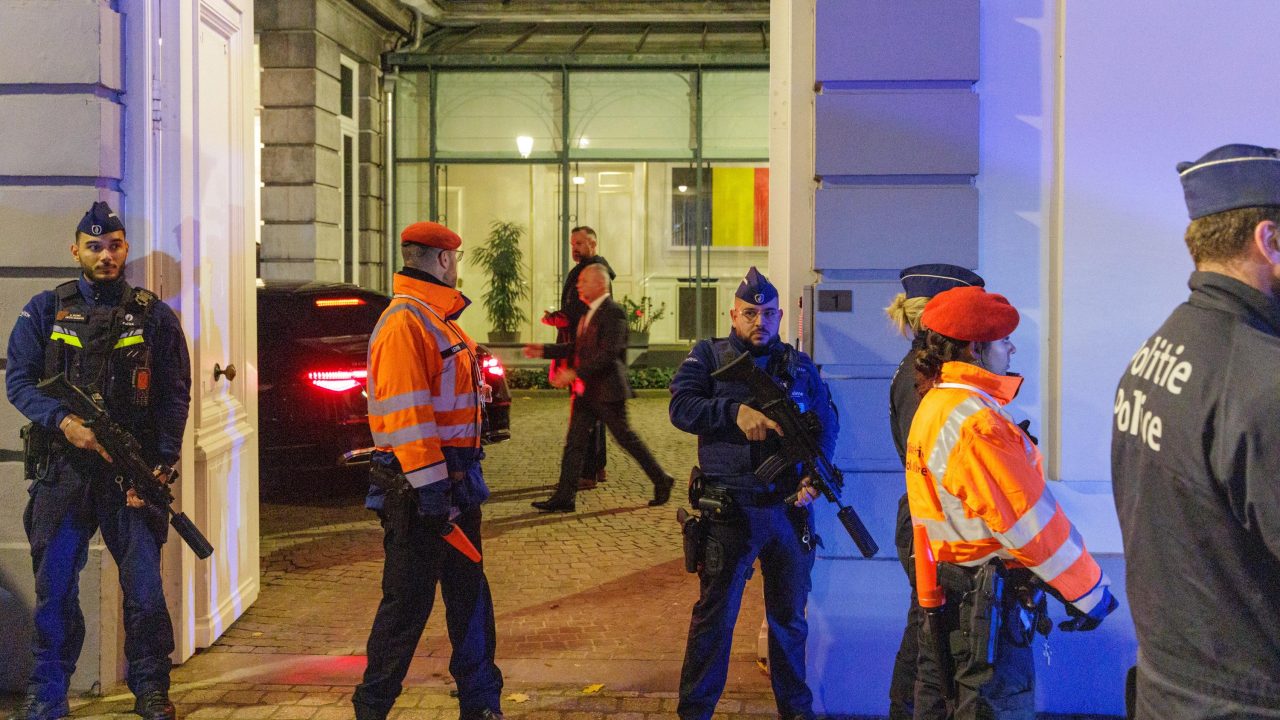
Caption: Security forces stand guard prior to Belgian Prime Minister Bart De Wever (not pictured) meeting with European Commission President Ursula von der Leyen and German Chancellor Friedrich Merz in Brussels, Belgium, 5 December 2025. The German Chancellor and European Commission President will meet with Belgian Prime Minister Bart De Wever in Brussels to discuss the EU’s proposal to use frozen Russian assets to fund Ukraine, as well as financial and judicial guarantees for Belgium. EPA/OLIVIER MATTHYS
Updated: December 9, 2025 - 07:10