Edit
RSF: Surge in violence against journalists in Serbia demands EU action
Between 1 July and 25 August, RSF documented 34 physical assaults on journalists, photojournalists and videographers
Reporters without borders (RSF) reports an alarming escalation of violence against journalists in Serbia, with 34 physical attacks recorded in less than two months, surpassing all annual totals since at least 2020.
“RSF calls on European Union member states and the European Parliament to send a clear message to the Serbian authorities that their passive stance – and potential complicity – in these abuses is incompatible with their goal of joining the EU”, states the international non-profit and non-governmental organisation headquartered in Paris, which focuses on safeguarding the right to freedom of information.
Unprecedented attacks on media professionals
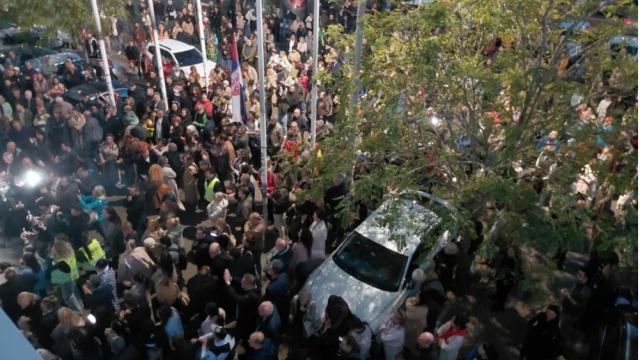
Between 1 July and 25 August, RSF documented 34 physical assaults on journalists, photojournalists, and videographers, primarily during anti-corruption demonstrations triggered by the deadly collapse of a railway station canopy in Novi Sad in November 2024.
Of these, 14 attacks were perpetrated by supporters of the ruling Serbian Progressive Party (SNS), headed by President Aleksandar Vučić, who also targeted peaceful protesters and some police officers. The remaining 20 incidents involved law enforcement officers using excessive force, including tear gas, against media workers.
The 2025 annual tally of 65 attacks, as reported by the Independent Journalists’ Association (NUNS) since 2008, marks a historic high, doubling the 17 cases recorded in 2024. This averages to one attack every two days, an intolerable rate that endangers journalists’ safety and press freedom.
A brutal example: assault in Novi Sad
On 13 August, one of the most severe attacks occurred outside the SNS headquarters in Novi Sad.
Zarko Bogosavljevic, editor-in-chief of the news website Razglas, and Nikola Bilić, a journalist from Novi Sad 192, were brutally beaten with metal rods by SNS supporters while covering a protest. Bilić, who sustained head injuries, required emergency medical treatment.
Such incidents highlight the growing hostility toward independent media.
Political incitement and media vilification
The surge in violence coincides with inflammatory rhetoric from President Vučić and pro-government tabloids.
Since December 2024, they have falsely accused protesters and independent media outlets, such as N1 and Nova S, of orchestrating a Western-backed “coup.”
In June, Vučić labeled these television channels “terrorists,” further inciting hostility.
RSF notes that police often fail to protect journalists during attacks, and in some cases, actively contribute to the violence through indiscriminate use of tear gas.
EU’s role and Serbia’s EU ambitions
Despite condemnation from EU Enlargement Commissioner Marta Kos in mid-August, Serbian Parliament Speaker Ana Brnabić, an SNS member, dismissed her criticism, telling her to “keep quiet.”
RSF urges the European Parliament and influential EU member states, such as Germany and France, to unequivocally condemn these attacks. Pavol Szalai, head of RSF’s EU-Balkans bureau, stated:
“Thirty-four attacks in less than two months is unacceptable. Must we wait for a journalist to be gravely injured or killed? The Serbian authorities’ passivity – and potential complicity – demands EU action. Serbia’s backsliding on press freedom is incompatible with its EU membership goals.”
EU’s new media law could succeed in the Balkans – if Brussels has the courage to enforce it
RSF’s ongoing advocacy
Since the protests began, RSF has repeatedly highlighted the rising violence and political pressure on Serbia’s media through public statements, a demonstration in Paris, and contributions to the EU’s Rule of Law report on Serbia.
Media under siege: Serbia’s democratic pledges questioned amid protests and press suppression
RSF also criticises the Serbian government’s preference for promoting Russian propaganda over fostering media freedom, further undermining democratic principles.
Serbia’s press freedom in decline
Serbia ranks 96th out of 180 countries in RSF’s 2025 World Press Freedom Index, placing it second to last in the EU-Balkans region.
The relentless attacks, death threats, and political vilification of journalists underscore a critical need for reform to align with EU standards.
“We especially call on the European Parliament and influential member states such as Germany and France to firmly condemn the record number of attacks on Serbian reporters. The Serbian government must understand that this backsliding is incompatible with its stated ambition to join the EU”, Szalai stated.
Other sources: Reuters, RSF statement
Caption: A person waves a Serbian flag during a remembrance rally for the victims of the Novi Sad train accident in Belgrade, Serbia, 1 September 2025. The march, organized by high school and university students, commemorates ten months since the railway station canopy collapsed on 1 November 2024, killing 16 people. EPA/ANDREJ CUKIC
RSF report: Media freedom is fragile even in democratic strongholds
Updated: September 5, 2025 - 05:21