 Edit
Romania’s “Captured justice”: documentary sparks nationwide protests and demands for judicial reform
A film exposes how a powerful elite has infiltrated the judiciary, undermining and sabotaging efforts to combat corruption
Romania witnessed a surge of public outrage following the revelations of a hard-hitting investigative documentary by the platform Recorder, titled “Captured Justice.”
The two-hour film, which amassed millions of views within days and was even broadcast on public television, exposed shocking allegations from current and former magistrates about systemic manipulation in the judicial system.
Interviewees, some speaking anonymously, described how high-profile corruption cases involving politicians and businessmen were deliberately delayed until statutes of limitations expired, or resolved through questionable acquittals. They pointed to mechanisms like the arbitrary reassignment of judges and undue pressure on independent magistrates, painting a picture of a judiciary “captured” by a small group of influential figures in exchange for protective laws from politicians.
The documentary centered on Lia Savonea, president of the High court of cassation and justice, portrayed as a key architect of this pyramidal power structure. Testimonies highlighted how laws enacted in recent years concentrated authority in the hands of a select few magistrates, who in turn ensured that powerful defendants evaded accountability. One magistrate starkly remarked that Romania had become “closer to a criminals’ paradise than a state governed by the rule of law.” The film condensed over a year and a half of investigative work, reviving long-simmering frustrations over stalled anti-corruption efforts despite Romania’s EU membership and the lifting of monitoring mechanisms like the Cooperation and Verification Mechanism.
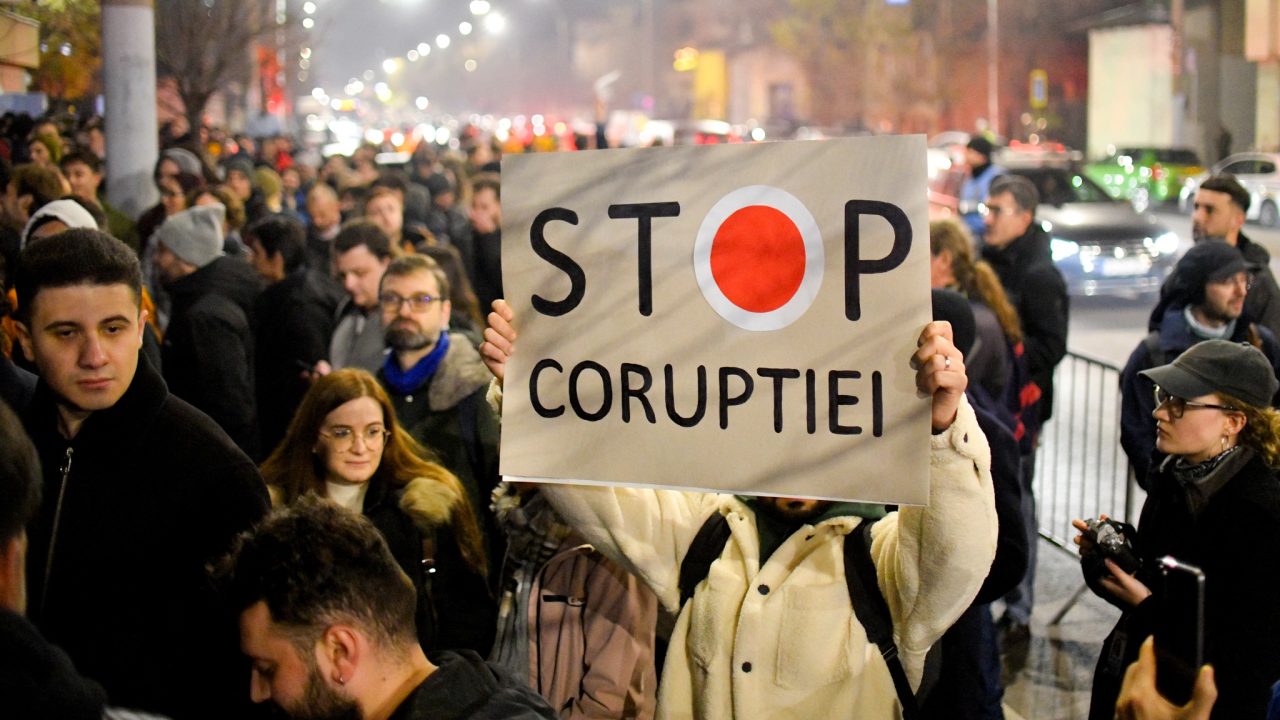
The public response was swift and visceral. On the evening of 10 December hundreds gathered spontaneously in front of the Superior council of magistracy (CSM) headquarters in Bucharest, chanting slogans such as “Justice, not mafia,” “We want justice, not immunity,” and “Independent magistrates, not obedient.” Protests continued the following day, with nearly a thousand demonstrators assembling in Victoria Square, directly facing the government building. Despite the winter chill, families brought children and pets, waving Romanian and European Union flags. Similar gatherings occurred in cities like Cluj-Napoca, where over 500 people protested outside the Palace of Justice for a second consecutive day, and in Iași, with banners proclaiming “If there is no justice, there is nothing.”
Protesters demanded sweeping changes: the resignations of Lia Savonea, the leadership of the National anti-corruption directorate (DNA), Justice Minister Radu Marinescu, and former Interior Minister Cătălin Predoiu. They also called for legislative reforms to close loopholes allowing indefinite postponements of trials. Personal stories fueled the crowds’ resolve. One demonstrator, Cristian Shemaru, expressed despair over inequality before the law, citing a recent case where a health insurance fund director escaped liability for fraud. A 17-year-old protester declared his aspiration to become a magistrate in a fairer system, while chants urged President Nicușor Dan to “defend justice” decisively.
The protests gained further momentum from dramatic events within the judiciary itself. At an extraordinary press conference held by the Bucharest Court of appeal on 11 December, leadership vehemently denied the allegations, labeling them a “campaign to destabilize” the system and incompatible with positive EU assessments. Yet, in a stunning interruption, Judge Raluca Moroșanu publicly affirmed the documentary’s claims, stating that honest magistrates faced terror through disciplinary actions. This internal dissent underscored the documentary’s impact.
Political reactions were mixed but acknowledged the gravity. President Nicușor Dan, who has prioritized judicial reforms since taking office earlier in 2025, invited magistrates to an open-ended discussion on 22 December and began compiling a report on systemic issues. He emphasized that solutions lie within the judiciary, assuring direct engagement with whistleblowers. Prime Minister Ilie Bolojan echoed calls for investigations, while Justice Minister Radu Marinescu, himself referenced in the film for past legal work with accused politicians, denied responsibility and stressed judicial independence, promising sanctions for proven delays.
The CSM’s judges’ section dismissed the documentary as part of a coordinated attack, while its prosecutors’ section announced checks into the allegations. Over 178 judges and prosecutors publicly expressed solidarity with the film’s sources, insisting that “truth and integrity should not be sanctioned.”
As protests spread to multiple cities, the Recorder investigation reignited a national debate on the rule of law. For many Romanians, it highlighted how far the judiciary has strayed from public expectations, threatening democratic foundations. With the documentary’s revelations still reverberating, pressure mounts for bold reforms to restore trust and ensure accountability at the highest levels. In a society weary of corruption scandals, these demonstrations signal a collective demand for a justice system that serves all citizens equally, not just the powerful.
Sources: Recorder.ro, Agerpress, Digi24
Caption: On the evening of 10 December hundreds gathered spontaneously in front of the Superior Council of Magistracy (CSM) headquarters in Bucharest, chanting slogans such as “Justice, not mafia”. Recorder’s Facebook page
Updated: December 12, 2025 - 13:56


