Edit
Romanian farmers clash with police at Bucharest protest
AUR leader George Simion defended the demonstrators after the violence, saying they had been “good and far too patient”
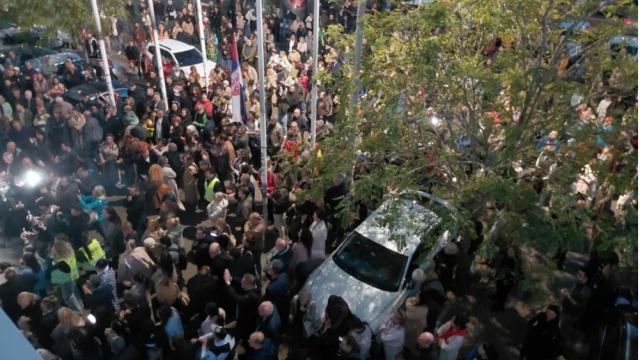
Thousands of livestock farmers gathered in Bucharest on Tuesday to protest restrictions imposed after outbreaks of peste des petits ruminants, a disease affecting sheep and goats, including measures requiring animals to be culled in areas where outbreaks are detected. The demonstration later descended into violent clashes with security forces, with police using tear gas after protesters broke through barriers and threw sticks and other objects.
The protesters, who came from across Romania, also oppose restrictions on the sale and movement of animals and the ban on exports of live sheep and goats imposed by the European Commission because of the disease.
The demonstration took place in Victoriei Square, outside the Romanian government headquarters. Several thousand sheep and goat breeders, as well as cattle farmers, took part, arriving from hundreds of kilometres away. Some supporters of far-right party AUR and supporters of former presidential candidate Călin Georgescu were also present.
Farmers told EUalive’s partner PressOne that national restrictions following the detection of several outbreaks had left many of them unable to sell their animals.
The protest also reflected wider economic pressures facing farmers. Drought has affected animal feed, while the cost of fodder, fuel, fertilisers and agricultural machinery has added to the difficulties facing the sector.
Some demonstrators, however, went beyond opposition to the measures themselves and questioned whether the disease was real. One sheep breeder told PressOne: “It’s like Covid, manipulation, they want us to eat plastics.”
The protest gradually became tense, with demonstrators forcing through a cordon established by the Romanian Gendarmerie and moving towards Paris Street.
According to the Bucharest Gendarmerie, protesters threw wooden sticks at law enforcement officers and broke through the security barrier. Gendarmes responded with tear gas.
More than 20 people required medical attention, according to the gendarmerie, with four taken to hospital for further treatment. Another update from the authorities said 24 people needed medical assistance, including eight gendarmes.
More than 30 people were taken to police units for checks and possible legal measures, according to Bucharest police. Four men were also taken to police stations, with three of them fined a total of 11,000 Romanian lei (approximately €2,091 EUR).
The violence also disrupted traffic in the area, with protesters blocking Victoriei Passage and several roads, affecting road and tram traffic.
Several journalists were also attacked during the clashes. Bucharest police said they had opened investigations after images emerged showing two journalists allegedly being physically assaulted and were taking steps to identify those responsible.
In one reported incident, a journalist from Snoop was filming men removing stones from a tram shelter and throwing them towards a gendarme barrier when a masked man hit her camera and threatened her. She later encountered the same man again in Victoriei Square and was threatened again.
Romanian political leaders condemned the violence while acknowledging the farmers’ grievances.
Interim Prime Minister Ilie Bolojan said peaceful demonstrations were an expression of democracy but that “nothing can excuse those who hijack these demonstrations and incite violence”. He warned against attempts to push Romania towards what he described as “dangerous destabilisation”.
Interim Agriculture Minister Tanczos Barna similarly condemned the violence, saying the farmers’ protest had been “hijacked and turned into acts of vandalism” by people who did not represent farmers’ interests. At the same time, he said many of the farmers’ demands were “absolutely justified” and noted that their representatives had been received for discussions at the Agriculture Ministry on Tuesday.
AUR leader George Simion defended the demonstrators after the violence, saying they had been “good and far too patient” and arguing that their dissatisfaction had accumulated over the past two years.
Romanian President Nicușor Dan described the violence in Victoriei Square as “extremely serious” and said he firmly condemned attempts to turn a legitimate protest into street fighting.
The Bucharest Gendarmerie said the incidents amounted to a serious disturbance of public order and involved vandalism and objects being thrown at law enforcement officers. Criminal investigations were being conducted over alleged public-order offences, destruction, assault and other violence.
Sources: EUalive’s partners PressOne and BGNES, Digi24
Caption: A shepherd supporter (R) holding a national flag fist bumps a riot-police officer after their second scuffle during a protest in front of the Romanian government headquarters in Bucharest, Romania, 15 September 2026. Thousands of shepherds from across the country gathered in the capital, unhappy with the extension of the ban on live sheep exports until 31 December 2026, a decision by the European Commission prompted by outbreaks of Peste des Petits Ruminants (PPR) and sheep and goat pox and attributed to insufficient preventive measures by the authorities. Farmers in the crop sector, who had been promised compensation of 100 euros per hectare for drought-affected crops, are also protesting because they will ultimately receive only 19 euros per hectare, an amount that fails to cover the losses caused by the extreme and prolonged drought. EPA/Robert Ghement
Updated: September 16, 2026 - 05:37