Edit
Romania enlists major industries to avert power rationing amid Danube drought crisis
Caretaker PM Ilie Bolojan secures voluntary evening demand cuts from large consumers after low water levels trigger energy emergency and force nuclear output reductions
Romania has turned to its largest industrial consumers to avoid forced electricity rationing after an unprecedented drop in the Danube’s water level pushed the country into an energy emergency.
The Caretaker government has reached a voluntary agreement with major industrial electricity consumers to reduce power demand between 19:00 and 23:00 as the country struggles with an energy crisis caused by severe drought and exceptionally low water levels in the Danube.
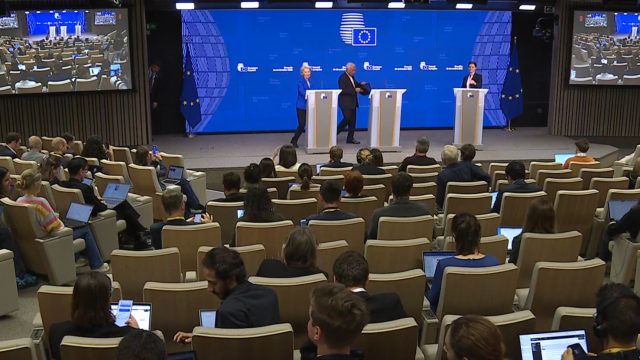
Speaking at a live-streamed press conference, PM Ilie Bolojan, who also serves as energy minister, said several large industrial companies had agreed to adjust their production schedules during peak demand hours. Public authorities will also reduce architectural lighting and dim street lighting wherever possible.
Earlier on Monday, Bolojan held an online meeting with representatives of around 80 companies consuming more than 50,000 MWh annually, alongside employers’ organisations. Each company will implement measures tailored to its production processes to avoid disrupting operations or damaging equipment.
Bolojan said Dacia and Ford had decided to suspend production from now until 19 August, using the shutdown for scheduled maintenance while reducing electricity demand by around 200 MW.
The government is also preparing an emergency decree establishing a demand-reduction mechanism for situations in which electricity supply cannot fully meet consumption. Under the scheme, large industrial consumers would receive 24 hours’ notice instructing them to limit consumption according to the technical characteristics of their facilities.
“This is a precautionary measure designed to enable coordinated action if necessary,” Bolojan said. He also called on municipalities and public institutions to cut electricity use wherever possible.
Asked whether households could also face restrictions, the caretaker prime minister said there were currently no plans for rolling blackouts affecting residential consumers.
The crisis has reignited Romania’s political debate over coal-fired generation.
Sorin Grindeanu, leader of the Social Democratic Party (PSD), announced that his party would table legislation preventing any electricity generation capacity from being permanently shut down until replacement capacity becomes operational.
He argued that, with the country’s second reactor at the Cernavodă nuclear power plant also facing the risk of shutdown, Romania should reactivate two additional 330 MW coal-fired units at the Turceni and Rovinari power stations.
“Their combined output would equal the production of the only reactor currently operating at Cernavodă,” Grindeanu was quoted by Romanian media as saying.
On Friday, Romania declared a nationwide state of heightened alert in the energy sector for the entire month of August.
Bolojan said the country would import electricity from Ukraine to help cover evening demand and confirmed that similar discussions were under way with Bulgaria and Greece.
Ukraine is helping and Bulgaria is better prepared
State-owned nuclear operator Nuclearelectrica confirmed that it would purchase electricity from Ukraine through Moldova’s state energy trader Energocom to compensate for the loss of output following the shutdown of Unit 1 at the Cernavodă nuclear power plant.
In a statement, the company said the measure was intended to reduce pressure on Romania’s electricity market following the government’s declaration of an energy emergency.
Romania shut down one of the two reactors at Cernavodă last week because of the Danube’s exceptionally low water level, which affected the plant’s cooling operations. The nuclear station normally supplies around 20% of the country’s electricity.
Meanwhile, opposition politicians have argued that the crisis also reflects Romania’s lack of electricity storage capacity.
Claudiu Năsui, an MP from the Save Romania Union (USR), said the country’s main problem was not electricity generation but its inability to store cheap daytime power.
He claimed that Bulgaria purchases low-cost Romanian electricity during the day, stores it in battery systems and sells electricity back onto regional markets during the evening peak because it has developed the largest battery storage capacity in the region.
He argued Romania could adopt a similar model, but current regulations discourage investment in battery storage and prosumer development.
Speaking to Digi24, energy expert Dumitru Chisăliță said such cross-border trading mechanisms do exist, although it is impossible to prove that electricity exported from Romania is the same electricity later returning to the market.
“Bulgaria buys electricity between 10:00 and 18:00 because it has significant storage capacity, then sells electricity in the evening. There is no guarantee it is selling it back to Romania; it could equally be sold to Hungary, Serbia or elsewhere. But yes, this is how the market works,” he said.
According to Chisăliță, Bulgaria expanded electricity generation and storage capacity simultaneously, while Romania concentrated primarily on adding generation.
“Romania built generation capacity without developing substantial storage. Bulgaria developed both in parallel. It did not build generation assets in isolation; the two evolved together. Bulgaria’s approach was more balanced,” he said.
Sources: Digi24, Hotnews.ro, BTA
Caption: An aerial photo taken with a drone shows the tip of Szentendre Island on the River Danube during low water levels near Nagymaros, Hungary, 14 July 2026. Due to a lack of precipitation and drought, the river’s water level is extremely low. EPA/ZOLTAN MATHE
Updated: August 4, 2026 - 05:22