Edit
Putin’s allies Belarus and Iran forge strategic alliance to counter Western sanctions
The two countries, staunch supporters of Russia, face Western sanctions, fostering a shared interest in countering external pressures
Iranian President Masoud Pezeshkian’s visit to Minsk on 20 August marked a significant milestone in Belarus-Iran relations, reinforcing their strategic partnership amid shared challenges posed by Western sanctions.
The summit between Presidents Alexander Lukashenko and Pezeshkian highlighted a mutual commitment to deepening cooperation across economic, cultural, and defence domains, positioning both nations as key allies of Russia in a shifting geopolitical landscape.
Both Belarus and Iran, staunch supporters of Russia’s actions in Ukraine, face stringent Western sanctions, fostering a shared interest in countering external pressures.
Pezeshkian, drawing on Iran’s four decades of experience under sanctions, pledged to assist Belarus in mitigating their economic impact. “Our shared goal is to uphold sovereignty and foster cooperation rooted in mutual trust,” he stated, as reported by Belarusian state media Belta.
Lukashenko echoed this sentiment, emphasising that their partnership prioritises the prosperity of their peoples and is not directed against any third party.
The leaders signed multiple agreements covering environmental protection, tourism, healthcare, veterinary science, standardisation, media, and investment in free economic zones. These agreements aim to elevate bilateral relations to match the high level of political trust.
Economic cooperation forms the cornerstone of this partnership. Belarus sees growing demand in Iran for its wood products, chemicals and fertilisers, while Belarusians value Iranian fruits, nuts, and advanced healthcare technologies. Joint industrial projects, including the production of agricultural machinery, tractors, and quarry equipment, are under development. Both nations also plan to enhance cooperation in banking, investment, science, technology, education, and sports, alongside humanitarian exchanges to foster cultural understanding.
Tourism emerged as another focus, with both leaders highlighting its potential to strengthen people-to-people ties. These initiatives aim to build a robust framework for economic resilience, leveraging Iran’s integration into the Eurasian Economic Union and participation in the North-South trade corridor.
Defence and regional security
Military-technical cooperation was a central topic, reflecting the strategic alignment of Belarus and Iran. Both nations have supported Russia’s efforts in Ukraine, with Iran supplying drones and Belarus providing territory for Russian military operations and even hosting Russian nuclear missiles, according to unconfirmed reports.
The leaders also addressed regional security concerns, particularly in response to recent U.S. strikes on Iran’s nuclear facilities, which Lukashenko condemned as a “serious threat to regional and global stability.” He reaffirmed Belarus’s support for Iran’s right to peaceful nuclear energy and called for de-escalation to prevent further instability.
Belarus and Iran are aligning their strategies within international frameworks such as the United Nations, the Shanghai Cooperation Organization (SCO), and BRICS. Their joint stance against Western sanctions and advocacy for a multipolar world order positions them as key players in reshaping global dynamics.
Lukashenko highlighted their collaboration with Russia and other partners as a counterbalance to what he described as “aggressive and hypocritical” Western policies.
The Minsk summit also touched on Belarus’s potential role in regional diplomacy. Belarusian authorities have expressed readiness to facilitate a meeting between Russian President Vladimir Putin and Ukrainian President Volodymyr Zelenskyy, though Lukashenko clarified that Belarus would not assume a mediator role unless requested.
This offer coincides with renewed U.S.-Belarus engagement, highlighted by a phone call between Lukashenko and U.S. President Donald Trump before the meeting in Alaska, where they discussed prisoner releases and Putin’s upcoming visit to Alaska.
U.S.-Belarus relations: a shifting dynamic
The Trump administration’s outreach to Belarus, including a high-level visit by General Keith Kellogg in June, signals a departure from the policies of former President Joe Biden and European allies, who have distanced themselves from Lukashenko’s regime due to its human rights record and support for Russia.
Trump’s call with Lukashenko, described as “wonderful” in a Truth Social post, focused on gratitude for the release of political prisoners and the potential release of approximately 1,300 more individuals. Lukashenko has invited Trump to Minsk, an offer the U.S. president did not reject.
EU sanctions and Belarus’s role in Russia’s war
The European Union has imposed comprehensive sanctions on Belarus for its role in supporting Russia’s war against Ukraine, albeit less severe to the sanctions imposed on Russia.
In June 2024, the EU extended export bans on dual-use goods, advanced technologies, maritime navigation goods, and luxury goods to Belarus, mirroring restrictions on Russia to address circumvention due to the high integration of their economies.
The EU also introduced restrictions on road transport by Belarusian-registered vehicles and mandated a “no-Belarus clause” in contracts to prevent the re-export of sensitive goods to Belarus.
The European Council’s conclusions in October 2022, March 2023, and June 2023 condemned Belarus’s continued military support for Russia, including allowing Russian armed forces to use its territory and deploy tactical nuclear weapons. The EU remains ready to implement further sanctions if Belarus continues its support for Russia’s actions.
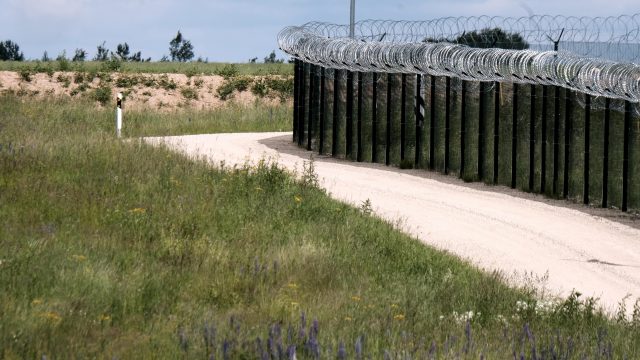
Since 2021, Poland, Lithuania, and Latvia have accused Belarus of orchestrating a surge of migrants from the Middle East and Africa across their borders. In response, Poland bolstered its border security, increasing troop deployment from 2,500 to 10,000 in 2021 to block unauthorized crossings from Belarus.
The European Union claims that Belarusian President Alexander Lukashenko is facilitating this migration by transporting individuals to Minsk and directing them toward EU borders as a retaliatory measure against economic sanctions imposed by Brussels on his regime.
Other sources used: Reuters, EU Council press releases
Caption: A handout photo made available by the Belarus President’s office shows President of Belarus Alexander Lukashenko (R) and Iranian President Masoud Pezeshkian (C) attending a welcoming ceremony during their meeting in Minsk, Belarus, 20 August 2025. EPA/BELARUS PRESIDENT PRESS SERVICE / HANDOUT HANDOUT EDITORIAL USE ONLY/NO SALES
Updated: August 21, 2025 - 10:19