 Edit
Protest over antisemitism law gathers mixed bag of Romanian anti-establishment forces
Under heavy police presence, the events remained largely peaceful, though the atmosphere carried extremist undertones
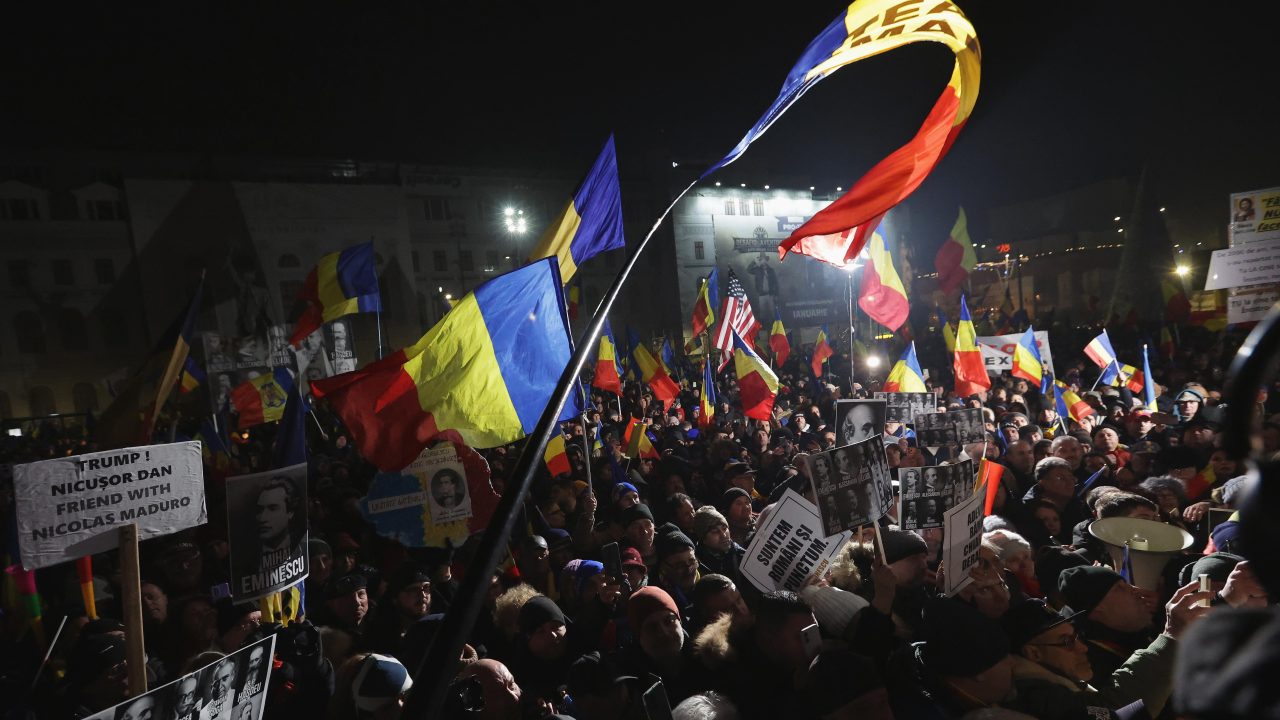
Thousands of demonstrators converged on central Bucharest on 15 January, transforming what began as a focused rally against the controversial so-called ‘Vexler Law’ into a broader outpouring of discontent with the Romanian government and its policies.
The evening’s events unfolded in University Square, an iconic place for Romania’s uprising against communism, where the initial gathering quickly splintered, reflecting deep divisions within Romania’s nationalist and anti-establishment circles.
The protest originated with a call from MEP Claudiu Târziu, founder of the newly formed Conservative Action party and a former key figure in the far-right Alliance for the Union of Romanians (AUR). Târziu had promoted the demonstration primarily as a civic response to the Vexler Law, officially known as the Law on Combating Antisemitism and Xenophobia.
From Vexler Law to broader discontent
Initiated by Silviu Vexler, president of the Federation of Jewish Communities in Romania and a member of parliament, the legislation strengthens penalties for promoting fascist, legionary, racist, or xenophobic organizations, symbols, and actions. It also targets the glorification of individuals guilty of genocide, crimes against humanity, or war crimes, including historical figures associated with Romania’s fascist past, such as elements of the Iron Guard.
Supporters view it as a necessary update to existing hate speech laws, addressing gaps that previously allowed open praise of extremist ideologies, including on social media. Critics, however, argue that its broad definitions risk infringing on free expression and cultural memory, potentially criminalizing reverence for certain national historical figures.
The law has stirred intense debate since its passage late in 2025. President Nicușor Dan, citing concerns over clarity, proportionality, and potential impacts on freedom of speech, referred it to the Constitutional Court and returned it to parliament for reconsideration rather than promulgating it. This decision drew sharp criticism from Jewish community leaders and international observers, who warned it could embolden extremist narratives. Vexler himself protested, describing the move as encouraging the promotion of antisemitism and far-right ideology.
Târziu framed the 15 January rally as a defence against what he called the most serious assault on the Romanian people in decades. Speaking from the podium, he insisted the gathering was not a partisan event and emphasized opposition to the law as an “effect” of a weakened state unable to represent national will. He accused the ruling coalition, including the Social Democratic Party, National Liberal Party, Save Romania Union, and Democratic Union of Hungarians, of enabling its adoption. Amid boos and chants of “traitors,” Târziu vowed continued pressure through parliament, streets, and legislation to repeal it. He also demanded answers about the annulment of the 2024 presidential election’s second round, which many nationalists claim was stolen illegally.
The diverse faces of Romania’s protest movement
As the rally progressed, the message expanded far beyond the Vexler Law. Târziu addressed widespread economic grievances: repeated tax increases, soaring fees, frozen salaries and pensions, and the perceived betrayal by successive governments over the past five years. He described Romania as reduced to a “begging bowl,” exploited by a “transnational mafia” extracting resources from land, forests, energy, and people. Farmers opposed to trade deals like Mercosur and workers struggling for basic sustenance joined the chorus, united in frustration over a state they saw as absent or complicit in national robbery.
The crowd, waving Romanian flags and chanting slogans like “National Unity,” “Freedom,” “Down with the government,” and “Thieves,” displayed a mix of symbols. Some carried a Dacian wolf-dragon emblem, while others held icons and crosses alongside priests. A few waved American flags, hinting at admiration for certain international populist currents.
AUR leader George Simion, whose party mobilized supporters despite Târziu’s departure from AUR, took the stage to amplify the anti-establishment tone. He condemned those “trying to restore dictatorship” and “stealing rights,” linking the protest to canceled elections and opposition suppression. Simion called on the Federation of Jewish Communities and minorities to distance themselves from Vexler and align with “the Romanian people.” He demanded respect for democracy, a return to the presidential runoff, and an end to burdensome taxes and duties.
The demonstration’s heterogeneous nature became evident as it divided. Târziu and a group marched to the Athenaeum to lay flowers at Mihai Eminescu’s monument, a symbolic gesture tying their cause to Romania’s cultural heritage.
Meanwhile, Simion, joined by journalist Anca Alexandrescu and thousands of others, proceeded to Victoria Square in front of the government building. There, despite sub-zero temperatures, over 10,000 people reportedly continued protesting austerity measures, chanting against the government and its economic policies.
Under heavy police presence, the events remained largely peaceful, though the atmosphere carried extremist undertones. Some messages veered into conspiracy-laden rhetoric about foreign influence and EU overreach, while isolated antisemitic expressions surfaced, tolerated or echoed in parts of the crowd. The protest highlighted Romania’s polarized political landscape, where opposition to a law combating hate speech intersects with broader nationalist, isolationist, and economic discontent.
Târziu’s insistence on a purely civic focus clashed with the rally’s evolution into a platform for wider grievances. Simion’s calls for ongoing mobilization, including future actions and even a planned “repatriation” effort for Romanians abroad, suggest these tensions will persist. As Romania grapples with its historical memory, economic hardships, and democratic challenges, events like 15 January reveal a society deeply divided over identity, governance, and the boundaries of free expression.
Sources: Agerpres, Digi24, Romania Insider
Caption: People wave Romanian flags and placards while shouting during a protest in downtown Bucharest, Romania, 15 January 2026. The protest was organized by the ultra-nationalist Conservative Action Party and joined by supporters of the Alliance for the Union of Romanians (AUR) against the government’s austerity measures and to mark National Culture Day, drawing participants from across the country. EPA/ROBERT GHEMENT
Updated: January 16, 2026 - 12:06


