Edit
Polish President vetoes aid for Ukrainians and threatens Kyiv Starlink funding
Nawrocki announced his own bill that would extend the period required to obtain Polish citizenship from 3 to 10 years
Polish President Karol Nawrocki on 25 August vetoed a bill that would have extended financial support for Ukrainians fleeing the war, a decision that officials warn will also cut funding for Ukraine’s Starlink internet service.
Poland has been supporting Ukraine’s internet connection since the start of Russia’s full-scale invasion by financing the Starlink systems, which are a lifeline for soldiers fighting on the front line.
Nawrocki noted that during the full-scale war of the Russian Federation, the strategic interests of Poland have not changed, and Russia remains the greatest threat to security. However, he is arguing that the financial situation and public sentiment in Poland have changed significantly.
“The law on assistance to the citizens of Ukraine, which I received, does not amend the public discussion. I do not change my mind and intend to fulfil my obligations. I believe that help should be received only by those Ukrainians who accept the challenge to work in Poland,” he said.
The Polish president’s decision to veto the bill “means that as of 1 October, Warsaw will not be able to continue paying for Ukraine’s Starlink subscription,” a spokesperson for Poland’s Ministry of Digital Affairs told public television TVP on 25 August.
The new version of the law on assistance to citizens of Ukraine, vetoed by Nawrocki, provided the extension of temporary protection for Ukrainians fleeing the war until 4 March 2026.
Among other measures, Nawrocki announced the submission of his own bill that, among other measures, would extend the period required to obtain Polish citizenship from 3 to 10 years and introduce harsher penalties for illegal border crossing.
“I think we have to achieve a certain social justice here. Poles in their country should be at least on an equal footing with our guests from Ukraine. For me, this is a matter of principle, so I did not sign the law on assistance to citizens of Ukraine in this form,” Nawrocki said in an interview with Polish newspaper Onet, quoted by European Pravda.
Nawrocki, a right-wing nationalist backed by the opposition Law and Justice party, narrowly won Poland’s presidential election on 1 June with 50.89% of the vote, defeating liberal rival Warsaw Mayor Rafal Trzaskowski.
While Poland has a parliamentary system in which the president’s authority is largely ceremonial, the Polish president retains the ability to veto legislation proposed by parliament.
Ukrainians should not be afraid
The head of the office of the Polish President, Zbigniew Bogutsky, stressed at a press conference on Monday that this decision was not directed against Ukrainians who are in Poland. He said Ukrainians should not be afraid if they work legally, pay taxes or have their own business. “However, there was a group that did not show interest in doing this,” he added.
Bogutsky noted that the law should be fair to Poles. “It is the Poles who are masters in their country, and it is the Poles who must have the greatest privileges, and not any other nationality,” he said.
Earlier, Nawrocki called on the Sejm to ban the “Bandera flag” in Poland after incidents that occurred during a concert of a Belarusian rapper in Warsaw.
Concert in Warsaw sparks controversy over nationalist flag, straining Poland-Ukraine relations
“Presidential vetoes are cutting blindly! Karol Nawrocki turns off the Internet in Ukraine with his decision, because de facto it means his decision on the law on assistance to Ukrainian citizens,” Polish Deputy Prime Minister Krzysztof Gawkowski wrote on X.
‘A gift for Putin’
“This is the end of the Starlink Internet, which Poland provides to Ukraine, which is waging war. This is also the end of support for storing Ukrainian administration data in a safe place. I can’t imagine a better gift for (Russia’s President Vladimir) Putin’s troops than cutting off Ukraine from the Internet,” he added, accusing Nawrocki of “helping Russia” by blocking support for Kyiv’s communications infrastructure.
“The bill, which President Nawrocki vetoed, extended the period of assistance, meaning this funding from the Ukraine Aid Fund, until the end of March next year,” the spokesperson of the Ministry for Difital Affairs Marek Gieorgica said. “Therefore, there is currently no legal basis for funding this from 1 October.”
Ukraine relies heavily on Starlink, the satellite internet system developed by Elon Musk’s SpaceX, to maintain connectivity in front-line areas and support government communications. Ukraine’s Digital Transformation Minister Mykhailo Fedorov announced on 3 April that Poland had supplied 5,000 additional Starlink terminals.
Since the start of Russia’s full-scale invasion in 2022, Ukraine has received over 50,000 Starlink terminals, with Poland providing nearly 30,000 – the largest contribution by any single country, according to Fedorov.
“Bandera symbols”
Nawrocki also proposed equating the “Bandera symbols” with Nazi and Communist symbols in Poland’s criminal code and revising the law on the Institute of National Remembrance to reflect “crimes committed by the Ukrainian Insurgent Army.”
The controversy over historical symbols has long complicated Polish-Ukrainian relations. While many in Poland associate Stepan Bandera’s legacy with wartime atrocities, in Ukraine the figure has come to symbolise resistance and national identity, especially in the fight against Russia’s ongoing invasion.
“In order to eliminate Russian propaganda and set relations with Ukraine on mutual respect, I believe we should also include in this bill an unambiguous slogan ‘stop Banderism’,” the Polish president declared.
A Ukrainian diplomatic source told the Kyiv Independent that while Ukraine appreciates Poland’s past support, equating Ukrainian symbols with Nazi and Communist ones risks fuelling negative sentiment in Ukrainian society.
“Any politicised decisions on allegedly equating Ukrainian symbols with Nazi and Communist ones may provoke stronger negative sentiment in Ukrainian society and will require a response from the Ukrainian side,” the source said.
Other sources: The Kyiv Independent
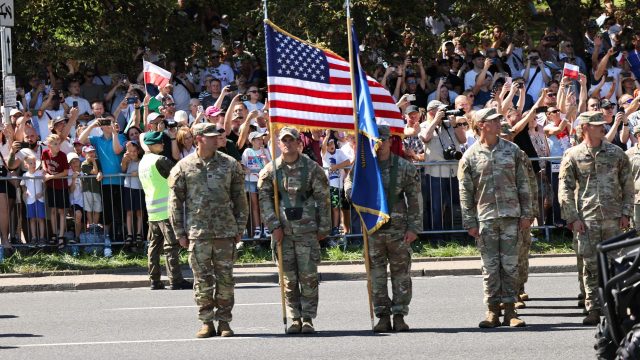
Caption: Polish President Karol Nawrocki speaks during the military parade on the occasion of Polish Armed Forces Day in Warsaw, Poland, 15 August 2025. EPA/RAFAL GUZ
Updated: August 26, 2025 - 06:03