Edit
Poland and Czechia forge alliance against EU climate costs
Prime ministers Donald Tusk and Andrej Babiš vow joint campaign to protect households from higher prices for fuel and heating
Polish Prime Minister Donald Tusk and Czech Prime Minister Andrej Babiš announced on Thursday a coordinated campaign to resist the EU’s planned expansion of emissions trading, declaring that their countries will work together to delay the ETS2 system and persuade other states in the region to join the effort.
Speaking at a joint press conference after talks in Warsaw, the two leaders argued that the scheme would impose unacceptable costs on households and industry in Central Europe and that EU climate rules must better reflect the different economic histories and energy structures of member states that emerged later from communism.
The ETS2, a new emissions trading system separate from the existing ETS that covers power plants and heavy industry, is designed to place a carbon price on fuels used in road transport and the heating of buildings. It was originally due to start in 2027 but has already been postponed until 2028. Tusk and Babiš said they now want a further postponement.
“I believe we will be able to convince other countries in the region to join us regarding the ETS and ETS2. Our economies cannot be condemned to suffer and incur losses,” Tusk said. He stressed that neither government questions the need to protect the climate, but insisted the burden must not fall hardest on countries that “started from a more difficult position.”
Tusk argued that Europe’s current priorities should be security and economic competitiveness rather than new measures that raise costs for citizens.
“This is not the time for austerity, nor is it the time for fanciful ideas,” he said of the ETS2. With Russia’s war in Ukraine continuing, defense spending rising and borders under pressure, he said European policy must become more realistic. “We are dealing with a very brutal and realistic approach to politics in Moscow, Beijing, and Washington. Europe can no longer afford to play the innocent.”
Babiš was equally blunt. “We will explain to our colleagues in the European Union that we fundamentally reject the ETS2 emissions trading system, which will only make life harder for our fellow citizens,” he said. He warned of particular damage to refineries and households and noted that the existing ETS1 system is already costly.
European Commission forecasts once projected allowance prices of about €26.50 by 2030; the price has instead climbed to roughly €89. “Our companies are the ones paying for all of this,” Babiš said. He contrasted conditions in Central Europe with those in Spain, where abundant sun, wind and sea power keep electricity cheaper. “We aren’t in Spain; we don’t have the same sun or wind,” he remarked, adding that the Commission must recognize that the region hosts many energy-intensive industries.
Divergent histories and the push for regional solidarity
Both leaders grounded their opposition in the distinct post-communist trajectory of their countries. Poland and the Czech Republic inherited heavy industrial bases and energy systems far more dependent on coal and other fossil fuels than those of Western Europe.
Tusk pointed out that the two nations “emerged from much more challenging conditions than the countries of Western Europe” and that EU policy must account for those differences. “Certainly, the Czech Republic and Poland will not be the countries that pay the highest price for the costs associated with climate protection,” he said. Babiš echoed the point, arguing that a more differentiated approach is required and that amending ETS1 rules while postponing ETS2 would give immediate relief.
The two prime ministers also announced closer coordination on the next multiannual EU budget, due to cover 2028–2034. They insisted that cohesion policy funding must be protected and that smaller member states should not see their shares reduced in favor of larger ones. Babiš criticized proposed reallocations and the continued existence of rebates long enjoyed by certain Western countries, a legacy he traced to the Thatcher era. “They argue that they are the ones paying. Yes, but you also receive rebates and discounts,” he said.
Tusk rejected any framing of cohesion funds as charity. “This is not ‘aid’ for our nations. We don’t need any favors from anyone,” he declared, describing the policy instead as an instrument that has strengthened competitiveness, infrastructure and investment in both countries. In the present geopolitical climate, he added, Europe needs a larger rather than a smaller overall budget to finance security.
Visegrad revival and bilateral depth
The Warsaw meeting also signaled a broader effort to restore practical cooperation among Central European states. Tusk and Babiš welcomed the revival of the Visegrad Group after earlier disputes, particularly between Poland and Hungary, had limited common positions. “We have managed to resume the work of the Visegrad Group,” Tusk said. Both men described bilateral relations as excellent, noting that Poland is the Czech Republic’s third-largest trading partner and that hundreds of Czech companies operate in Poland while Polish exports to the Czech market have grown strongly.
They agreed to hold joint government consultations before the end of the year and to explore cooperation in the defense industry and cybersecurity. Babiš expressed interest in Poland’s air-defense solutions and suggested the two countries try joint military procurement again despite earlier failures.
The leaders also touched on the recent U.S. midterm elections. Babiš, who has maintained good relations with President Trump, said the Democratic gains were largely expected and expressed hope that Washington would focus on ending the war in Ukraine and stabilizing the Strait of Hormuz, given the economic impact of those conflicts. Tusk struck a more ironic note, declaring that “democracy won in America” and advising the U.S. president against over-reliance on the veto, drawing on his own experience with Polish presidents.
Babiš used the occasion to recall personal and commercial ties to Poland that stretch back to the late 1970s, when he traveled to Gdańsk, Świnoujście and Tarnobrzeg on business. The long acquaintance, he said, underpins a shared assessment of European affairs. Both governments are members of the “Friends of Cohesion” group and of the “coalition of the willing” supporting Ukraine. While they acknowledge occasional differences of emphasis, they insist their overall view of the Russian threat and the need for sustained support is aligned.
The joint front presented in Warsaw is intended to influence upcoming EU negotiations on both climate instruments and the next long-term budget.
Sources: EUalive’s media partners FocusEurope.pl and updateEU. Edited by a.k.
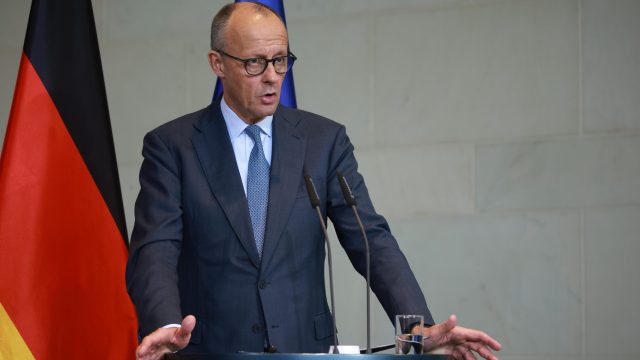
Caption: Polish Prime Minister Donald Tusk (R) and Czech Prime Minister Andrej Babis (L) hold a joint press conference following their meeting at the Prime Minister’s Office in Warsaw, Poland, 04 November 2026. EPA/Albert Zawada
Updated: November 5, 2026 - 11:26