Edit
Opposition leader Janša’s meeting with Israeli intelligence firm sparks election scandal in Slovenia
Security experts warn about the societal consequences of the political turmoil, including voter apathy and erosion of trust
Slovenia’s conservative opposition leader, Janez Janša, is locked in a tight race to reclaim the premiership in Sunday’s closely contested parliamentary election on 22 March, but his campaign has been overshadowed by explosive allegations of meetings with representatives of the Israeli private intelligence firm Black Cube.
Janša, head of the Slovenian Democratic Party (SDS) and a longtime pro-Israel figure, initially denied any such contacts. He has since acknowledged that meetings took place, though he and his party strongly reject claims of wrongdoing or involvement in election interference.
This controversy, centered on claims of foreign interference and covert operations, has intensified political tensions in a tightly contested race.
The emergence of the scandal and Janša’s shifting statements
The controversy erupted on Monday when the 8th of March Institute, collaborating with investigative journalists and experts, revealed that representatives from Black Cube, a firm renowned for discreet intelligence gathering and operations in over 75 countries, had visited Slovenia. The allegations suggested these activities were tied to political intelligence collection, potentially aimed at influencing the upcoming elections. Black Cube, founded by former Israeli intelligence officers around 2010, has a history of involvement in high-profile international cases, including scandals in Hungary and Romania that echo the current wave of leaked recordings in Slovenia.
In a live confrontation on POP TV that same day, Janša categorically denied any contact with Black Cube representatives. He stated he had never heard of the company and insisted that neither he nor the SDS had met with any such agents, on that date or any other. This firm denial framed the accusations as baseless attacks from political opponents.
By Wednesday, the narrative shifted dramatically. Slovenia’s Intelligence and Security Agency (SOVA) briefed the National Security Council Secretariat, concluding that the evidence pointed to direct foreign interference in the Slovenian electoral process. State Secretary Vojko Volk emphasized that such actions were likely commissioned from within Slovenia itself. In response, during an appearance on Planet TV, Janša acknowledged knowing one of Black Cube’s representatives and confirmed that the individual had visited the SDS headquarters on Trstenjakova Street in Ljubljana. He refrained from specifying exact dates but portrayed the episode as part of a broader effort by state authorities to shield corruption rather than a legitimate security concern.
The 8th of March Institute quickly countered on social media, accusing Janša of falsehoods. They claimed Black Cube representatives had visited the SDS headquarters twice – first on 11 December 2025 (a detail corroborated by Volk at a press conference), and again on 22 December, when Janša allegedly met them personally outside a villa, according to a witness speaking to Mladina journalist. The institute described these encounters as evidence of collaboration with what they termed “private Mossad” operatives attempting to undermine Slovenian sovereignty and sway the elections.
Freedom Movement General Secretary Matej Grah highlighted the rapid erosion of Janša’s credibility. He recalled watching the Monday debate where Janša confidently accused Prime Minister Robert Golob of lying and denied any knowledge of Black Cube figures. Just two days later came the partial admission. Grah labeled this reversal not a mere oversight but a serious breach of trust, even invoking terms like high treason in the heated political climate.
The scandal’s backdrop includes leaked audio recordings published last week on anti-corruption2026.com, featuring conversations among prominent figures such as former Justice Minister Dominika Švarc Pipan, lawyer Nina Zidar Klemenčič, lobbyist Rok Hodej, and others from energy and infrastructure sectors. These tapes allege corruption within the ruling coalition, fueling suspicions that Black Cube’s methods, often involving covert recordings, may be connected to the SDS and the leaks’ timing.
Security expert Dr. Branko Lobnikar, a professor at the University of Maribor’s Faculty of Security Sciences, stressed in an interview with Siol.net that the wiretaps are undoubtedly illegal. He noted that foreign influence attempts are common in European elections, with Slovenia no exception. However, the greater risk lies not in the interference itself but in its societal fallout. Such scandals can foster voter apathy by reinforcing perceptions that all politicians are equally corrupt and that participation changes nothing. Lobnikar warned that passivizing the electorate, discouraging turnout, serves as a subtle way to undermine democracy when direct subversion fails. The minimal damage occurs when citizens still engage and vote decisively.
Electoral stakes and broader implications
With the elections imminent, the latest Mediana poll for public broadcaster RTV Slovenija indicates a highly fragmented parliament. Seven parties are projected to cross the threshold: the SDS leads with around 23.9–31% support (securing roughly 31 seats), followed by the Freedom Movement at 20.1–25% (about 25 seats). Smaller parties include the Social Democrats (SD) at 6.6–7%, New Slovenia (NSi) at 6.1–7%, Democrats at 5.7–8%, Resnica at 4.2–5%, and others. A center-right coalition (SDS, Democrats, NSi) might reach around 45 seats, while the center-left (Freedom Movement, Levica/Vesna, SD) could hit 39—both short of the 46 needed for a majority. This setup points to prolonged coalition negotiations, possibly involving smaller parties.
As Slovenia approaches 22 March, this scandal has overshadowed policy debates, raising questions about electoral integrity, foreign meddling, and domestic political ethics. Whether the allegations prove substantiated or remain partisan weapons, they underscore the fragility of trust in a pivotal democratic moment.
The article in EUlive’s partner media, Siol.net, in Slovenian, can be found here.
Slovenia’s rightward turn? Trumpist-Orbán-inspired Janša poised for comeback
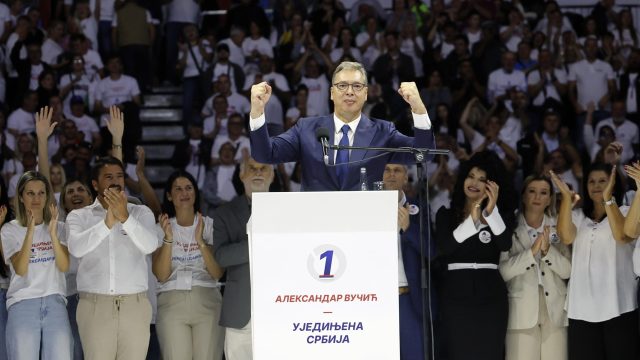
Caption: Janez Janša and part of his team in Ljubljana on 6 March. (Janša’s Facebook page)
Updated: March 19, 2026 - 12:21