Edit
New report tracks deepening far-right coordination in Europe and expanding authoritarian networks
On AfD, the study documents an expansion of Russia’s engagement beyond earlier financial support toward dialogue and recognition of the party as a potential governing force
A new data-backed report from the U.S.-based non-profit Action for Democracy finds that authoritarian-leaning parties in European democracies are increasingly coordinating ahead of potential gains in office, while the Russia-China axis and mid-tier regimes expand funding, media alignment, and practical support for like-minded forces worldwide.
The study, titled “The Authoritarian Collaboration Index: 2026 October Trends Report” and released on 27 October, draws on a live dataset built from more than 600 million articles, press releases, and other sources in over 100 languages. It updates trends from March through early October and accompanies the organisation’s earlier mapping of the global autocratic ecosystem. Action for Democracy has formalised a partnership with the Human Rights Foundation, linking its Authoritarian Collaboration Index to the latter’s Tyranny Tracker methodology. The findings were timed for a Foreign Press Association event in London.
The report highlights growing bilateral ties among European far-right parties as a means of mutual legitimisation. It notes the formalisation of relations between Nigel Farage’s Reform UK and Marine Le Pen’s National Rally, including a September 2026 memorandum on English Channel migrant crossings. The text affirms that neither party will allow international law, including the European Convention on Human Rights, to constrain sovereignty. Over six months, the relationship has served to present both as “governments-in-waiting,” with policy details often secondary to the validation conferred. Informal contacts continue within the Patriots grouping, though Reform and National Rally have remained reticent about formal links with Germany’s Alternative for Germany (AfD).
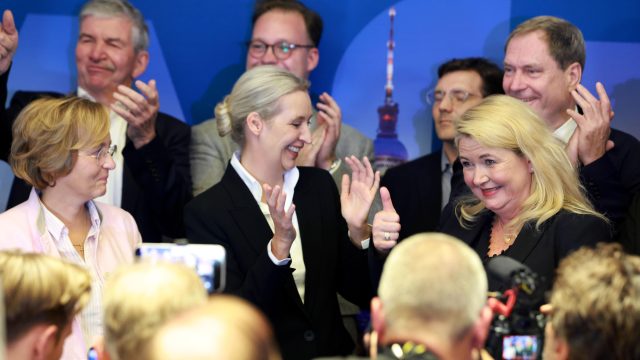
On AfD, the study documents an expansion of Russia’s engagement beyond earlier financial support toward dialogue and recognition of the party as a potential governing force. This includes a proposed Russia–Germany–US business forum for 2027, floated days after AfD secured 43.8 percent and 39 of 83 seats in the Saxony-Anhalt election on 6 September. Historic links dating to at least 2016 are placed in context, alongside past European examples of Russian-linked loans to parties such as National Rally.
Beyond Europe, the report describes Russia widening offers of regime security across Africa. In Madagascar, assistance has moved from equipment to training for presidential guards and special forces, with reports of private security for officials. In Mozambique, Russian supplies of weapons and training have targeted the northern insurgency. Reciprocal circuits of election observation that exclude established democratic bodies continue to be institutionalised.
Authoritarian practices previously associated primarily with China and Russia are now being adapted and exported by a wider circle of governments. Belarus and Nicaragua have converted admiration for Beijing’s party-state into formal party-to-party ties with the Chinese Communist Party. Gabon is cited as a reference for coup leaders seeking electoral cover, while San Salvador has begun offering its mega-prison model as technical assistance. Africa’s first research centre for Xi Jinping Thought is operating inside a party school. Mid-tier regimes run their own circuits, including Vietnam’s training programme for young leaders from ruling parties in Southeast Asia and the Kremlin-backed Sovintern event, which drew more than 100 groups from over 70 countries.
Media and technology cooperation has become more explicit. Building on earlier platforms such as TV BRICS and the Belt and Road Journalists Network, Russia and China have signed four new agreements in the period, including Chinese platforms carrying content from EU-sanctioned Russian outlets. Conferences with state-backed media from Africa and Southeast Asia have produced commitments to a synchronised “true narrative,” news-exchange deals, and training.
Global conflicts are described as accelerants. Iranian strikes in the Gulf in 2026 hastened military network-building, illustrated by the exchange of Saudi money for Pakistani soldiers and the formation of the Mecca Defence Alliance involving Turkey, Pakistan, and Saudi Arabia. Russia and North Korea have deepened one of the closest relationships in the network, adding physical infrastructure and a Russian pledge for a five-year military cooperation plan, alongside North Korean missile and personnel contributions to the war in Ukraine.
Domonkos D. Kovacs, project lead of the AuthCollab Index and Director for Advocacy at Action for Democracy, said the findings show China and Russia remain central while mid-tier regimes and parties including Reform UK, National Rally, and AfD increase their presence. “Although these actors have not yet formed a single bloc, their growing connections are creating channels through which authoritarian ideas, tactics and narratives can cross borders, gain legitimacy and reach new audiences,” he stated. He called for democratic actors to match the formalisation of previously tacit agreements by building expertise, exposing opaque political finance, and strengthening media and civil society.
The Index tracks more than 100,000 collaboration events from January 2024 onward across seven categories – financial, diplomatic and normative, network building, propaganda and messaging, military and technology, information sharing and learning, and transnational repression. It covers fully authoritarian regimes, hybrid regimes, and authoritarian-leaning parties inside democracies, classifying actors with reference to the Tyranny Tracker and related surveys. As of October 2026 it monitors 139 actors. The database is updated daily and is intended to make the architecture of cross-border authoritarian cooperation visible to researchers, journalists, and policymakers.
Caption: President of National Rally (RN) of France, Jordan Bardella (L) and Reform UK leader Nigel Farage (R) pose with a signed memorandum of understanding on their pledges to stopping small boat migration to the UK, during the second day of Reform UK Annual Conference at NEC in Birmingham, Britain, 4 September 2026. The party’s annual conference runs from 03 to 05 September to set out its policies with speeches from senior figures and focuses on building support ahead of the next general election. EPA/TOLGA AKMEN
Updated: October 27, 2026 - 14:22