Edit
Moscow threatens Armenia with EAEU suspension over EU aspirations, echoing 2013 Ukraine crisis
Leaders of the Russian-led Eurasian Economic Union (EAEU) urged Armenia to choose its future by referendum “as soon as possible”
The Russian-led Eurasian Economic Union (EAEU) has moved to pressure Armenia by considering its suspension later this year, citing risks to the bloc’s economic security from Yerevan’s pursuit of European Union membership – a stark reminder of Moscow’s playbook used against Ukraine over a decade ago.
Following a summit in Astana, Kazakhstan, leaders of Russia, Belarus, Kazakhstan, and Kyrgyzstan issued a joint statement urging Armenia to hold a popular referendum “as soon as possible” on whether to continue its path toward the EU or remain in the Moscow-dominated group. Armenian Prime Minister Nikol Pashinyan was notably absent from the meeting, citing his campaign for parliamentary elections scheduled for 7 June.
Russian President Vladimir Putin, speaking after the summit, said the EAEU would be forced to “scale back practically all our work with Armenia concerning integration processes in the economic sphere.” He added that while Russia and Armenia share a “special relationship,” the decision ultimately rests with the Armenian people.
Economic leverage and immediate risks
Suspension from the EAEU would deliver a severe blow to Armenia’s economy. Russia accounts for about 35% of Armenia’s foreign trade, and the country relies on Russian gas for 82% of its supplies. Moscow has already begun applying pressure, imposing temporary restrictions on agricultural imports and threatening cuts to cheap oil products and gas.
Pashinyan’s government has actively pursued closer ties with the West, including passing legislation last year to formally launch the EU accession process, while publicly criticising Moscow – particularly over its handling of security guarantees in the South Caucasus following Azerbaijan’s victories in Nagorno-Karabakh.
Echoes of Ukraine 2013: when pressure backfired
This latest episode closely mirrors events in Ukraine in late 2013. Then-President Viktor Yanukovych, facing intense Russian economic and political pressure – including threats of trade disruption and offers of large loans – abruptly suspended preparations to sign an EU Association Agreement. The decision triggered massive pro-European protests in Kyiv’s Maidan Nezalezhnosti square, which rapidly escalated into the Revolution of Dignity. Yanukovych fled to Russia in February 2014, paving the way for Russia’s annexation of Crimea and the start of the ongoing conflict in eastern Ukraine.
In both cases, Moscow has used membership in its preferred economic structures as leverage to block Western integration, framing the choice as binary and existential for the bloc. The EAEU leaders’ call for a referendum in Armenia explicitly includes the option of staying in the Russian-led group, echoing the zero-sum approach applied to Yanukovych.
Armenia’s crossroads ahead of elections
With elections just days away, polls show Pashinyan’s Civil Contract party leading with around 30% support, though pro-Russian opposition forces remain a significant factor. Armenia’s move westward has accelerated since 2020–2023, as Yerevan grew disillusioned with Russia’s role as a security partner in the region.
Analysts warn that while economic shocks from potential EAEU suspension could be painful in the short term – with GDP per capita already roughly half of Russia’s – a forced retreat from EU ambitions could spark domestic unrest similar to Ukraine’s Maidan. Pashinyan has so far signalled a desire to maintain cooperation with both blocs, but the EAEU ultimatum leaves little room for ambiguity.
Georgia’s stalled EU journey leaves Armenia as a “hole in the map”
The December review of Armenia’s membership will likely serve as another pressure point, testing whether Yerevan can withstand Moscow’s economic diplomacy without repeating Ukraine’s turbulent path.
With Reuters
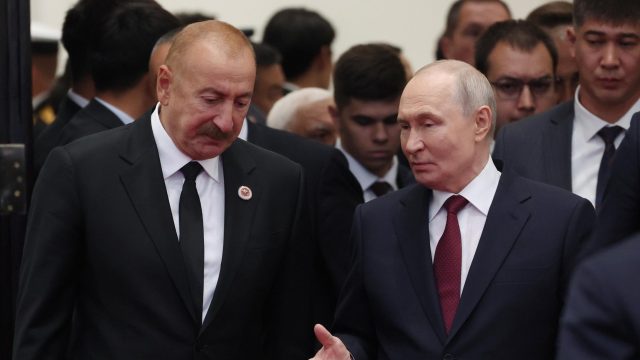
Caption: Russian President Vladimir Putin (C) and Armenian Prime Minister Nikol Pashinyan, (L) attend a meeting at the Kremlin in Moscow, Russia, 1 April 2026. EPA/PAVEL BEDNYAKOV/AP POOL
Updated: May 30, 2026 - 08:35