Edit
Interview: Albania targets 2027 to close all EU negotiation chapters
Foreign Minister Ferit Hoxha details Tirana’s rapid progress in negotiations, the remaining challenges in key sectors, strong public support for integration
In an exclusive interview with Focus Europe, Albania’s Minister for Europe and Foreign Affairs, Ferit Hoxha, expressed confidence that the technical phase of negotiations can be completed by the end of 2027. He highlighted the country’s strong preparation, full alignment with EU foreign policy, and deep public support for integration, while acknowledging that tougher work lies ahead in areas such as environment, agriculture, and transport.
Albania has emerged as one of the fastest-moving candidates for EU membership. Alongside Montenegro, it is now viewed in Brussels as a frontrunner in the Western Balkans. In just 13 months, Tirana opened all six negotiating clusters and 33 chapters – a remarkable acceleration under the EU’s revised 2020 methodology.
Hoxha, who lived through the turbulent post-communist transition as a student, recalled the youthful cry that defined Albania’s European aspiration: “We want Albania like the rest of Europe.” That goal, he said, has remained unchanged for 35 years.
“The destination was very clear and it has not changed since that time,” Hoxha told Focus Europe. “On 13 October 2024, Albania had opened 0 clusters, 0 chapters. By 17 November 2025, we had opened 6 clusters and 33 chapters. This is the magnitude of what we have done in 13 months.”
He described the rapid progress as a moment of national self-discovery, proving Albania’s capacity, maturity, and political resolve. As the first country negotiating under the new methodology, Tirana is now addressing interim benchmarks outlined in the European Commission’s recent report. While the process requires time, Hoxha insisted the 2027 target for closing all chapters is realistic.
“Not every chapter is equally difficult,” he explained. Albania is well advanced in areas such as science and technology, trade, and especially Chapter 31 on external relations, where its alignment with the EU’s common foreign and security policy is “exemplary.” Progress is also strong in several other chapters where screening showed the country is ready to move forward.
The more demanding files remain environment, agriculture, and transport, where the EU acquis is extensive. Hoxha stressed full transparency in negotiations: “Nobody fools anybody, nobody can really bypass anything.” In sectors needing extra time, Albania is prepared to discuss transitional periods — a normal part of every past accession.
Beyond technical talks, Hoxha emphasized Albania’s broader strategic value to the Union. The country has consistently acted as a responsible regional actor, promoting dialogue and innovative cooperation initiatives. It brings a tolerant, open society with strong interfaith harmony, a vibrant European identity, cultural heritage, and tourism potential.
“Joining the European Union is reconnecting with ourselves, with our identity, with our European identity,” Hoxha said. “Profoundly, in absolutely everything we feel Europeans, because we are Europeans.”
Public support remains exceptionally high. According to the Eurobarometer survey from early 2025, more than 90% of Albanians favour EU membership – a level few countries can match. The government actively communicates the process through dedicated outreach, particularly to students and young people, who will be the main beneficiaries. These dialogues focus not only on benefits but also on the responsibilities that come with EU citizenship.
On the international stage, Hoxha confirmed unconditional alignment: “There is no area that we are not aligned with the European Union.” This commitment holds even in difficult decisions and extends to active participation in EU missions. In the current volatile geopolitical climate, with Russia’s war against Ukraine underscoring the need for stability, Hoxha views enlargement as a strategic investment for a stronger Europe.
Cooperation with Italy was highlighted as a cornerstone of Albania’s European journey. Hoxha praised Italy’s long-standing role as a supporter, from Operation Alba in 1997 to today’s strategic partnership. On migration — a key European concern — Albania responded promptly to Italy’s request: “Italy calling, Albania responding.” The resulting protocol reflects mutual friendship and a shared commitment to European solutions.
Relations within the Western Balkans are equally constructive. Hoxha noted that all six countries of the region aspire to EU membership and expressed hope that Kosovo will soon gain candidate status. While Albania and Montenegro are often seen as frontrunners, Tirana focuses on domestic reforms rather than rankings. Close cooperation with Montenegro, including the exchange of experiences between negotiating teams, helps accelerate progress across the region without rivalry.
Hoxha concluded with a clear message of determination. Albania has demonstrated speed and seriousness in its EU path. With continued reforms and sustained public backing, the country aims to contribute meaningfully to the European project of peace, rights, and shared prosperity.
This accelerated timeline comes at a moment when enlargement has returned to the centre of EU debate. If Tirana meets its targets, Albania could significantly strengthen the Union’s presence in the Western Balkans and prove that the EU enlargement is still alive.
The full-size interview in Italian can be found here.
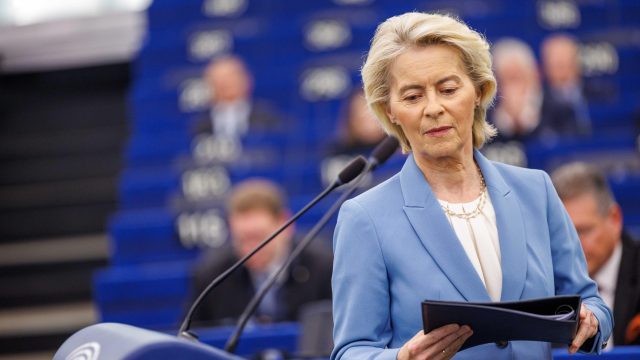
Caption: Ferit Hoxha in Brussels, 10 March 2026 [Council Newsroom]
Updated: April 7, 2026 - 17:32