 Edit
How the EU is squandering its critical raw materials: the Bulgarian case
Bureaucracy in Sofia and weak leadership from Brussels risk sidelining one of Europe’s most resource-rich member states
The passivity of European institutions, combined with the heavy administrative machinery of the Bulgarian government, is sidelining strategically important natural resources at a moment of intensifying global competition that the EU is already losing to the United States and China, an EUalive investigation finds.
Nearly two years after entering into force, the EU Critical Raw Materials Regulation, designed to reduce the bloc’s heavy dependence on key inputs needed for the green transition, semiconductors, batteries and other pillars of the 21st-century economy, has yet to mobilise either industry or national authorities.
Despite its ambition, the regulation does not impose concrete quantitative obligations on individual member states. The targets are collective: by 2030 the EU should achieve 10% extraction, 40% processing and 25% recycling of critical raw materials within the Union. There are no clearly defined national quotas, deadlines or responsibilities, creating the risk of another strategic failure driven by diffused accountability.
Had the regulation assigned country-specific tasks reflecting national resource potential, the results might have been significantly more effective than the current planning framework.
EUalive examined how the regulation operates in Bulgaria – a country with a traditionally strong mining sector and deposits of critical raw materials – where administrative inertia and Russian disinformation campaigns on social media are obstructing development.
Strong industry, poor regulation
The Balkan state ranks third in Europe in copper production, at roughly 100,000 tonnes annually, after Poland and Spain. Bulgaria is also among Europe’s major gold producers, with annual output of about 10 tonnes.
The country operates several gold mines and has potential for additional discoveries. It also hosts the third-largest tungsten reserves in Europe, the largest manganese deposit, and one of Europe’s largest lignite coal basins, whose seams also contain critical raw materials. Deposits of antimony, molybdenum and fluorite are also present.
At the same time, existing deposits are gradually being depleted and no new ones are being opened, while campaigns by pro-Russian parties block attempts to launch projects, openly lobbying for nationalisation of investors’ businesses.
Today, opening a mine in the EU and Bulgaria requires an estimated 15–17 years, due to bad organisation and heavy administrative procedures. The country however, lacks time, as many operating mines will close by 2040 – only 14 years from now.
“Bulgaria currently holds leading positions in the extraction of metals and industrial minerals, some of them critical and strategic for the EU. The country has significant processing capacity, including porcelain, glass, cement and other high value-added end products, but this potential is not unlimited. Operating deposits have a horizon to around 2040 and without new geological exploration and preparation of future projects Bulgaria’s role will gradually weaken,” said Ivan Mitev, executive director of the Bulgarian Mining and Geological Chamber, in comments to EUalive.
He criticises the EU regulation for blurring responsibilities and leaving implementation largely in the realm of good intentions, without a mechanism to measure national contributions.
Bulgaria starts from a favourable position not only in extraction but also in recycling: almost all steel production for various industrial sectors is based on recycled metals.
“Without a national framework that specifies the European targets, Bulgaria’s contribution remains more the result of the sector’s own efforts than of a clearly defined state policy,” Mitev said.
Investors say the government shows willingness for dialogue but lacks national targets, long-term vision and new exploration programmes.
“The geological information on which the assessment of these resources is based was mainly collected in the 1970s and 1980s. Under the current data conditions, the potential cannot be adequately assessed against today’s technological, economic and environmental requirements,” the chamber head added.
According to him, heavy bureaucracy is not only a Bulgarian problem but an EU-wide one. He points to a recent European Court of Auditors report identifying lengthy and fragmented permitting procedures and lack of coordination as key obstacles to raw-materials projects in the EU.
EU vulnerable to critical raw materials shock despite flagship law, auditors warn
Industry representatives argue that two-year timelines for exploration and the start of production are not utopian, demonstrating that Europe could quickly reduce resource dependencies if political will existed.
“In 1931 copper mineralisation was discovered in the Sredna Gora region and by 1936 extraction had already begun. In the post-war period, within 17 years, around 60 underground mines were opened and developed in Bulgaria, three metallurgical plants were built and numerous flotation facilities established,” Mitev noted.
Another obstacle is insufficient European financial instruments for projects related to critical and strategic raw materials. There are no direct funding mechanisms specifically targeting mining, particularly at the early and riskiest stages of exploration.
Bulgaria absent from the EU strategic raw materials map
So far, the European Commission has selected 47 strategic projects to secure access to critical raw materials within the EU. None are located in Bulgaria, despite the country’s potential.
“The absence of Bulgarian projects signals that the country is not actively participating in this process. Meanwhile, new mining decisions domestically are concentrated mainly in inert materials. These are important for construction but not in the focus of European policies on strategic and critical raw materials,” Mitev said.
As a result, the Bulgarian economy is losing revenue, since critical raw materials generate significantly higher added value.
A European Commission spokesperson told EUalive that a new selection round is under way, with more than 160 project applications submitted.
“For confidentiality reasons we cannot disclose the location of the proposals,” the spokesperson said.
The Commission also highlighted a key issue indicating limited engagement by Bulgarian authorities. The regulation requires each member state to designate a single contact point to facilitate permitting procedures with Brussels. Two years after adoption, Bulgaria has still not appointed one, according to the Commission.
Government says it is working…
The Bulgarian Ministry of Energy told EUalive it is drafting a new National Industrial Strategy for the extractive sector focusing on mining and critical and strategic raw materials, expected to be adopted this year.
The government is currently concentrating on a project assessing the potential extraction of critical raw materials from lignite coal at the state-owned Maritsa East mining complex, developed in cooperation with the University of North Dakota in the United States.
“The university supports mapping of the mines in the complex for rare earth element content in lignite coal. Based on samples already sent to the US, expectations about their presence are optimistic,” the ministry said.
Asked how Bulgaria intends to meet the EU’s 2030 quantitative targets, the reply illustrated the diffusion of responsibility within the European strategy: Sofia does not regard the 10% extraction, 40% processing and 25% recycling targets as national obligations.
“These targets apply at Union level, not to each country individually,” the ministry responded.
At the same time, the government acknowledges the benefits of critical raw materials extraction, though without pursuing targeted policy measures. The sector already accounts for roughly 5% of Bulgaria’s GDP and provides higher-than-average wages to about 150,000 workers, in addition to concession revenue from resource extraction.
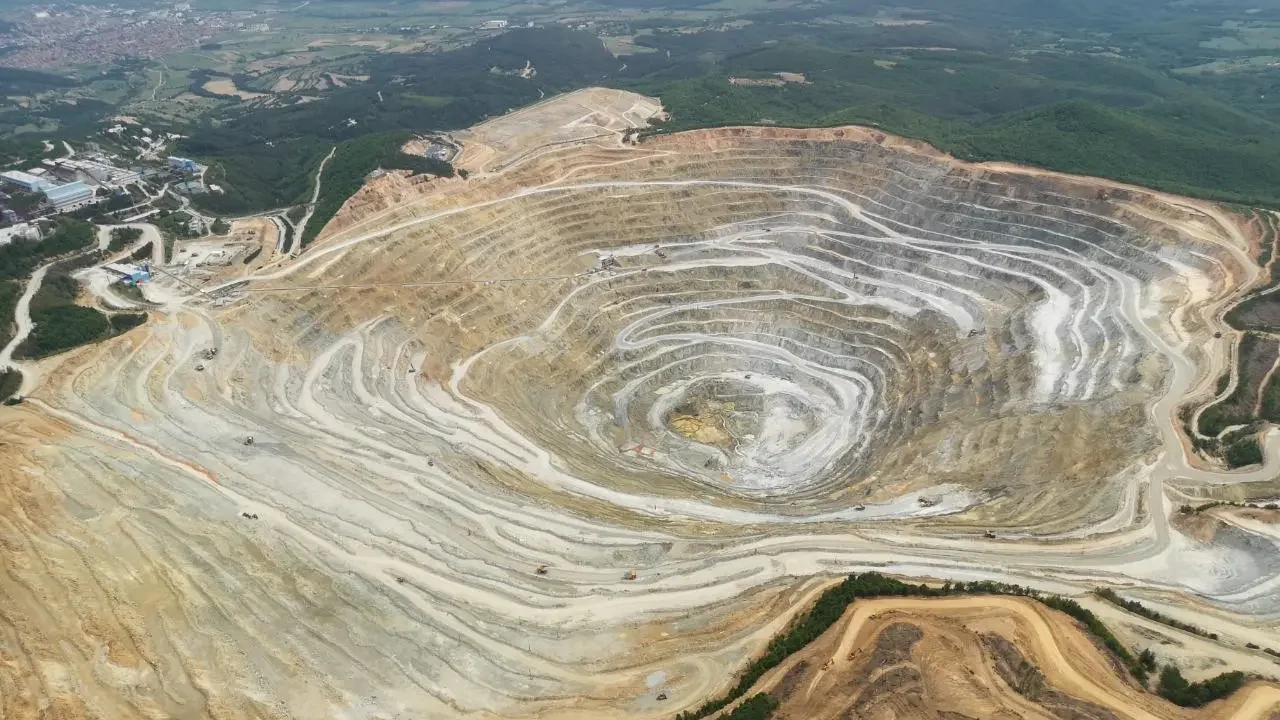
Caption: The open-pit copper mine of the Bulgarian company Assarel Medet in the mountainous region of Sredna Gora
Updated: February 16, 2026 - 13:27


