Edit
Europe’s migrant population hits record, exposing gap between political rhetoric and reality
Rising long-term migration contrasts with falling asylum claims, shifting debate from crisis management to structural change
The number of immigrants living in the European Union has reached a record high, underlining a structural transformation that is increasingly at odds with the bloc’s political discourse on migration.
According to a report by the Centro per la Ricerca e l’Analisi sulle Migrazioni, a research centre focused on migration trends, drawing on data from European and international organisations, the number of foreign-born residents in the EU stood at 64.2 million in 2025. This marks a sharp increase from around 40 million in 2010, meaning immigrants now account for roughly 14% of the EU’s population.
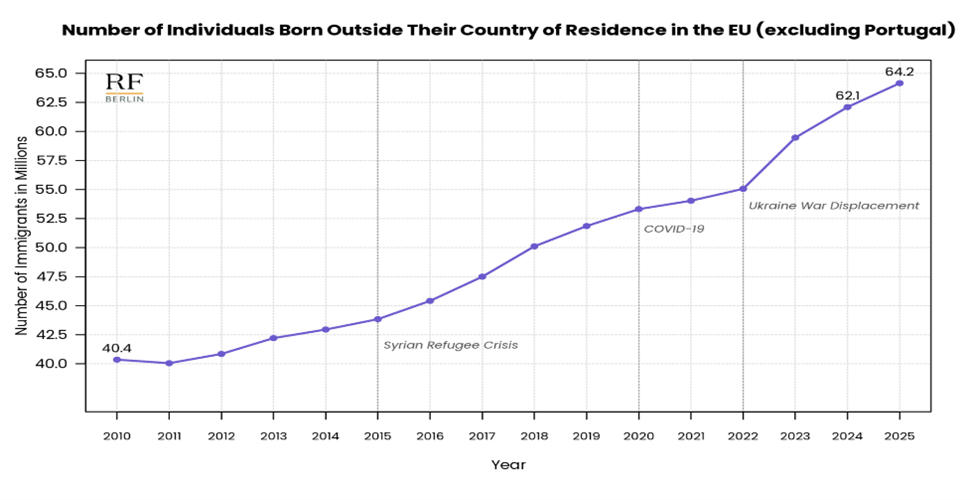
The figures suggest that migration is no longer a temporary or emergency-driven phenomenon, but rather a long-term demographic shift. With an estimated average annual increase of 2.1 million people, the trend shows no signs of reversing.
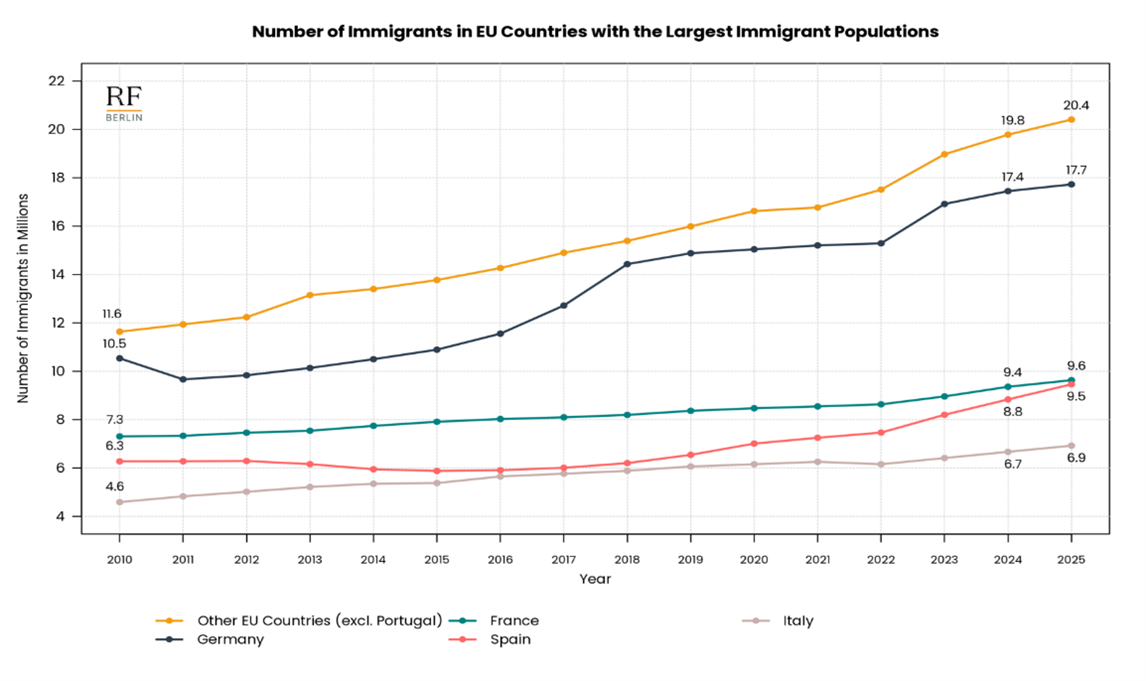
Germany remains the country with the largest foreign-born population, with nearly 18 million residents born abroad, representing 21.2% of its population. Spain has also seen a sharp increase, with an additional 700,000 foreign-born residents recorded in just one year. Meanwhile, Luxembourg, Malta and Cyprus have the highest shares relative to their population size, while France and Italy have experienced slower growth.
Yet the most striking development lies elsewhere. While the number of immigrants continues to rise, asylum applications across the EU have dropped significantly. In 2025, asylum claims fell by 26.6% compared to the previous year.
This divergence points to a fundamental shift in migration dynamics. Growth is no longer driven primarily by humanitarian crises or irregular arrivals, but by more stable, long-term factors such as family reunification, labour mobility and the retention of migrants who choose to settle permanently.
A structural transformation, not a temporary crisis
These trends challenge the dominant narrative in much of Europe’s political debate, which continues to frame migration largely as a crisis requiring containment.
In reality, the data suggests that migration has become an integral and enduring feature of European societies. Around three-quarters of the foreign-born population in the EU is of working age, contributing to key sectors of the economy and addressing labour shortages in areas ranging from healthcare and logistics to construction and agriculture.
Despite this, political discourse in several member states continues to treat migration as a temporary disruption rather than a structural reality. Calls for restrictive policies and, in some cases, for reversing migration flows run counter to demographic and economic trends that indicate continued growth and integration.
The gap between rhetoric and reality highlights a broader paradox within the EU. While societies are becoming increasingly diverse and interconnected, policy responses remain heavily focused on border control, deterrence and return mechanisms.
Over the past decade, the centre of gravity in EU migration policy has shifted towards security-driven approaches. Measures aimed at strengthening external borders, outsourcing migration management and accelerating returns have taken precedence over earlier efforts to promote integration and inclusion.
This shift is reflected in the EU’s recent policy framework, including the migration and asylum pact, which prioritises management, control and selection of arrivals. However, critics argue that such an approach risks overlooking the internal dimension of migration—namely, the millions of people already living and working within EU societies.
From integration to containment
Earlier EU initiatives placed greater emphasis on integration. In 2005, then European Commissioner Franco Frattini launched the Common Agenda for Integration, focusing on access to rights, education, employment and social inclusion.
Although limited in scope and largely dependent on national implementation, the initiative addressed a central question: how to build cohesive societies in the context of increasing diversity.
Today, that question has largely been replaced by a different one – how to prevent further arrivals. The political focus has shifted from inclusion to exclusion, reflecting growing concerns about security, identity and social cohesion.
However, the scale of the current migrant population suggests that such a narrow focus may be insufficient. With over 64 million foreign-born residents, migration is no longer a marginal issue but a defining feature of contemporary Europe.
Migrants are present across all sectors of society, from public services and education to business and academia. Treating migration primarily as a matter of public order risks ignoring its broader social and economic implications.
A policy crossroads for the EU
The EU now faces a strategic choice. It can continue to prioritise defensive, security-oriented policies that aim to limit and control migration flows, or it can adopt a more comprehensive approach that recognises migration as a structural component of European society.
Revisiting an integration agenda would not necessarily represent a shift towards idealism, but rather a response grounded in demographic and economic realities. Policies focused on education, labour market access, urban development and anti-discrimination measures could play a central role in shaping more cohesive societies.
At the same time, acknowledging the complexity of migration does not mean ignoring the challenges it presents. Social tensions, inequalities and governance gaps remain real and require targeted policy responses.
However, the data suggests that the key challenge for Europe is not whether migration should be addressed, but how it should be managed in the long term.
As migration continues to reshape European societies, the need for policies aligned with this reality is becoming increasingly urgent. The figures offer a clear message: migration is not a passing phase, but a lasting transformation, one that will continue to define the EU in the decades ahead.
The author Luca Jahier is former president of the European Economic and Social Committee. The original article in Italian was published by EUalive’s partner Focus Europe.
Caption: Local police officers remove immigrants who had been living in a square in Badalona, Barcelona, Spain, 19 December 2025. Around fifty migrants spent two nights outdoors after being evicted from an abandoned building on 17 December, with nowhere else to go. EPA/ALEJANDRO GARCIA
Updated: April 25, 2026 - 07:26