Edit
European Parliament attempts to cut off MEPs’ informal relations with Russian colleagues
This comes against the backdrop of leaked attempts at dialogue between senior politicians in Brussels and Russian President Vladimir Putin
In an official letter, European Parliament President Roberta Metsola has referred the matter to the Advisory Committee on the Conduct of Members of the European Parliament over MEPs who signed the declaration from the St. Petersburg conference on 4 June.
In April, at the end of the plenary session in Strasbourg, MEP Fernand Kartheiser (non-attached, from the Alternative Democratic Reform Party, a conservative and mildly populist political party in Luxembourg) sent an email to all his colleagues and assistants mentioning a “constructive and very successful meeting” in Istanbul involving MEPs and representatives of the Russian State Duma, despite a full ban on such formats. He politely invited interested MEPs to participate in the subsequent Economic Forum in St. Petersburg (SPIEF) in June and even offered assistance with organising travel if needed.
MEPs’ informal meetings with Russian officials spark fresh concerns in Brussels
This is not Kartheiser’s first attempt to warm relations with Russian politicians, or as he describes it – “strengthening dialogue between Europe and Russia, especially regarding Ukraine and sanctions.” Last year, he was expelled from the European Conservatives and Reformists (ECR) group after his participation in the Moscow Economic Forum in 2025. According to Brussels edition of Politico, Kartheiser worked as a double agent for the CIA in the 1980s.The European Parliament’s spokespersons told Capital at the time that any parliamentary-level dialogue, as well as access to European institutions for official Russian parliamentarians, had been completely halted following Russia’s full-scale invasion of Ukraine in February 2022. Kartheiser also responded to Capital’ inquiry, stating that he had no right to invite anyone to the forum and was doing so on his own initiative without official authorization.
“I cover all expenses with personal funds and would not like to mention the colleagues with whom we participate in these meetings, so that they do not face negative consequences,” the MEP added.
The European Parliament decides to act on its own
A month and a half after the event, European Parliament President Roberta Metsola appears to have decided to take action. In an official letter, she referred the case to the Advisory Committee on the Conduct of Members and attached the so-called St. Petersburg Declaration of 4 June, signed by MEP Fernand Kartheiser (note: name also appears as Fernan Kartkhayzer / F. Kartzaizer in the original).
In the letter, seen by Capital, Metsola emphasizes that the declaration could create a false impression of the existence of an unofficial communication channel between the EP and the State Duma of the Russian Federation in the form of “parliamentary diplomacy.” This seriously distorts the institution’s official position, which has repeatedly condemned Russian aggression against Ukraine and officially terminated cooperation with the State Duma.
“There is also an explicit decision of the Bureau that this position should not be circumvented through individual meetings in any format with Russian representatives subject to EU restrictive measures,” Metsola writes.
Since the declaration indicates that other MEPs may have participated in the meetings besides Kartheiser, she insists on revealing their identities and checking whether they complied with the rules to formally declare their contacts with the European Parliament.
The plot thickens
In an angry letter to his colleagues (which Capital has also obtained), Kartheiser reacts to President Metsola’s referral. He explains that he is outraged to learn from the media about such actions by the EP leadership. He calls it “strange and worrying” to be contacted by the press for comment before he had even seen the letter himself. He received a copy only 12 hours after the first call from a journalist, and via an “informal channel.”
Kartheiser expresses bewilderment as to why the European Parliament is only now “discovering” this activity and initiating proceedings against him, given that he has been openly and transparently conducting informal dialogue with Russian parliamentarians since May 2025 (over a year). He finds the EP leadership’s reaction surprising, especially since “the EU Council is currently openly discussing the resumption of dialogue with Russia at the governmental level (although they have not yet agreed on a representative and mandate).” He emphasizes that the St. Petersburg Declaration he signed simply supports exactly this development in the Council.
According to him, there is no alternative to dialogue for addressing current challenges, and at some point the EP will also have to resume official dialogue with Russian institutions.
“The situation in which the EU is the only major international actor without relations with the Russian Federation is, in his view, unsustainable and unproductive. Adopting endless resolutions condemning Russia at every plenary session is no substitute for active diplomacy aimed at conflict resolution,” Kartheiser believes. He also points to the Council’s attempts to open diplomatic channels for communication.
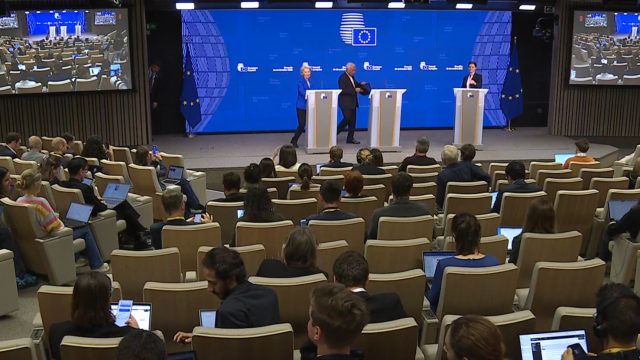
The topic was also raised at the leaders’ meeting in Brussels at the end of last week, specifically regarding the renewal of dialogue with Russia by a member of the cabinet of European Council President António Costa, which became a source of sharp disagreements among member states. The Netherlands, Poland, and the Baltic states were among the strongest opponents, despite official calls from Ukrainian President Zelenskyy for EU participation as a party in peace negotiations with Russia – especially in light of the U.S. withdrawal from these efforts.
“What my office did was establish a diplomatic channel. We cannot rely solely on other participants to interpret Russian messages; we must also be able to convey our own messages directly to Russia,” Costa commented after the Council meeting. However, the position around which member states rallied is that the European Union is not a mediator. “The EU stands with Ukraine,” the President of the European Council nevertheless stressed. And, he added, “unfortunately it is clear that we do not have a reliable signal that Russia wants to engage in real negotiations.”
This whole story in no way exonerates the Luxembourgish MEP with Kremlin contacts, as he tries to present it. Rules apply to everyone in an institution, and if he and other colleagues have exceeded their powers, the European Parliament must know what is happening in its own backyard and take measures if the situation requires it.
The original article in Bulgarian by Capital.bg can be found here.
Caption: Participants watch Russian President Vladimir Putin’s speech on a TV screen during the 29th St. Petersburg International Economic Forum (SPIEF) in St. Petersburg, Russia, 5 June 2026. The 29th St.Petersburg International Economic Forum ran from 3 to 6 June 2026, gathering sveral Western representatives described by critics as “useful idiots”. EPA/ANATOLY MALTSEV
Updated: June 24, 2026 - 05:47