Edit
EU-Western Balkans Summit highlights stalled Serbia-Kosovo normalization amid Vučić’s boycott
The absence of Serbian representatives meant Belgrade was unable to oppose the summit's joint declaration
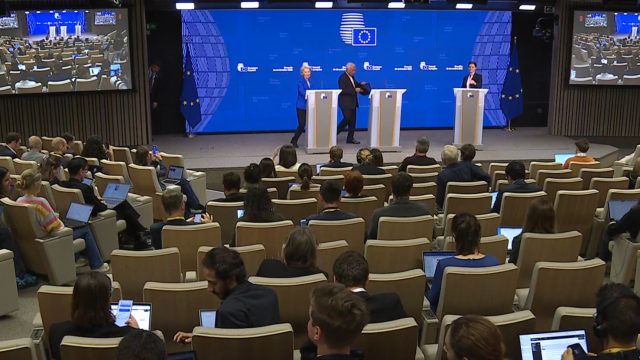
Leaders from the European Union and the Western Balkans gathered in Brussels on Tuesday evening for a high-level summit, reaffirming their commitment to enlargement but underscoring the persistent roadblocks posed by unresolved tensions between Serbia and Kosovo, in a meeting notably snubbed by Serbian President Aleksandar Vučić.
The absence of Serbian representatives meant Belgrade was unable to oppose the summit’s joint declaration, which emphasized that “the lack of normalization of relations between Pristina and Belgrade continues to slow down both partners on their European path.”
The document, adopted by the EU and other Balkan partners, called for the full implementation of all agreements reached in the EU-mediated dialogue, particularly the 2023 Agreement on the Path to Normalization and its Ohrid Annex.
Vučić’s decision to boycott the summit—marking the first time he has skipped such an event—stems from mounting frustrations with the EU’s accession process for Serbia.
Serbia snubs EU-Western Balkans summit amid stalled reforms and backlash over collapsed Kushner deal
In statements to Serbian media, Vučić cited the need to protect national interests, amid stalled negotiations where the EU has refused to open new clusters in Serbia’s membership talks, including Cluster 3 on competitiveness and growth.
Analysts also point to broader grievances, such as EU criticism of Serbia’s democratic backsliding, its close ties with Russia – highlighted by Vučić’s planned attendance at a Moscow event in May – and backlash over the recent collapse of a controversial real estate deal involving Jared Kushner’s firm in Belgrade, which was derailed by corruption charges.
“We will continue on the EU path,” Vučić told RTS, but emphasized that Serbia would not be “blamed” for compromises it deems unfair.
The declaration, released by the European Council, reiterated the EU’s “full and unequivocal commitment” to Western Balkans membership, framing enlargement as a “geostrategic investment” in peace and stability amid Russia’s war in Ukraine and global challenges.
Leaders stressed that Balkan countries must accelerate reforms, uphold European values like freedom of expression, independent media, gender equality, and minority rights, while fostering regional cooperation and reconciliation.
Support under the €6 billion Western Balkans Reform and Growth Facility – aimed at boosting socio-economic convergence – was explicitly tied to “measurable progress” in rule of law, democratic reforms, and, crucially for Serbia and Kosovo, normalization of relations.
The EU welcomed steps toward Single Market integration and enhanced connectivity in energy, transport, and digital sectors, pledging continued aid for energy diversification to reduce dependencies on Russia.
The summit also expressed “unwavering support” for Ukraine, praising Balkan nations aligned with the EU’s Common Foreign and Security Policy and urging others – implicitly including Serbia – to join.
Migration management, anti-corruption efforts, and combating organized crime and terrorism were highlighted as shared priorities.
Despite the positive rhetoric, Vučić’s boycott underscores deepening rifts. Serbia’s EU accession has been frozen since 2022, with no new chapters opened due to concerns over media freedom, judicial independence, and alignment with EU foreign policy – particularly on Russia sanctions, where Serbia has diverged.
Kosovo, meanwhile, has made strides, including visa liberalization in 2024, but remains hindered by the normalisation impasse and domestic divisions.
EU officials, including High Representative Kaja Kallas, lamented Serbia’s absence but stressed that the door remains open for constructive engagement.
The next EU-Western Balkans Summit is slated for Montenegro in June 2026, offering another chance for dialogue.
Montenegro has solidified its position as the frontrunner among Western Balkans candidates for EU membership, with the European Commission recommending in its November 2025 enlargement report that negotiations be advanced to the final stage.
In a significant milestone on 18 December, EU leaders at the Brussels summit will endorse the Commission’s proposal to initiate drafting of Montenegro’s accession treaty – the first such step for any candidate since Croatia in 2011 – paving the way for potential membership by the end of the decade if reforms continue apace.
The original article by Beta agency in Serbian can be found here. Edited by g.g.
Caption: Council President Antonio Costa at the Western Balkans Summit in Brussels on 17 December 2025. [Concil newsroom]
Updated: December 18, 2025 - 07:36