Edit
EU loses patience with Serbia, presses for clear stance on Russia
EU Commissioner for Enlargement said that 60% of Serbia's trade is with the EU, compared to just 1.5% or less with Russia.
The European Union is pressing Serbia to align its foreign policy with the eurobloc, particularly on Russia, as a prerequisite for accession, while the European Commission’s latest enlargement report warns that the country’s reform momentum has slowed sharply.
EU Commissioner for enlargement Marta Kos, responding to a BGNES reporter’s question if Belgrade’s ties with Moscow threaten Western Balkan security, stated: “We expect from Serbia a clear geopolitical position, especially at a time when Russia is killing people in Ukraine.”
The comments were made on 4 November, immediately following the European Commission’s presentation of its annual enlargement reports.
Kos, who hails from the region, acknowledged Serbia’s historical connections to Russia but stressed its status as a candidate country. She highlighted the need for alignment in foreign and security policy, noting that Serbia lags far behind others: four Western Balkan nations achieve 100% alignment with EU positions, Ukraine 99%, Moldova 98%, and Serbia only 61%.
“Serbia will have to decide,” she said, pointing out that 60% of Serbia’s trade is with the EU, compared to just 1.5% or less with Russia.
President Aleksandar Vučić maintains that Serbia adheres to “military neutrality” while expressing readiness for cooperation with European partners.
The European Commission’s annual Enlargement package, adopted on 4 November, underscores that Serbia’s reform pace has slowed significantly. Brussels urges Belgrade to accelerate changes, fully align with EU foreign and defence policies, and abandon anti-European rhetoric.
The report criticizes Serbia for not imposing sanctions on Russia, and also for granting citizenship to Russian nationals – posing potential security risks, and facing growing domestic challenges.
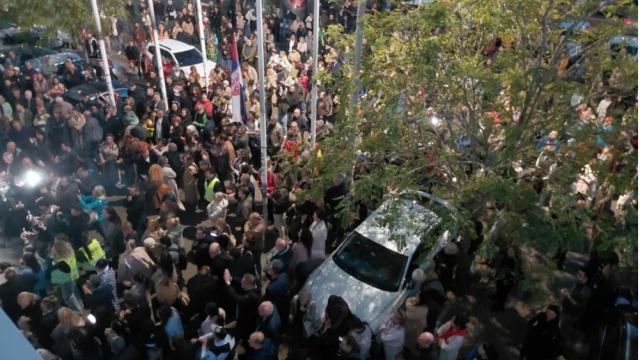
Polarization in Serbian society has deepened since mass protests erupted in November 2024, triggered by the collapse of the concrete canopy of the railway station in Novi Sad, which claimed 16 lives. Fueled by widespread anger over corruption, impunity, opaque governance, excessive police brutality against demonstrators, and mounting pressure on civil society, these unrests have shattered trust between stakeholders, stalled the EU accession process, and curtailed freedoms of expression and assembly. Judicial independence continues to be undermined by political interference.
According to the report, civil society organizations face mounting obstacles, including verbal attacks and smear campaigns from high-level officials, spyware complaints targeting human rights defenders and journalists, rising strategic lawsuits against public participation (SLAPPs), expulsions of foreign representatives (some from EU member states), and police searches of CSO offices in February 2025 at the Special Anti-Corruption Department’s request. No judicial proceedings followed these searches, widely seen as intimidation. Government-CSO cooperation is strained, with room for greater transparency in public funding.
In foreign policy, Serbia’s alignment improved slightly through retroactive endorsements of some EU decisions condemning Russia, yet high-level bilateral contacts with Moscow intensified – including Vučić’s presence at the 9 May military parade. More broadly, anti-Western narratives persist at all levels. Belgrade has not joined EU sanctions against Russia’s aggression in Ukraine.
Serbia’s new Free Trade Agreement with China, effective 1 July 2024, also raises strategic concerns.
On the economic front, Serbia maintains a good level of preparation for a functioning market economy but advanced little. Growth was robust in 2024 yet slowed sharply in early 2025, with widening external imbalances. The budget deficit undershot targets, inflation returned to the central bank’s band under tight monetary policy, the banking sector stayed stable, and labor conditions improved.
However, fiscal rule applications were delayed, public wage reforms stalled, state aid often bends to political pressures for state-owned enterprises and major investors, and SOEs dominate key sectors. Bureaucratic hurdles, rule-of-law weaknesses, and a sudden 20% price cap on goods from 1 September for six months risk market distortions despite anti-inflation aims.
The report reaffirms enlargement as a top EU priority, with accession increasingly feasible through merit-based progress. Candidates like Montenegro, Albania and Moldova, appear as frontrunners, while Serbia, North Macedonia and Bosnia and Herzegovina are clearly lagging behind.
Meanwhile, European Parliament rapporteur for Serbia Tonino Picula criticized the Commission’s longstanding leniency toward Vučić’s government.
“The European Commission’s attitude… has been too lenient for too long,” he told N1 TV, urging Brussels to adopt a firmer stance.
Picula warned that delaying resolution of Serbia’s “unofficial state of emergency” risks escalating unrest, citing ignored signs of autocracy, corruption, institutional erosion, and rejection of core EU values.
Once backed by figures like former German Chancellor Angela Merkel, Vučić’s administration now faces calls for change, with Picula hoping the latest report signals a tougher approach – “taking off the gloves, or at least one glove.”
Sources: BGNES, European Commission annual Enlargement package
EU urges North Macedonia to deliver on constitutional changes and step up rule of law reforms
Caption: Kaja Kallas, high representative for foreign affairs and security policy and Marta Kos, commissioner for enlargement, present 2025 Enlargement Package on 4 November in Brussels. European Commission
Updated: November 5, 2025 - 11:51