 Edit
EU leaders push for breakthrough on Ukraine funding via frozen Russian assets as summit drags on
Poland’s PM Donald Tusk made it clear that the alternative idea of European borrowing lacked support
EU leaders made tentative progress on Thursday toward financing Ukraine’s defence and reconstruction in 2026-2027 by tapping profits from frozen Russian central bank assets, Polish Prime Minister Donald Tusk said, amid marathon talks that could spill into Friday.
The summit, originally scheduled to wrap up Thursday evening, shows no signs of concluding soon, with European Commission President Ursula von der Leyen telling reporters earlier: “We will stay here as long as it takes to adopt a decision on how to support Ukraine financially.”
Diplomats indicated technical discussions on legal safeguards could extend overnight, reflecting deep divisions over risk-sharing.
Tusk, emerging during a break, confirmed a consensus shift away from joint EU borrowing toward a reparations-style loan backed by the €210 billion in immobilised Russian sovereign assets – mostly held at Belgium’s Euroclear depository.
“We are certainly after a breakthrough,” he said. “Everybody agrees that it is worth trying and that the use of Russian assets for Ukraine would be justified and good for Europe.”
However, he cautioned that holdouts – primarily Belgium, fearing Russian legal retaliation, and others seeking ironclad protections – would “fight until the end to maximise guarantees.”
“This declaration that we all want to use Russian assets for Ukraine was made and I don’t think anybody is going to go back on it,” Tusk added.
The emerging plan focuses on extraordinary profits generated by the frozen assets (estimated at €15-20 billion annually), potentially unlocking up to €165-180 billion in loans for Kyiv’s military and rebuilding needs. Tusk dismissed alternatives like tapping the EU budget’s “headroom” or common borrowing, noting lack of enthusiasm in key capitals.
“We will rather be looking at the reparations loan on the basis of Russian assets and… provide guarantees for countries most at risk, like Belgium.”
Tusk made it clear that the alternative idea of European borrowing lacked support.
“The use of the so-called headroom in the EU budget does not inspire enthusiasm in key EU countries, so I would not see hope for plans to use European money for this,” he said.
Ukrainian President Volodymyr Zelenskyy, who met bilaterally with several leaders including von der Leyen and French President Emmanuel Macron, held a brief press conference afterward but offered no fresh details.
“We discussed support – military, financial, political,” he said, reiterating Kyiv’s urgency amid battlefield pressures and winter energy strains. Sources close to the talks said Zelenskyy pressed for rapid disbursement but acknowledged the EU’s internal hurdles.
Belgium’s concerns loom large: As host to Euroclear, it risks lawsuits or countermeasures from Moscow if assets are seized outright. Prime Minister Bart De Wever has demanded robust legal shields, including EU-wide indemnity. Hungary’s Viktor Orbán, a frequent holdout on Ukraine-related decisions, remained sceptical on Thursday, reportedly describing the frozen assets plan as a “dead end” lacking majority support – potentially complicating the search for consensus despite the emerging preference for asset-based financing over joint borrowing.
The push aligns with G7 efforts to leverage immobilised assets without full confiscation, following a June 2024 agreement to use profits for a $50 billion loan. Thursday’s momentum builds on last week’s political accord to indefinitely extend the freeze, overcoming Hungarian and Slovak objections.
With the Trump administration signalling a faster push for peace and potential reduction in U.S. financial aid – amid uncertainty over Putin’s willingness to end the war – the EU faces growing pressure to bridge the funding gap as the conflict will enter its fifth year.
As talks continued late into the evening, farmers’ protests over the separate EU-Mercosur trade deal added external noise outside the European Council building. Inside, leaders grappled with the finer points of risk allocation, with a potential overnight extension increasingly likely.
With Reuters.
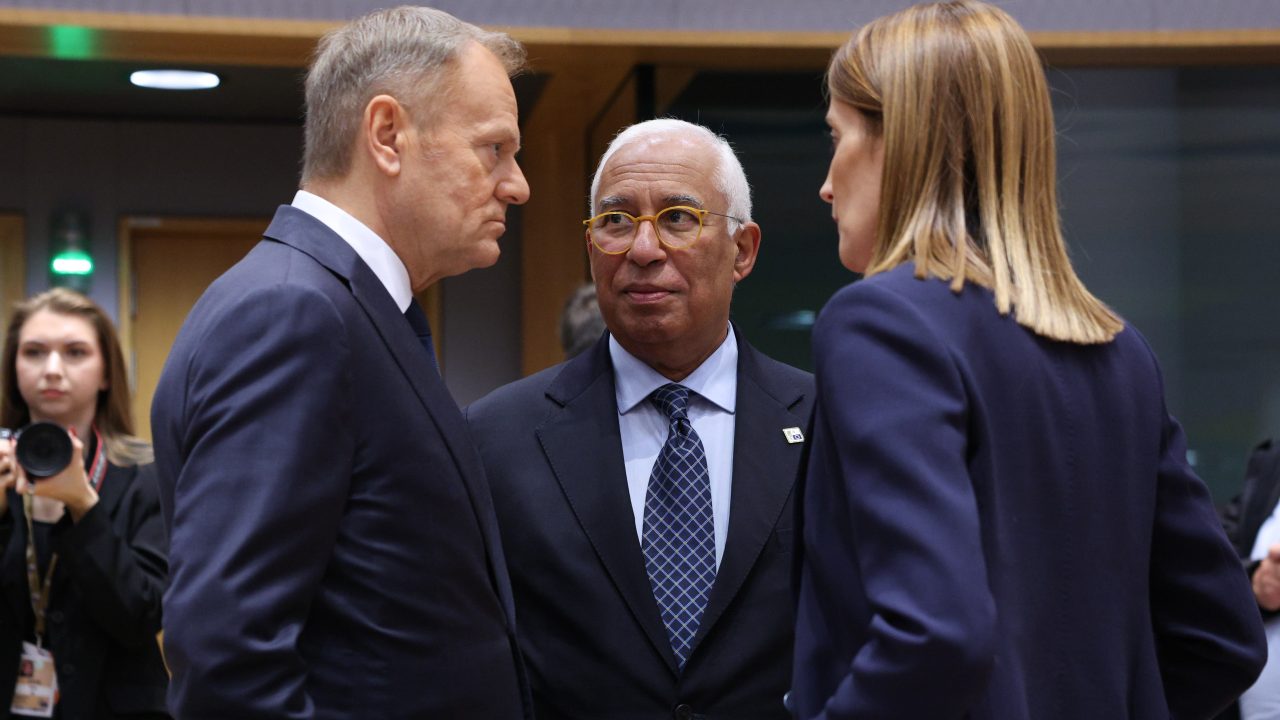
Caption: From left to right: Polish PM Donald Tusk, President of the European Council António Costa, European Parliament President Roberta Metsola, at the EU summit on 19 December 2025.
Updated: December 18, 2025 - 16:28


