Edit
Draghi advocates for pragmatic federalism: coalitions of willing EU states to counter global threats
Draghi's advocacy comes at a critical juncture, as EU leaders prepare for an informal retreat on 12 February at Alden Biesen Castle in Belgium
In a landscape of escalating geopolitical tensions and economic uncertainties, former European Central Bank President Mario Draghi has emerged as a vocal proponent for a more integrated European Union, emphasising “pragmatic federalism” built on coalitions of willing member states driven by shared strategic interests rather than ideological unity.
This call, highlighted in a recent Financial Times opinion piece and reinforced in Draghi’s 2 February speech at KU Leuven University in Belgium, underscores the urgency for Europe to evolve from a loose confederation into a genuine federation to avoid subordination, division, and deindustrialization amid pressures from powers like the United States and China.
Draghi’s vision, articulated in his KU Leuven address where he was awarded an honorary doctorate, paints a stark picture of a “defunct” post-World War II global order – one characterized by the erosion of rule-based international norms, U.S.-led security guarantees, and open economic systems.
“It’s dead,” Draghi bluntly stated, warning that without deeper integration, Europe risks being “picked off” state by state through tariffs, supply chain dominance (such as China’s control over rare earths and batteries), and fragmented policies that external actors can exploit.
He contrasted Europe’s successes in federated areas – like trade, the single market, competition policy, and monetary union – where the bloc negotiates as a unified power, with its failures in confederated domains such as defence and foreign policy, where vetoes and national interests hinder collective action.
This pragmatic approach rejects a “federal Big Bang” or grand institutional overhaul, which Draghi acknowledges lacks the political conditions today.
Instead, it favours opt-in coalitions among willing countries in strategic sectors: tech leaders harmonizing regulations to scale firms rapidly, defence powerhouses pooling R&D and procurement, or industrial giants co-investing in semiconductors and energy grids to cut costs.
As Draghi noted in an October 2025 speech referenced in the FT, this model draws from the euro’s success as a federated system, enabling Europe to “act decisively in all circumstances” without forcing uniform participation.
Draghi’s enduring influence on EU policy
Mario Draghi, often dubbed “Super Mario” for his pivotal role in stabilizing the eurozone during the 2010s debt crisis, has long been a architect of European economic resilience. As ECB president from 2011 to 2019, his famous 2012 pledge to do “whatever it takes” to preserve the euro averted a potential collapse, injecting trillions in liquidity and bond-buying programs.
Later, as Italy’s prime minister from 2021 to 2022, he steered the country through pandemic recovery with reforms tied to EU funds.
In September 2024, Draghi authored a landmark report on European competitiveness commissioned by the European Commission, advocating for €800 billion in annual investments to close gaps in innovation, energy, and defence – equivalent to the Marshall Plan’s scale relative to GDP.
The report, which influenced the EU’s “Competitiveness Compass,” warned of Europe’s “slow agony” without bold action, a theme echoed in his recent interventions.
Amid the second Trump administration’s emphasis on U.S. interests – potentially through tariffs and reduced NATO commitments – Draghi’s message resonates with EU leaders grappling with transatlantic strains and the need for strategic autonomy.
The FT opinion piece by Martin Sandbu, published November 16, 2025, amplifies Draghi’s October speech in Oviedo, Spain, positioning coalitions of the willing as a path to “ever closer union” without alienating sceptics.
Sandbu cites examples like the stalled EU-Mercosur trade deal, arguing that variable geometry – where subsets of states advance integration – could bypass vetoes, much like military aid coalitions for Ukraine.
Upcoming address to EU leaders
Draghi’s advocacy comes at a critical juncture, as EU heads of state and government prepare for an informal retreat on 12 February at Alden Biesen Castle in Belgium, convened by European Council President António Costa.
The agenda focuses on bolstering the single market, reducing dependencies, and enhancing competitiveness, drawing directly on Draghi’s and Enrico Letta’s reports.
Draghi is scheduled to exchange views with leaders at 11:00 a.m., offering a platform to elaborate on his federalism doctrine amid discussions on transatlantic relations and internal reforms.
This retreat follows an emergency meeting on 22 January, addressing U.S.-EU tensions, and aims to foster candid exchanges ahead of formal spring summits.
With FT and agencies.
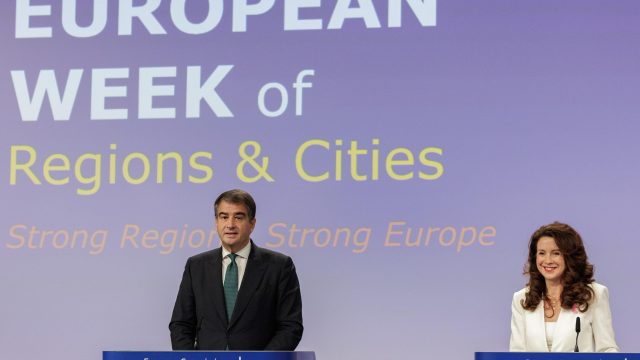
Caption: On 16 September 2025, Ursula von der Leyen, President of the European Commission, hosted the conference titled ‘One Year After the Draghi Report’ at the Charlemagne building in Brussels, Belgium. [Europe by Satellite]
Updated: February 9, 2026 - 10:00