 Edit
Double standards in German conservatism: Spahn’s surrogacy decision turns into catastrophe
The timing of the scandal in which the politician decided to become father through surrogacy un the U.S. could hardly be worse for Merz and the CDU
In a dramatic turn that has shaken Germany’s governing coalition, Jens Spahn, the influential centre-right politician and former health minister, resigned on Saturday as leader of the Christian Democratic Union’s (CDU) parliamentary group.
The resignation stems from intense backlash over his decision to become a father through surrogacy in the United States, a practice he had publicly criticised in the past and one that his party continues to fiercely oppose. At 46, Spahn had been a powerful voice on the CDU’s right wing, known for his hardline stance on immigration and his survival through previous controversies. Yet this personal milestone proved incompatible with the expectations of his political role.
The announcement of Spahn’s resignation came just days after he and his husband, Daniel Funke, revealed the birth of their son, Georg. Speaking to the tabloid Bild, Spahn described the child as “our greatest joy,” a feeling “almost impossible to put into words.” The couple, married since 2017, turned to a surrogate mother in the U.S. because surrogacy remains strictly banned in Germany under the 1990 Embryo Protection Act. Violations can result in up to three years in prison or hefty fines for those involved in arrangements domestically. While raising a child born abroad via surrogacy is not illegal, the act itself clashes directly with the CDU’s ethical and legal position.
A longstanding stance undermined by personal circumstances
Spahn’s past statements made the revelation particularly damaging. In 2015, he wrote that “as a gay man and a Christian I find it personally very hard to warm to the idea of a rented womb.” As health minister in 2020, he rejected calls from the liberal Free Democrats to relax the ban, citing concerns over children’s identity and potential exploitation. As recently as February of this year, the CDU reaffirmed its opposition at a party conference, passing a resolution against both commercial and altruistic surrogacy to prevent abuse and health risks. Spahn was present at that meeting, even as the surrogate carrying his child was already several months pregnant.
This apparent contradiction ignited swift and fierce criticism from across the political spectrum. Within his own party, figures like Daniel Peters, CDU leader in Mecklenburg-Western Pomerania, declared Spahn “no longer tenable” as parliamentary group leader. Peters argued it was “completely unacceptable” for a senior politician to vote for strict rules while circumventing them privately. Marion Rosin of the CDU’s Women’s Union in Thuringia echoed this, telling the BBC that politicians who set standards must live by them, or risk losing all credibility. Even opposition voices weighed in. Janosch Dahmen of the Greens stressed that the issue was not the child but double standards: politicians advocating rules must explain why those rules do not apply to them.
Spahn initially tried to defend his choice, admitting he had wrestled internally with the surrogacy question. In his resignation statement, however, he acknowledged the growing tension. “In recent days, I have come to realise that my personal happiness in starting a family with my husband and becoming a father is incompatible with my political office,” he wrote. He also reflected on the “increasing relentlessness in public discourse,” urging a more human tone in politics despite firm policy positions. Chancellor Friedrich Merz, Spahn’s ally and leader of the CDU, accepted the resignation as “right and inevitable,” posting on X that “credibility is the most valuable asset in politics.” Merz indicated the move could open the door for a broader government reshuffle.
Political ramifications in a turbulent landscape
The timing of the scandal could hardly be worse for Merz and the CDU. Germany faces sluggish economic growth, with forecasts for 2026 downgraded to just 0.5 percent and 2027 to 0.9 percent. The government is preparing a package of tax cuts, pension reforms, greater labour market flexibility, and anti-dumping measures to combat weak performance and global pressures. At the same time, the far-right Alternative for Germany (AfD) continues to gain ground, polling above 40 percent in some eastern states. In Saxony-Anhalt, there is even talk of the AfD potentially securing an outright majority, a historic first for a far-right party in a German state since World War II.
Analysts suggest the controversy plays directly into narratives pushed by populist opponents, who accuse the establishment of elitism and hypocrisy. Journalist Christian Wölfel, writing for Bavarian broadcaster BR24, noted that Spahn’s actions confirm the story that fringe groups use to win votes: powerful politicians flouting rules denied to ordinary citizens. Others speculate that Merz may privately welcome the departure, as Spahn had openly harboured ambitions for higher office and posed a potential internal challenge.
Spahn’s exit is not the end of his political career, but it marks a significant blow. He has weathered past storms, including controversies over overpriced COVID-19 protective equipment purchases during his time as health minister. Yet the surrogacy issue cut to the heart of credibility and consistency – values central to conservative politics. His interim replacement is expected to be Alexander Hoffmann of the Christian Social Union (CSU), who expressed respect for Spahn’s decision.
The episode highlights deeper tensions in Germany and across Europe over surrogacy. While countries like France, Spain, and Italy also maintain bans, legal recognition of children born abroad varies. France’s top court recently ruled in favour of recognising such children, while Italy under Giorgia Meloni’s government criminalised travel for surrogacy in 2024. In Germany, the debate touches on ethics, family rights, identity, and the limits of personal freedom versus collective norms.
For the CDU, the resignation underscores the challenges of maintaining moral authority in a coalition government amid rising populism and economic strain. Merz has framed it as an opportunity for renewal, but the party must now navigate questions of trust and unity heading into key regional elections this autumn.
Sources: Bild, ZDF, Deutsche Welle, BBC
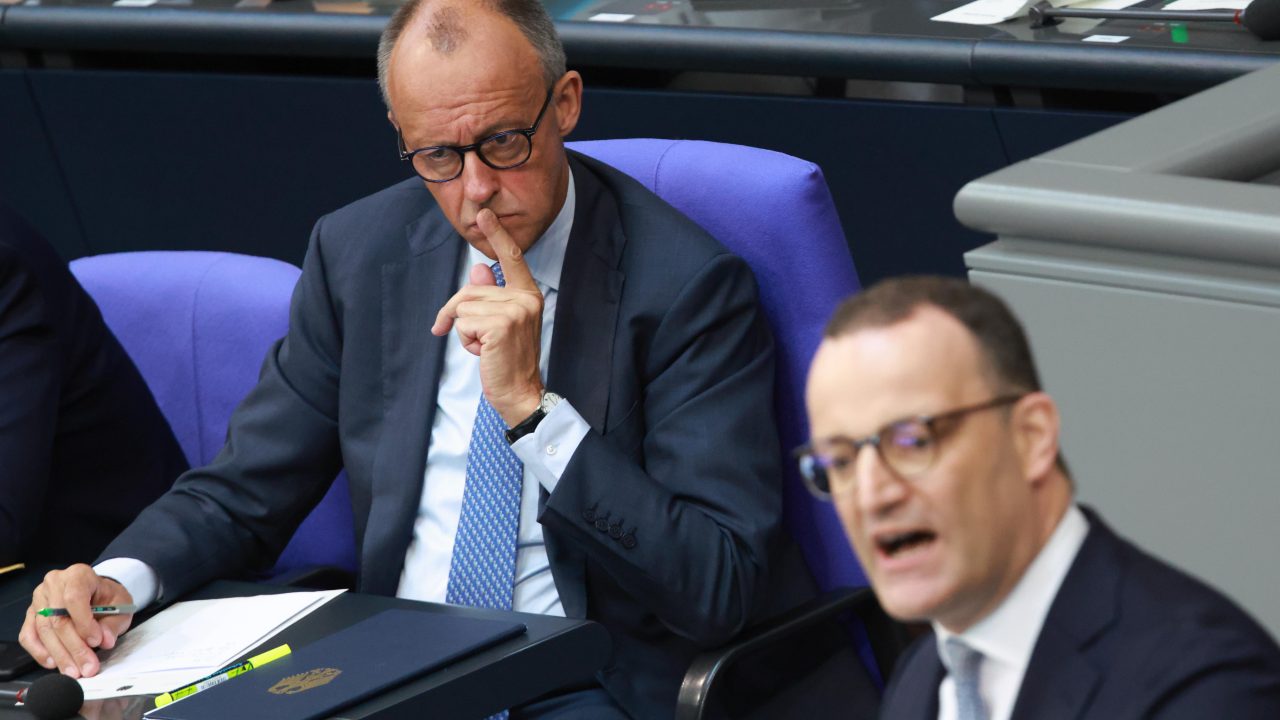
Caption: German Chancellor Friedrich Merz (L) looks on as Christian Democratic Union (CDU) parliamentary group chairman in the German parliament, Jens Spahn, speaks at the German parliament ‘Bundestag’ in Berlin, Germany, 11 June 2026. German Chancellor Friedrich Merz delivered a government statement on the upcoming European Council meeting. EPA/CLEMENS BILAN
Updated: July 20, 2026 - 10:28