Edit
Dodik’s diplomatic gamble: leveraging Putin and Trump to secure his political survival
Bosnia’s Republika Srpska faces deepening crisis with early election and referendum defiance
Bosnia and Herzegovina’s autonomous Republika Srpska (RS) is plunging into one of its most severe political crises since the 1995 Dayton Peace Accords, as the region’s Central Election Commission (CEC) announced on Thursday (28 August), an early presidential election scheduled for 23 November, despite fierce opposition from pro-Russian Serb nationalist leader Milorad Dodik and the RS parliament.
The election aims to resolve a standoff following the CEC’s decision to strip Dodik of his presidency after a court sentenced him to one year in prison and banned him from political activity for six years for defying rulings by the international High Representative, Christian Schmidt, and Bosnia’s Constitutional Court. Dodik, a dominant figure in RS politics since 2006, has rejected the verdict, vowing to remain in office with the backing of Bosnian Serb lawmakers, escalating tensions in a country still scarred by the 1992–95 war that killed approximately 100,000 people and displaced 2 million.
The crisis intensified when Dodik, leveraging his Alliance of Independent Social Democrats (SNSD), orchestrated a late-night vote on 23 August in the RS National Assembly to hold a referendum on 25 October, challenging the legitimacy of Schmidt’s authority, the court’s verdict, and the CEC’s mandate termination.
The referendum question, presented by SNSD’s Srdjan Mazalica, asks residents if they support Schmidt as the “unelected foreigner” overseeing the Dayton Accords and the rulings against Dodik. Despite securing 50 of 83 votes, the referendum lacks legal binding force under RS law, as it addresses issues outside the entity’s jurisdiction, and was opposed by key opposition parties, including the Party of Democratic Progress and Serb Democratic Party. Dodik framed the referendum as a “serious warm-up” for a future vote on RS independence, a provocative stance that risks destabilizing Bosnia’s fragile multi-ethnic framework established by the Dayton Accords, which divides the country into the Serb-majority RS and the Bosniak-Croat Federation.
Dodik’s defiance extends beyond domestic politics, as he announced plans to travel to Moscow in September and October 2025 to lobby Russian leaders, including President Vladimir Putin, for support in RS’s quest for independence and to veto the EU’s ALTHEA military mission in Bosnia, which he calls an “occupation factor.”
In an interview with Sputnik, Dodik stated, “I will ask our Russian friends to clarify this situation and support our desire to hold a referendum and gain independence,” signalling his intent to leverage Russia’s UN Security Council veto power. This aligns with his broader rejection of Western oversight, particularly Schmidt’s “Bonn powers,” which grant the High Representative authority to enforce Dayton provisions. Dodik’s rhetoric, comparing Schmidt to “Hitler in the pubs,” underscores his confrontational approach, while his claim that “Muslims want to eliminate him from politics” fuels ethnic tensions, further straining Bosnia’s unity.
Parallel to his Moscow outreach, Dodik has intensified lobbying in the United States, bolstered by the Heritage Foundation, a conservative think tank influential in Trump’s administration. A July 2025 report by the Foundation, authored by former USAID official Max Primorac, criticized the Office of the High Representative (OHR) as an “obstacle to nation-building” and called for ending its Bonn powers, aligning with Dodik’s narrative.
Lobbyists like Rod Blagojevich, former governor of Illinois, convicted of corruption and subsequently pardoned by Trump, and Mark Zell, vice chairman of Republicans Overseas, are working to lift U.S. sanctions imposed on Dodik in 2017 and 2022 for undermining Dayton. Dodik claimed a two-hour discussion with Trump’s envoy Richard Grenell to optimize cooperation with the U.S., asserting that “Bosnia is an illusion built by Trump’s opponents.” These efforts highlight RS’s strategic pivot to counter Western pressure, though the Heritage report notably omits mention of sanctions relief, a key RS goal.
The international community has responded with alarm. The EU delegation in Bosnia condemned the 25 October referendum as a violation of the rule of law, stating, “Subjecting a court decision to a public vote runs counter to the independence of judicial authorities.” Britain’s ambassador, Julian Reilly, labelled it “illegal,” urging RS to respect Bosnia’s sovereignty and constitutional order.
The CEC’s decision to hold the 23 November election, adopted by a 5-2 vote, faced legal debates over candidate eligibility, with concerns that restricting the presidency to Serb candidates could undermine democratic pluralism. CEC chair Irena Hadziabdic noted unresolved legal ambiguities, referencing similar issues in 2007, while the election budget is set at 6 million BAM.
Dodik’s refusal to step down, coupled with his call to boycott the election as “impossible and useless,” risks further escalation. His government reshuffle, including Prime Minister Radovan Viskovic’s resignation and the nomination of Savo Minic, aims to consolidate SNSD’s grip on RS. The crisis, one of the gravest since the Dayton Accords, threatens to unravel Bosnia’s fragile peace, with Dodik’s separatist rhetoric and international lobbying challenging the EU, U.S., and UN’s ability to enforce the 1995 framework.
Additional sources: Reuters, Balkan Insight, edited by g.g.
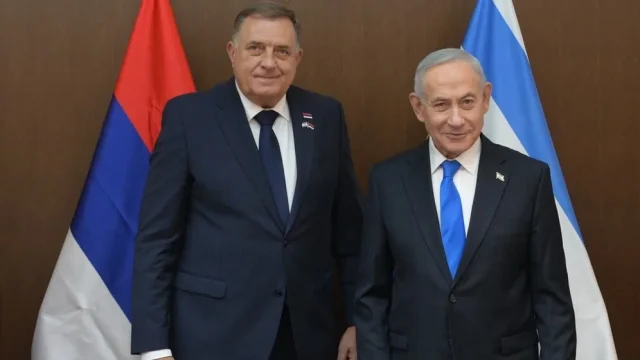
Caption: Disputed President of Republika Srpska Milorad Dodik attends the international basketball friendly match between Serbia and Slovenia in Belgrade, Serbia, 21 August 2025. EPA/ANDREJ CUKIC
Updated: August 29, 2025 - 06:19