 Edit
Did Trump recently prevent a Serbia-Kosovo war? Or did Kosovo’s President make a blunder?
The Kosovo President claimed on 10 July that Trump's statement refered to the "last weeks", and not events during his first term
Richard Grenell, the former U.S. Presidential Envoy for Special Missions, publicly criticised on Sunday (13 July) Kosovo President Vjosa Osmani for manipulating statements made by US President Donald Trump regarding Kosovo-Serbia relations.
During Donald Trump’s first term (2017–2021), Richard Grenell served as the U.S. Ambassador to Germany (2018–2020), Acting Director of National Intelligence (2020), and Special Presidential Envoy for Serbia and Kosovo Peace Negotiations (2019–2021). Currently, as of July 14, 2025, Grenell is the Presidential Envoy for Special Missions, a role he was appointed to by President-elect Trump on December 14, 2024, tasked with addressing global hotspots such as Venezuela, North Korea, and tensions in the Balkans.
Last June, Trump claimed on Truth Social that during his first term, he prevented a war between Serbia and Kosovo, asserting, “Serbia and Kosovo were clashing heavily, as they had been for decades, and this long-standing conflict threatened to turn into war. I stopped it”.
Osmani claimed on 10 July that Trump’s statement refered to the “last weeks”, and not events during his first term.
“He (Trump) is very clear in his statement that he is talking about the last few weeks,” Osmani said, emphasising that it is not about the events of 2023 or 2020, but “about the events that are very, very recent.”
In a post on X, Grenell accused Osmani of manipulating Trump’s words and claimed she should be “ashamed” for suggesting Trump prevented a fresh escalation between Serbia and Kosovo.
Osmani’s narrative has been contested also by Serbian officials, who argue it lacks evidence and misrepresents historical efforts, such as the Wasington Agreement,
The 2020 Washington Agreement, signed by Kosovo and Serbia, focused on economic normalization between the two countries. It included commitments to develop infrastructure, diversify energy supplies, and mutually recognise professional certificates and diplomas. The agreement was signed in Washington D.C. on 4 September 2020, with the aim of fostering cooperation and reducing tensions.
Grenell emphasised Trump’s role in the 2020 Washington Agreement, and noted that Trump was nominated for the Nobel Peace Prize for these efforts in 2019 and 2020, stressing that Osmani was not involved in the agreement.
“To pretend there was something new is absurd,” Grenell stated, sharing a photo quoting Osmani’s claim that she had “credible information” about Trump’s recent intervention.
In November 2019, Grenell was appointed by Trump as the special envoy for negotiations between Kosovo and Serbia, and he has been closely involved in this process.
In response, Osmani announced she would address the accusations in a press conference upon returning to Kosovo from her US visit.
Serbian President Aleksandar Vučić and Foreign Minister Marko Djurić accused Osmani of fabricating claims against Serbia. Djurić, in a social media post, stated, “Manipulations and fabrications seem to be the only way for Pristina to attract attention in Washington today,” reaffirming Serbia’s commitment to peace and cooperation with the US.
Trump’s recent remarks on Truth Social and at a White House press conference in June have fueled the controversy. He claimed that during his first term, Kosovo and Serbia were “on the brink of a serious conflict,” which he had prevented, and reiterated that he recently “stopped the war in the region.” However, Trump provided no specific details about the timing or nature of these events, leading to confusion.
KFOR, NATO’s peacekeeping force in Kosovo, neither confirmed nor denied Trump’s claims, stating only that their “commitment to the stability of the region remains unchanged.” NATO Secretary General Mark Rutte, during a recent summit in The Hague, emphasized the Alliance’s ongoing engagement in the Western Balkans, including discussions with leaders from Kosovo and Bosnia.
The escalation of the situation in northern Kosovo culminated in September 2023 when an armed group of Serbs, led by Milan Radoićić, former vice-president of the Serbian List, attacked the Kosovo Police in the village of Banjska and killed a police sergeant.
Kosovo’s ongoing political deadlock
Amid these diplomatic tensions, Kosovo faces a deepening internal political crisis. The Kosovo Assembly has failed to constitute itself for the 46th time, with Sunday’s session unable to form a committee for electing the Assembly President. The next attempt is scheduled for Tuesday at 11:00, but expectations for a breakthrough remain low.
Kosovo in constitutional crisis after 43 failed attempts to elect a Parliament Speaker
Hekuran Murati, an MP from the ruling Vetëvendosje party, defended their candidate, Albulena Haxhiu, for Assembly President, claiming unanimous support from the governing coalition (Vetëvendosje, Guxo, and Alternativa). He accused the opposition of “violating the Constitution” by boycotting the process. In contrast, opposition figures like Arbëreshë Krasniqi (NISMA) expressed concern over the deadlock, noting that party leader Fatmir Limaj would meet acting Prime Minister Albin Kurti to seek a resolution.
Opposition criticism has intensified. Armend Zemaj (LDK) described the Parliament as a “mirror of a deep political crisis,” accusing Vetëvendosje of undermining democracy and seeking unchecked power. Jahir Demaku (PDK) claimed Kurti’s government avoids parliamentary oversight, contributing to “increased poverty and corruption.” Time Kadrijaj (AAK) argued that Vetëvendosje has abandoned the parliamentary chamber to evade accountability.
The latest session saw heightened tensions when session chair Avni Dehari barred opposition MPs Përparim Gruda (PDK), Zemaj, and Kadrijaj from speaking, sparking disputes over procedural fairness. With only 43 of 82 present deputies voting, the session failed to achieve results, reflecting the ongoing paralysis.
Kosovo’s political and diplomatic challenges are intertwined, with external disputes over Trump’s statements compounding internal governance issues. The unresolved parliamentary deadlock raises the specter of early elections if political forces cannot find common ground.
Edited by ak. and g.g.
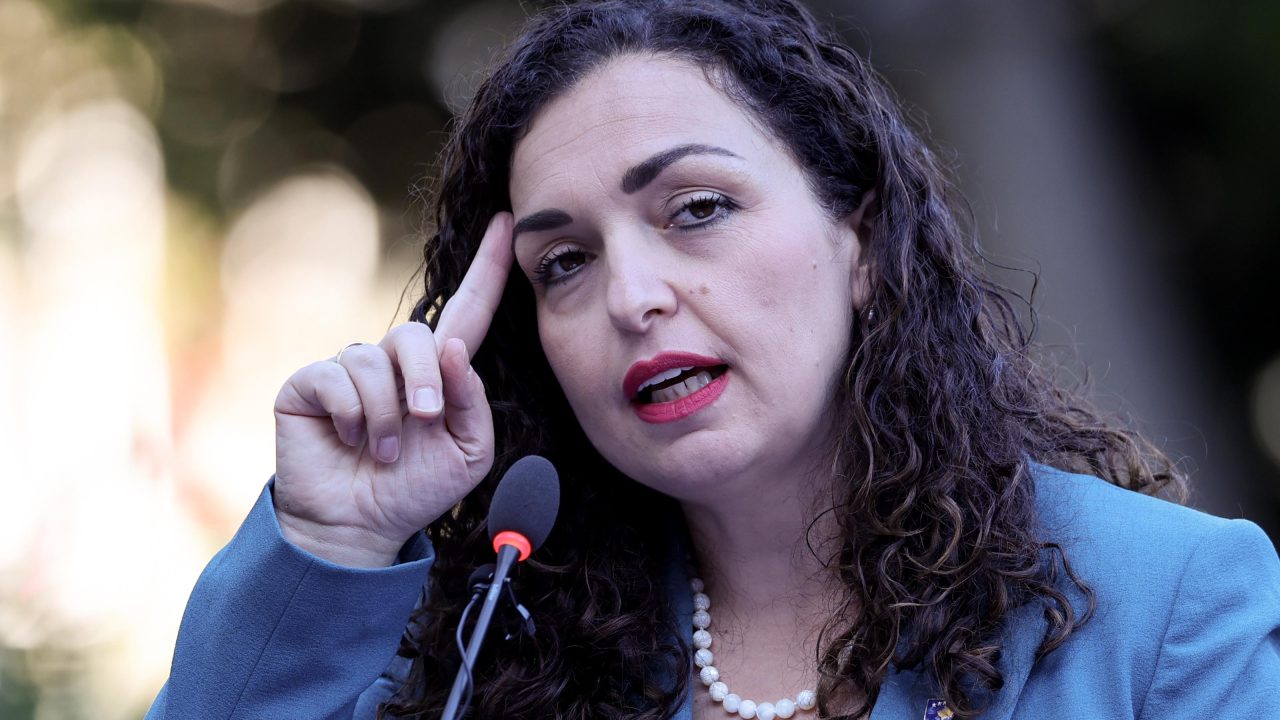
Caption: President of Kosovo Vjosa Osmani speaks during the joint press conference with the European Council President Antonio Costa in Pristina, Kosovo, 14 May 2025. EPA/GEORGI LICOVSKI
Updated: July 14, 2025 - 12:12