Edit
Czech President vs. Prime Minister: constitutional crisis erupts over NATO summit
The dispute centers on Andrej Babiš’s decision to exclude Petr Pavel from the Czech delegation to the upcoming summit in Ankara
In a dramatic escalation of long-simmering tensions, Czech President Petr Pavel has filed a competency lawsuit against the government led by Prime Minister Andrej Babiš.
The dispute centers on Babiš’s decision to exclude the president from the Czech delegation to the upcoming NATO summit in Ankara, Turkey, on 7 and 8 July. This legal action, lodged with the Constitutional Court, seeks clarity on the respective powers of the head of state and the executive in representing the country abroad. The court is expected to address the matter promptly, highlighting deep divisions at the highest levels of Czech politics.
The conflict underscores broader questions about the separation of powers in the Czech Republic’s constitutional framework. Pavel, a former high-ranking NATO official and steadfast advocate for strong alliance commitments, argues that the exclusion represents an unprecedented infringement on his constitutional role. In a video statement, he emphasized that the issue extends far beyond a single seat at an international meeting. It concerns the fundamental principle of preventing arbitrary restrictions on the powers of constitutional bodies.
A history of rivalry and divergent visions
The roots of this confrontation run deep. Pavel and Babiš faced off in the 2023 presidential election, with the former general securing victory. Babiš, a populist billionaire leading the ANO party, returned to power in late 2025 at the head of a coalition including Eurosceptic partners. Their political styles and priorities have often clashed, particularly on foreign policy and defence.
Pavel has consistently supported robust aid to Ukraine and full adherence to NATO obligations. In contrast, Babiš’s government has pursued a more cautious fiscal approach, reducing emphasis on military spending increases. The prime minister has justified the delegation composition as “purely practical,” noting that the government must defend its positions on defense budgets during the summit. Only the prime minister, along with the foreign and defence ministers, will attend, according to official announcements.
This is not the first time representation at NATO summits has sparked debate. Pavel pointed out that his predecessors, including Miloš Zeman, participated regularly. He himself has attended every NATO meeting since taking office in 2023. During Babiš’s earlier term, there was less friction with Zeman, partly due to closer political alignment. Observers note that ideological differences with Pavel, combined with the current summit’s focus on sensitive issues like spending targets, have intensified the standoff.
The defence spending debate fueling the fire
At the heart of the discord lies NATO’s evolving defence spending expectations. The alliance has long targeted 2% of GDP for defence, a goal most members met in recent years. However, Babiš has acknowledged that the Czech Republic will likely miss this benchmark again in 2026, citing inherited budget deficits from the previous administration of Petr Fiala. He has pledged efforts to reach the target from 2027 onward while prioritizing fiscal consolidation.
The Ankara summit will also address ambitious longer-term goals agreed at the 2025 Hague Summit, aiming for significantly higher combined defence and security-related investments by 2035. U.S. officials, including those in the current administration, have pressed allies to shoulder more of the burden, signaling a shift away from perceived subsidization of European defence.
For Pavel, a veteran with decades in the armed forces and experience chairing NATO’s Military Committee, these matters carry profound strategic weight. He warned when signing the budget that current military allocations fall short of addressing real threats and alliance commitments. His willingness to attend informal elements of the summit, while allowing the government to lead formal discussions, reflects an openness to compromise, yet he insists on upholding institutional norms.
Babiš has responded measuredly, stating he respects the president’s right to pursue legal action but views it as unhelpful for inter-institutional relations. “It is not appropriate for constitutional representatives to sue each other,” he remarked on social media. The prime minister maintains the decision stems from practical governance needs rather than personal exclusion.
Implications for Czech democracy and international standing
This lawsuit arrives at a delicate moment for the Czech Republic. As a key NATO member, its internal divisions risk projecting instability to allies at a time of heightened global security challenges. The dispute could set important precedents regarding presidential involvement in foreign policy, potentially influencing future governments and heads of state.
Pavel has stressed that failing to defend these competencies could open the door to further erosions of constitutional roles. He has also expressed concern that prolonged public conflicts erode public trust and allied confidence. For his part, Babiš’s coalition appears focused on domestic priorities, including budget discipline, even as it navigates alliance pressures.
The Constitutional Court’s ruling may not only resolve the immediate question of summit participation but also illuminate the contours of executive power in a parliamentary republic with a directly elected president. Analysts suggest the outcome could shape the dynamics of Czech politics heading into future elections, including Pavel’s potential re-election bid.
As the Ankara summit approaches, the Czech delegation’s composition and messaging will be closely watched. Whether the legal proceedings yield a swift resolution or extend the public spectacle remains uncertain.
Sources: FocusEurope.pl, Radio Prague, Reuters
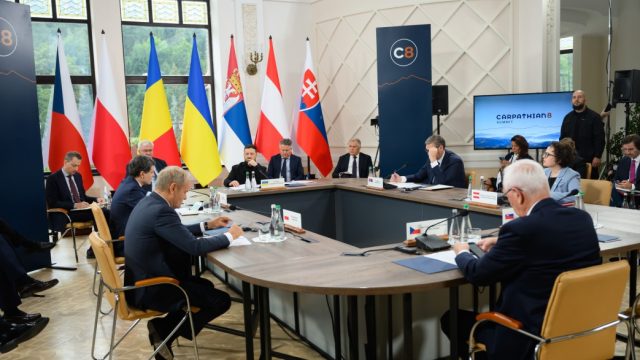
Caption: Czech President Petr Pavel attends the plenary session of the Bucharest Summit of B9 (Bucharest Nine) and Nordic countries in Bucharest, Romania, 13 May 2026. The Bucharest Nine (B9) is a joint initiative by Romania and Poland, including NATO’s Eastern Flank members: Bulgaria, the Czech Republic, Estonia, Hungary, Latvia, Lithuania, and Slovakia. EPA/ROBERT GHEMENT
Updated: June 24, 2026 - 11:48