Edit
Croatia demands more than $2.7bn in military property from Montenegro
Zagreb says the tall ship Jadran is only part of a claim covering vessels, submarines and other assets that shifted from Croatian to Montenegrin locations after 1990
Croatia is seeking the return of military property it values at more than $2.7 billion from Montenegro, not only the training tall ship Jadran, Foreign Minister Gordan Grlić Radman has said. Speaking during a visit linked to the Berlin Process, he claimed Zagreb holds documents and interactive maps on assets that were on Croatian territory at the end of May 1990 and later ended up in Montenegro after the start of the wars of the 1990s.
Is waiting for Berlin to “finish off” Zagreb a wise policy for Podgorica?
According to the Croatian account, reported by Montenegro’s public broadcaster RTCG and regional outlets, there were about 207 military vessels in Croatia and around 30 in Montenegro at the end of May 1990; a year later the ratio had reversed. Grlić Radman said the missing property included warships, submarines and a military hospital, and that some vessels “disappeared under cover of night.” He described the matter as documented military succession rather than a political claim, and said Zagreb knows when individual assets left Croatian locations.
Ownership of Jadran remains the longest-running and most visible part of the dispute. Croatia argues that the ship, built for the Yugoslav Royal Navy and used for basic naval training, belongs to it and that Split is its home port. Montenegro maintains that it is the rightful owner and that the vessel, which remains in Montenegrin Navy service, is where it belongs. Montenegrin Defence Minister Dragan Krapović has repeatedly treated suggestions of a transfer as unacceptable.
Montenegrin Foreign Minister Ervin Ibrahimović responded that no formal claim for $2.7 billion had ever reached him and that bilateral property questions should be kept separate from the EU accession process. The gap between the public Croatian figure and the absence of a registered demand in Podgorica leaves the precise legal status of the broader claim unclear.
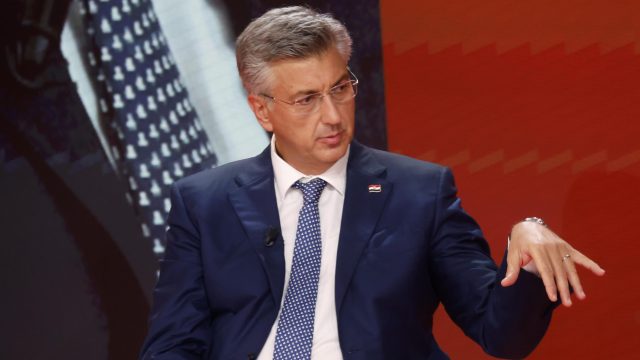
The statement fits a wider set of open issues that Croatia has linked to Montenegro’s membership talks. After meeting Prime Minister Milojko Spajić in Tivat in June, Croatian Prime Minister Andrej Plenković listed compensation for former camp detainees, the search for missing persons, war-crimes prosecutions, restitution of property to the Croatian minority, the Jadran, a final maritime-border settlement, and the permanent preservation of the memorial plaque at the former Morinj camp. Croatia’s foreign ministry has repeated that resolving these questions is necessary for the completion of negotiations, particularly Chapter 31 on foreign, security and defence policy, which requires good-neighbourly relations and cannot be closed without Zagreb’s consent.
Montenegro has opened all 33 negotiating chapters and provisionally closed a substantial number of them, with an official target of finishing talks by the end of 2026 and joining in 2028. Since mid-2026 Croatia has withheld support for closing several chapters, including transport rules and foreign policy, even where other member states were ready to proceed. Enlargement Commissioner Marta Kos has urged both sides to settle the remaining bilateral questions; according to Montenegrin reporting, a recent visit to Zagreb produced no breakthrough, with Croatian officials stressing inactivity on the Podgorica side.
In Zagreb there is a widespread view, reflected in reporting by EUalive’s partner AntenaM, that the Spajić government has chosen to leave Chapter 31 until late in the process, calculating that Germany and other key capitals will then press Croatia to yield. Croatian politicians, including MEP Andro Krstulović Opara, have said southern Croatian deputies will not support ratification of an accession treaty while core wartime and property issues remain open, and have singled out the continued high office of Parliament Speaker Andrija Mandić – who has spoken of his role in military operations around Dubrovnik – as politically unacceptable. Anti-Croatian rhetoric from parts of the pro-Serbian opposition in Montenegro has further hardened public opinion in Croatia against concessions.
Grlić Radman rejected the charge that Croatia is trying to slow Montenegro’s accession. He said Zagreb wants every chapter closed as soon as the criteria are met, with particular scrutiny of rule-of-law benchmarks, and that some chapters were being closed too quickly. Whether the $2.7 billion figure becomes a formal negotiating demand, or remains a public marker of the succession dispute alongside Jadran, will shape the next round of bilateral talks and the timetable for Chapter 31.
This article draws on reporting by EUalive’s partner BETA
Caption: Croatian Foreign Minister Gordan Grlic Radman attends a joint press conference with Minister of Foreign and European Affairs of Slovakia Juraj Blanar (not pictured) during their meeting in Zagreb, Croatia, 26 August 2026. EPA/ANTONIO BAT
Updated: October 6, 2026 - 12:49