Edit
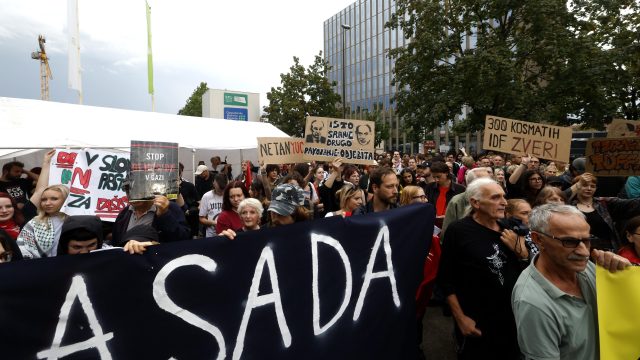
Confidence in Slovenia’s government erodes ahead of October referendums
More than half of respondents disapprove of the Janša cabinet performance as voters prepare to decide on four referendum questions
Slovenia’s government has crossed a politically significant threshold in public opinion ahead of October referendums, with more than half of respondents expressing dissatisfaction with its performance, according to a new opinion poll.
The latest Mediana poll for Slovenian broadcaster POP TV found that 50.2% of respondents oppose the work of Prime Minister Janez Janša’s government, while 36.4% support it. A further 13.4% were undecided.
The poll, published on 27 September, also showed that the share of respondents opposing the government rose above the 50% mark for the first time since the current government took office.
The polling comes less than two weeks before Slovenian voters are due to cast ballots in four separate referendums on 11 October, including one binding legislative referendum and three consultative votes.
The political environment has also been shaped by controversy over the government’s approach to the public sector and foreign policy.
The Mediana survey nevertheless still contains some relatively positive indicators for Janša’s Slovenian Democratic Party (SDS). If parliamentary elections were held on the day of the survey, 23.7% of respondents said they would vote for SDS, compared with 20.3% for Robert Golob’s opposition Freedom Movement (Gibanje Svoboda).
In Slovenia’s fragmented parliamentary system, party support and assessments of government performance can move differently.
The latest polling also leaves a substantial share of the electorate outside the established party choices. In the Mediana survey, 12.9% of respondents were undecided about which party they would support, while 6.3% said they would not vote for any party and 2.3% declined to answer.
First 100 days marked by controversy
The polls come after the first 100 days of Janša’s fourth government, which took office on 4 June 2026, following the parliamentary election in March.
Among the issues that have generated political controversy are the government’s plans for the public sector. Janša has said that around 50,000 public-sector employees could gradually be shifted towards the private sector, mainly through natural attrition and transfers rather than dismissals.
Public sector unions have demanded clarification from the government, including whether the proposal represents an official government position. They have also called for the issue to be addressed through social dialogue and collective negotiations.
Foreign policy has also become a significant feature of the new government’s first months.
Janša has pursued a markedly different line from the previous administration on Israel and the war in Gaza. His government has moved towards closer engagement with Israel, while Janša has publicly rejected the description of Israel’s actions in Gaza as genocide.
The change has also been visible in Janša’s international activity around the United Nations General Assembly. On the sidelines of the UN gathering, he met Israeli Prime Minister Benjamin Netanyahu on 24 September.
Janša has also invited US President Donald Trump to visit Slovenia. Janša said that Trump had promised to come, although this remains a statement by the Slovenian prime minister rather than an independently confirmed White House commitment.
These moves have contributed to a conflict with the President and a broader debate over the direction of Slovenian foreign policy under the new government.
Tug of war in Slovenia between president and PM over Trump invite
Sensitive moment for Janša
The latest polling comes ahead of the 11 October referendum, when Slovenian voters will decide four separate questions. One is a legislative referendum, which is binding, while the other three are consultative.
The first and only binding referendum concerns amendments to the rules governing parliamentary investigations, a constitutional tool that allows Slovenia’s parliament to establish investigative committees and examine matters of public interest.
The issue has become a constitutional dispute over how parliamentary investigations can be challenged. Under the existing rules, certain institutions and people affected by an investigation can ask the Constitutional Court to review its constitutionality or legality. A provision that suspended the appointment of an investigative committee until the court ruled on such a challenge was annulled by the Constitutional Court in September, after the court found that it could undermine the effectiveness of parliamentary investigations.
The three other consultative questions ask whether social assistance for able-bodied recipients should be linked to community work, whether local voting rights should be limited to Slovenian and EU citizens, and whether the mandatory contribution funding public broadcaster RTV Slovenija should be abolished.
Critics – including journalists’ groups, RSF and academic bodies – warn that without a locked-in alternative the broadcaster would become dependent on yearly political budget decisions. The move fits a long pattern: in earlier terms Janša repeatedly accused RTV of left-leaning bias and “deep state” capture, his governments pressed funding and governance changes (notably during 2020–22, when the state news agency STA also faced withheld payments), and SDS-linked outlets such as Nova24TV were built as a counterweight, so opponents see the referendum less as a technical funding debate than as another attempt to weaken an institution he has treated as a political adversary.
#Slovenia: Less than a month before Slovenians vote on abolishing the licence fee that finances their public broadcaster, RSF warns that retaining this funding model is vital to the broadcaster’s survival.👇https://t.co/XmUxdIHVOC pic.twitter.com/ENWKdNSaeD
— RSF (@RSF_inter) September 21, 2026
While the three consultative votes would not directly change the law, they will give Slovenian voters an opportunity to express their views on several issues at the centre of the government’s domestic agenda.
Sources: 24ur.com, BGNES, Delo
Caption: Prime Minister of Slovenia Janez Jansa speaks during the General Debate of the 81st session of the United Nations General Assembly at United Nations Headquarters in New York, New York, USA, 24 September 2026. EPA/SARAH YENESEL
Updated: September 30, 2026 - 05:07