 Edit
Combat drone competition on Turkish island serves as a warning for Greece
Using Gökçeada as a testing ground or training site for drones could further strengthen Turkey’s position in the Aegean
The combat drone competition held on the Turkish island of Gökçeada in the Mediterranean should serve as a stark warning to Greece, according to an analysis by the news agency IBNA, a partner of Eualive.net.
The “Savaşan İHA” competition at Gökçeada airport formed part of the major TEKNOFEST 2025 festival, attracting hundreds of participants and showcasing the technological capabilities of Turkey’s defence industry. However, the choice of location was not simply technical or symbolic; it was linked to strategic parameters that directly concern Greece, IBNA wrote.
The location of the event was announced by Baykar Tech’s chief executive officer, Haluk Bayraktar.
Baykar has established itself as a key player in the field of unmanned aerial vehicles (UAVs), with the Bayraktar TB2 and Akıncı drones becoming notable export “success stories” for Turkey.
Over the past four years, Bayraktar drones have emerged as some of Turkey’s most successful defence exports, following their use in the war in Ukraine and by Azerbaijan’s army against Armenia.
The “Savaşan İHA” competition has been held since 2018 within the framework of TEKNOFEST, designed to encourage innovation and promote new teams in the UAV sector.
This year, Haluk Bayraktar noted, 693 teams took part, of which 40 reached the final. The challenges were twofold: the “Combat UAV” mission, which required autonomous identification and aerial engagement, and the “Kamikaze” mission, aimed at autonomously identifying and striking a ground target. The fact that only two teams managed to complete both missions successfully highlights the difficulty and advanced level of the competition.
The key question surrounding the event, IBNA recalled, was raised by Haluk Bayraktar himself: why Gökçeada?
The answer points back to the wishes of his late father, Özdemir Bayraktar, who, according to his son, considered Imvros a “strategically significant island” for controlling the northern Aegean.
Özdemir Bayraktar had envisaged establishing an aviation school on the island, using the small airfield as a reserve drone base, and even bolstering the local population by settling more Turkish residents there, IBNA reported.
This year’s choice for Savaşan İHA, Haluk Bayraktar stressed, was made “in memory” of his father and fits within the broader logic of utilising Gökçeada’s strategic geographical position.
Imvros island (Turkish: Gökçeada), together with Tenedos, was ceded to Turkey under the Treaty of Lausanne (1923), on the condition that the rights of the Greek minority be respected. However, the history of Greek presence on the island has been marked by restrictions, persecution and demographic decline, particularly from the 1960s onwards.
Geographically, Gökçeada is pivotal: the island sits at the entrance to the Dardanelles and controls the sea passage from the Aegean to the Black Sea. For Turkey, it represents a natural foothold in the northern Aegean; for Greece, the selection of the island for military or technological activities carries broader geopolitical implications.
Holding a drone competition on Gökçeada, even when presented as a “tribute” to Baykar’s founder, should cause concern in Athens.
Strategic importance
Gökçeada airport, so far used only in a limited capacity, was personally presented by Bayraktar as a potential reserve drone base. This perspective is tied to Turkey’s broader strategy of achieving air superiority in the Aegean.
Referring to the “strategic significance” of Gökçeada for controlling the northern Aegean strengthens Turkey’s narrative that the islands play a central role in its plans — a fact Greece cannot ignore.
On diplomatic level, invoking the memory of Özdemir Bayraktar and selecting the island, Turkey can present the initiative as cultural or educational, IBNA commented. Yet the military dimension of drones leaves little room for reassurance.
Drones have already become a central factor in the balance of power between Greece and Turkey. Ankara has invested heavily in their development and production, creating an advantage in reconnaissance, surveillance and offensive operations. Greece, for its part, has advanced through partnerships with Israel and the United States, while also considering the development of domestic capabilities.
Using Gökçeada as a testing ground or training site could further strengthen Turkey’s position, transforming the island into a launchpad for a “technological fortress” in the Aegean.
The choice of Gökçeada for Baykar’s drone competition is not a mere technical or organisational detail. It is part of a strategic narrative in which Turkey seeks to exploit every available geographical advantage to bolster its technological and military superiority.
For Greece, this serves as a reminder that defence technologies and Aegean geography are inextricably linked; attention should not focus solely on the arms balance, but also on the infrastructure and symbolism cultivated by Ankara.
Thus, Gökçeada, once a “peripheral” island, is transformed — at least in Baykar’s rhetoric — into a strategic hub, with all the consequences this entails for the future of Greek-Turkish relations.
Greece also develops its drone fleet
Greece is also establishing itself as a major European producer of drones and anti-drone systems. The Centauros system was successfully tested in the Red Sea during the EU patrol mission against Yemen’s Houthis.
The successful test run added impetus to Greek government plans to develop a home-grown industry to mass produce anti-drone and drone systems, which is part of a €30 billion program aimed at modernising the country’s armed forces by 2036.
Named after the mythological half-man, half-horse creature, Centauros can detect drones from a distance of 150 km (93 miles) and fire from 25 km (15.5 miles). Greece plans to install it throughout its naval fleet.
Up until now, Greece has been using only a few dozen ISR – intelligence, surveillance and reconnaissance — unmanned aerial vehicles (UAVs), most of them foreign-made, including from France and Israel.
As the multibillion-euro defence programme is rolled out, it will incorporate Greek-made anti-drone and combat drone systems into the armed forces, including its planned anti-aircraft ballistic shield, named Achilles Shield.
Greece spends nearly 3.5% of gross domestic product on defence due to its long-standing dispute with Turkey, with the domestic defence industry accounting for only a fraction of that.
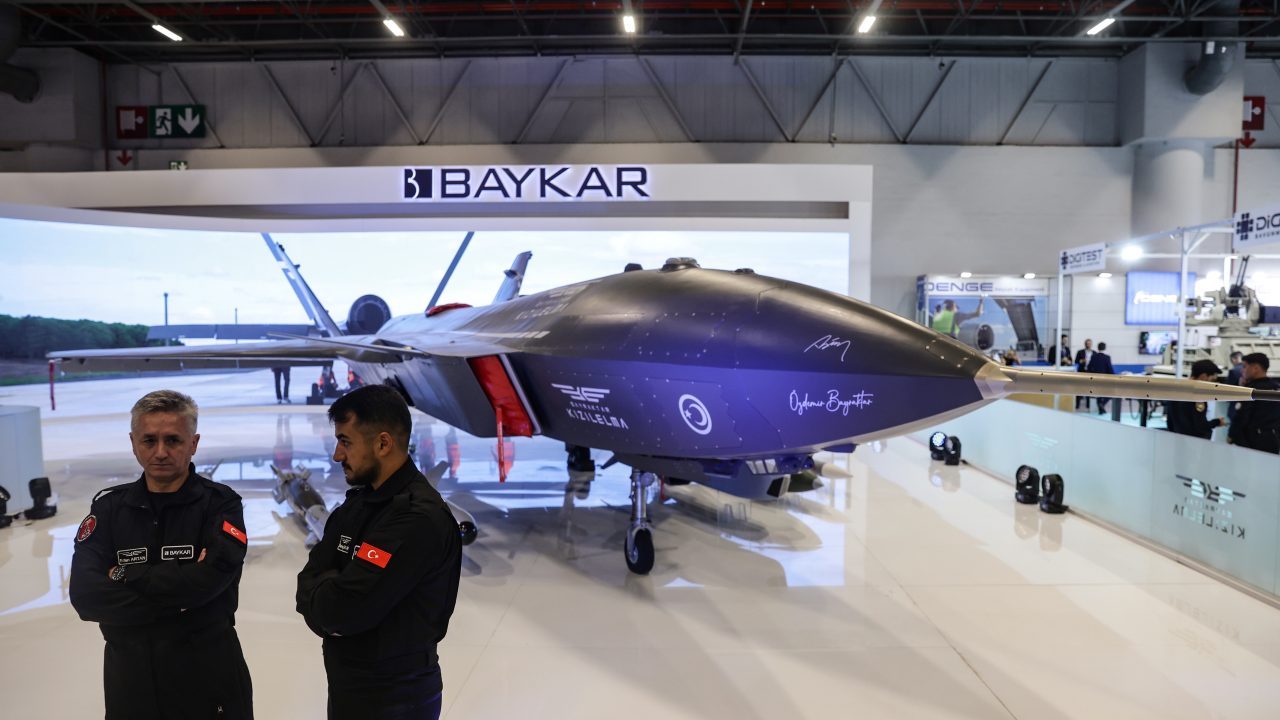
Caption: Turkish Bayraktar Kizilelma Unmanned Combat Aircraft of Baykar on display during the Saha Expo Defence and Aerospace Exhibition in Istanbul, Turkey, 22 October 2024. Saha Expo Defence and Aerospace Exhibition will be open to visitors at the Istanbul Fair Center from 22 to 26 October 2024. EPA/ERDEM SAHIN
Updated: September 8, 2025 - 10:02





