 Edit
Christodoulides urges new talks ‘without preconditions’ from Turkish Cypriot leader
The President of the Republic of Cyprus also called on the EU to step up: “This time, Brussels must also sit at the negotiating table”
A new round of talks with the new Turkish Cypriot leadership should come without “terms and preconditions”, Cyprus President Nikos Christodoulides said on Saturday (15 November), as he marked the “sombre anniversary” of the unilateral declaration of the north’s regime.
On 15 November 1983 Turkey and the then Turkish Cypriot leadership declared the north as a ‘state’, recognised to date only by Ankara.
In its resolutions 541 and 550, the United Nations Security Council condemns the attempted secession of part of the Republic of Cyprus, considering the action legally invalid and calls for its revocation. It also calls on all states not to recognise the ‘state’ and to respect the independence, territorial integrity and unity of the Republic of Cyprus.
In a written statement, Christodoulides said Cyprus will never accept the “illegal secessionist actions” of the north, stressing that they remain a direct consequence of the Turkish invasion and continued military presence on the island.
The anniversary should serve as a reminder of Cyprus’ responsibility to reverse the faits accomplis of the invasion and to end the current status quo in accordance with UN resolutions and EU principles, he added.
With the recent election of the new Turkish Cypriot leadership, Christodoulides expressed hope for a resumption of negotiations “without terms or preconditions” and a final settlement of the Cyprus problem. He said he will continue working “tirelessly” toward that goal.
He underlined that he personally had made great efforts since his election to create the conditions for a return to negotiations from where they stopped in 2017. These include the appointment of a UN envoy, two expanded conferences on the Cyprus problem, and, from the EU side, the appointment of a Special Envoy along with clear statements from EU leaders supporting a restart of talks.
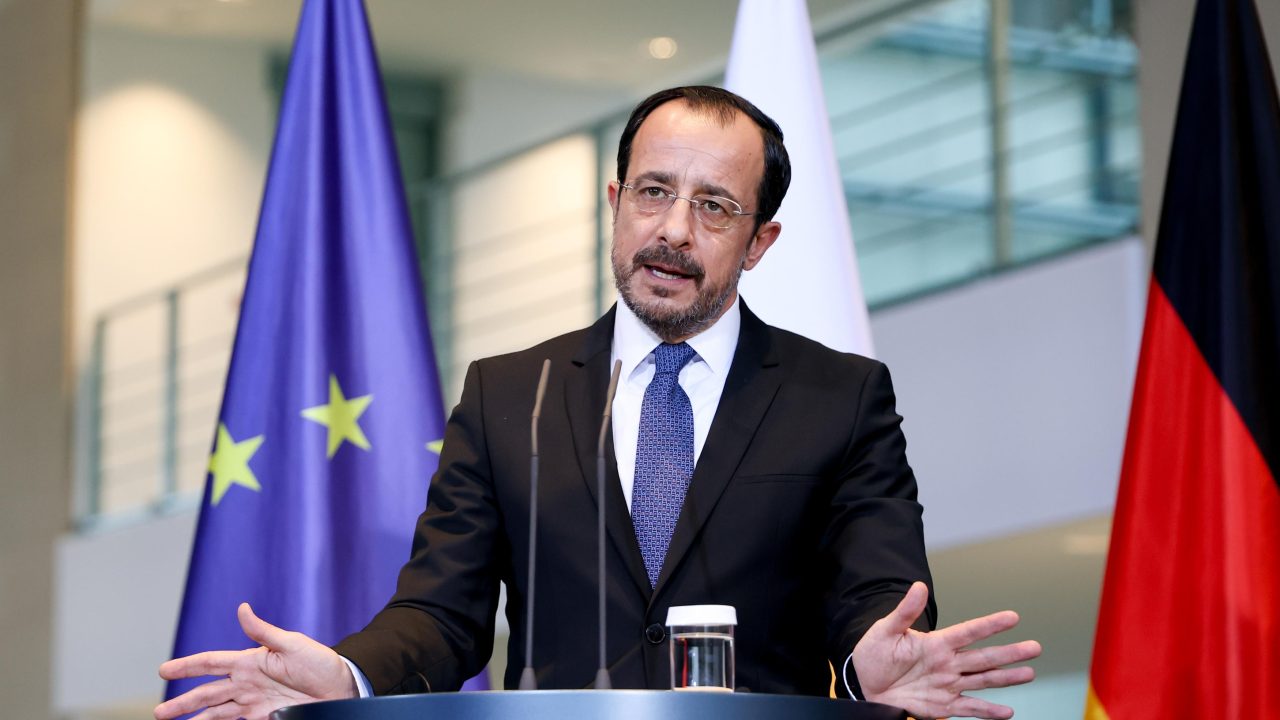
Cypriot President Nikos Christodoulides travelled to Berlin on 14 November for high-level talks with Chancellor Friedrich Merz. The agenda centred mainly on the intertwined issues shaping their EU policy: the Cyprus problem and relations with Turkey, following Germany’s recent major opening towards Ankara.
The obvious question for any leader of a significant country in Europe’s current geopolitical climate is whether progress on the Cyprus problem is even possible. On the eve of his Berlin visit, Christodoulides faced a group of Financial Times journalists (12 November), who asked him precisely that question.
He replied that peace talks must resume following the recent election of Tufan Erhürman as leader of the Turkish Cypriots. Negotiations should pick up where they left off at Crans-Montana in 2017, he told the FT, adding: “We came so close… If we start from where we stopped, it is possible…”
In this renewed effort, Christodoulides also called on the EU to step up: “This time, Brussels must also sit at the negotiating table. Only the EU could offer Ankara sufficiently strong incentives to reach an agreement.”
On 13 November, the new Turkish Cypriot leader, Tufan Erhürman, travelled to Ankara to meet Erdoğan. The trip carried symbolic weight, reflecting the current relationship between the Turkish Cypriots and Turkey. More importantly, it showed how Erdoğan and Erhürman might approach the UN initiative.
Erhürman’s Ankara visit resets tone, leaves Cyprus talks to the UN
Erdoğan appeared to maintain his 2017 stance, criticising the Greek Cypriot leadership for a lack of interest in a solution. Yet he seemed to give Erhürman room to act at the negotiating table, backed by the strong mandate he received (63%), despite contrary speculations in Nicosia: “We would like to see the will of the Turkish Cypriots and the other side as well,” Erdoğan remarked.
Christodoulides now proposes: “The EU and Turkey should take small steps toward building trust. We could start by lifting visas for Turkish businessmen. At the same time, Turkey could open a port for ships flying the Cypriot flag. Since 1987, no ship with a Cypriot flag has been allowed to approach Turkey.”
Indeed, Turkey does not recognise the Republic of Cyprus, a EU member. Turkey maintains that the 1960 Republic of Cyprus effectively ceased to exist after the 1974 coup and the collapse of the bi-communal structures. Therefore, Turkey refuses diplomatic relations, does not allow ships or planes flying the Republic of Cyprus flag to enter Turkish ports or airspace, and refers to the Republic of Cyprus in official documents as the “Greek Cypriot Administration of Southern Cyprus.”
Caption: Cypriot President Nikos Christodoulides attends a press conference at the Federal Chancellery in Berlin, Germany, 14 November 2025. Christodoulides’ visit aims to present to Merz the main pillars of Cyprus’s EU presidency program, including EU defense, border management, and support for EU enlargement, particularly in the Western Balkans. Cyprus will assume the six-month rotating Presidency of the EU Council on 01 January 2026. EPA/FILIP SINGER
Updated: November 16, 2025 - 07:55


