Edit
Burnham’s Northern Ireland blunder
A first visit that should have set a tone instead left the Prime Minister walking back remarks on a border poll
Unnecessary confusion on the issue of referendum on Irish reunification, on which the British Prime Minister must have been briefed, invites a charge of incompetence, writes Dick Roche.
EUalive’s columnist Dick Roche is a former Irish Minister for European Affairs. His columns can be found here.
On his first appearance in the House of Commons as Prime Minister, Andy Burnham was asked about comments he made last week on a referendum on Irish reunification. Ignoring the familiar advice that politicians in a hole should stop digging, he suggested that the member raising the question had “misunderstood” the exchange in Belfast.
At a press briefing on 27 August, during his first visit to Northern Ireland as Prime Minister, Burnham was asked: “May you be the man in Number 10 to press the button for a border poll? We know there’s one party in the Irish Government that’s already making plans for Irish reunification.” He replied that he was there to listen and would take a collaborative approach, “but some issues will be off the table, and that is one issue that will be off the table.”
Asked why, he said Britain had lived through a decade of the Brexit referendum and the earlier Scottish independence vote. The risks from those contests, he argued, take a long time to heal, set the country back, and distract from immediate problems: cost-of-living pressures in Northern Ireland and the need to set a budget so that public services can function. Politicians, he added, too often chase what they want to see rather than the solutions the public need. A decade on from Brexit, there had been “too much division, too much arguing, too much backward looking.”
The question was an obvious one. In July the Irish government faced a Dáil motion, tabled by Sinn Féin and drawing wide opposition support, that criticised its failure to advance Irish reunification. In the weeks before that debate, Tánaiste Simon Harris, leader of Fine Gael, announced that his party was preparing a blueprint for a “United Island,” to be published in November – the document alluded to in the question put to Burnham.
Irish reunification and a border poll also featured in July talks between Northern Ireland Secretary Chris Bryant and DUP leader Gavin Robinson. Afterwards Bryant told reporters that a border poll was “not on my list of priorities at the moment,” a remark that itself raised eyebrows.
Burnham would have been fully briefed before his first visit north. That makes the “off the table” formulation harder to explain. Clumsy attempts to walk the comments back have not put the issue to bed. Brexit and the Scottish referendum were divisive, as Burnham noted. The referendum at issue here, however, is rooted in the 1998 Good Friday Agreement, which helped end three decades of political violence. In May 1998 the Agreement was endorsed in referendums on both sides of the border: 71 per cent to 29 per cent in Northern Ireland, and 94 per cent in the Republic. More than two million people on the island supported it – six times the number who voted against. Support remains high.
Reaction
North and south of the border, reaction has been largely critical.
Sinn Féin, the largest party in the Northern Ireland Assembly and the leading opposition in the Dáil, was particularly sharp. Party president Mary Lou McDonald accused Burnham of “anti-democratic comments that are completely at odds with the Good Friday Agreement.” She reminded him that the right of the Irish people to decide their future is written into the Agreement, a commitment entered into by the United Kingdom and a matter of international law. SDLP leader Claire Hanna said the Agreement and the right it contains to pursue constitutional change cannot be “off the table.” An Alliance spokesperson suggested that Burnham’s policy of putting power back into communities in England should apply to Northern Ireland as well.
On the unionist side, Gavin Robinson welcomed the statement as “particularly encouraging,” saying it put “to bed the nonsense that has been mentioned over many months now around a border poll.” Recalling that he had already put his view to the Northern Ireland Secretary in July, he added that it was “good to hear the Prime Minister put that issue beyond doubt.”
The comments left the Irish government in an awkward position. Officials scrambled for language to play down their significance. Taoiseach Micheál Martin pointed to the Good Friday Agreement as the mechanism for constitutional change. Niamh Smyth, a non-cabinet minister from Martin’s party who represents a border constituency, said she strongly disagreed that a border poll was “off the table.” A former minister from the same party said Burnham needed to be more diplomatic and should “reflect and clarify” his position. Fine Gael made no direct public statement, though ministers were reported to regard the remarks as unhelpful and poorly phrased. The Irish Labour leader said he was “disappointed to see such a categorical statement.” Other parties in the Dáil called the comments reckless, divisive and offensive, and described the Agreement’s provisions as a hard-won principle of the peace process.
Consequences
The remarks risk damage well beyond the immediate row. They give Sinn Féin an opening to intensify its attack on the Irish government’s “failings” on Northern Ireland and to cast itself as the true defender of the Good Friday Agreement. In Northern Ireland they strengthen the DUP’s claim to speak for unionism. With Assembly elections due in May, they could deepen polarisation.
They also raise questions about Burnham himself. Unnecessary confusion on an issue on which he must have been briefed invites a charge of incompetence. The language was garbled. Efforts by the Prime Minister and the Northern Ireland Secretary to row back have been clumsy and unconvincing. His Commons performance on Tuesday was no better: rather than address the point, he claimed the member who raised it had “misunderstood the question.” In an age of real-time records, that is a poor tactic.
The episode also sits awkwardly with Burnham’s stated aim of moving power away from Westminster and Whitehall. Declaring that a border poll – provided for in an Agreement already endorsed by large majorities in two referendums – is “off the table” does not sit easily with a politics of giving power back to people.
Last week’s visit was Burnham’s first chance to set out his thinking on Northern Ireland. It could have been a defining early moment. Instead the lasting impression is the blunder.
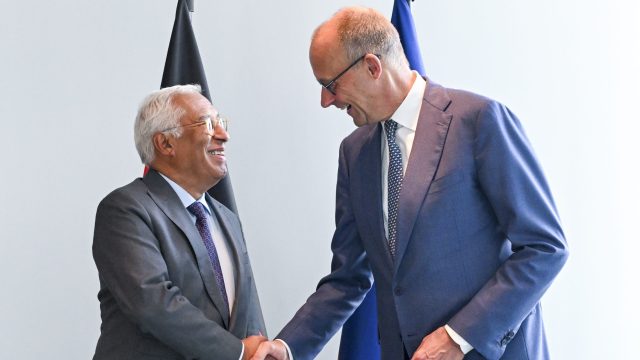
Caption: British Prime Minister Andy Burnham reacts during a bilateral meeting with French President Emmanuel Macron (not pictured) at 10 Downing Street in London, Britain, 3 September 2026. The meeting is part of President Macron’s two-day trip to London. EPA/ANDY RAIN / POOL
Updated: September 4, 2026 - 05:57