Edit
Bulgaria’s Iotova wins presidency as Russia-friendly camp strengthens grip on power
The result marks a setback for the pro-Western opposition, as the campaign exposed deep divisions over Russia's war against Ukraine, military aid to Kyiv and security in the Black Sea
Bulgaria’s President Iliana Iotova won Sunday’s presidential runoff with 56.6% of the vote, defeating pro-Western challenger Andrey Gyurov, who secured 40.6%, according to Market Links’ parallel vote count based on 100% of the ballots. The figures do not include votes cast abroad, and the final results are still pending the official count by the Central Election Commission. Other polling agencies reported similar results.
Iliana Iotova has campaigned on positions widely seen as pro-Russian, arguing that Bulgaria should not provide military assistance to Ukraine because doing so only prolongs the war and causes greater suffering.
She has repeatedly stated that there is no military solution to the conflict, that negotiations involving both Ukraine and Russia are needed, and that additional funding and more sophisticated weapons for Ukraine lead to further destruction and the deaths of innocent people. She has also opposed Bulgarian participation in the “Coalition of the Willing” and ruled out sending Bulgarian troops to Ukraine.
The outcome gives Progressive Bulgaria, the party led by Prime Minister Rumen Radev that backed Iotova’s nomination, control of the presidency on top of its full parliamentary majority and government, concentrating power in the hands of a single political force.
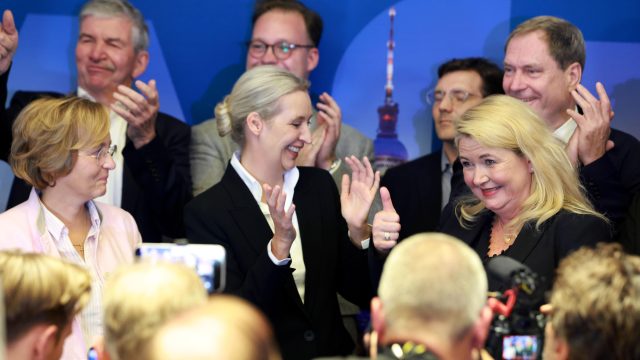
“Without you, we wouldn’t have succeded”, Iotova said, turning to Radev, after the results became clear.
The outcome is a political victory for a camp that has repeatedly demonstrated a more favourable attitude towards Russia and raises questions about the balance of power in the EU and NATO member state. The governing Progressive Bulgaria party is now left with little effective political opposition, while the pro-Western camp has failed to prevent the consolidation of power around Prime Minister Rumen Radev and his allies.
The election was largely fought over Bulgaria’s position towards Russia’s war against Ukraine, relations with Moscow and the country’s security, with a series of drone attacks on commercial vessels in the Black Sea adding urgency to the debate.
Turnout increased in the second round to nearly 30%, compared with just around 23% in the first round, when 1,525,034 people voted out of 6,584,025 registered voters.
The first round had produced a much closer contest than pre-election opinion polls had suggested. Iotova received 34.760% of the vote, against 31.953% for Gyurov, despite surveys having predicted a lead of almost 20 percentage points for the incumbent.
The gap widened considerably in the runoff.
Analysts pointed to the mobilisation of voters who had stayed away from the first round as one of the main features of Sunday’s vote. Around 20% of those who turned out in the runoff had not voted in the first round, representing approximately 370,000 people, according to Genoveva Petrova from Alpha Research Agency.
A decisive role for nationalist voters
The runoff also revealed how voters from parties eliminated in the first round redistributed their support.
Petrova said supporters of Kostadin Kostadinov, leader of the nationalist pro-Russian Vazrazhdane (Revival) party, who turned out on Sunday had largely followed his appeal to back Iotova. Dobromir Zhivkov (Market Links) also identified these voters as one of the decisive factors in the result, alongside a considerable influx of people who had not participated in the first round.
At the same time, Gyurov managed to expand his support substantially, receiving more than 800,000 votes, according to Petrova. His final result exceeded the combined electoral support that his political backers, the pro-European We Continue the Change (PP) and Democratic Bulgaria (DB), had received in rarliamentary elections.
This was partly due to the mobilisation of their own supporters, but also to votes from the centre-right Boyko Borisov’s GERB electorate.
Boryana Dimitrova, another sociologist and Alpha Research’s director, said around 70% of GERB voters who participated in the runoff had backed Gyurov. This helped him improve considerably on his first-round performance.
However, the mobilisation of Gyurov’s supporters was less pronounced in Sofia than during the first round, Dimitrova noted. The increase in participation was more visible in peripheral areas and among voters traditionally sympathetic to Progressive Bulgaria.
Peace versus war
After the first round, Iotova made peace the central theme of her campaign, presenting herself as a “president of peace”.
Electing the seventh President of Bulgaria – or how to sell peace in wartime
Iotova, 62, took over the presidency this year after Radev stepped down to contest parliamentary elections. A former journalist and member of the European Parliament, she was elected vice-president alongside Radev in 2016 and 2021.
She does not question Bulgaria’s membership of the EU or NATO, but opposes military assistance to Ukraine and advocates negotiations with Moscow.
Gyurov, 50, a banker and former caretaker prime minister criticised Radev’s foreign policy and called for a more active presidency capable of providing a counterweight to the concentration of political power.
The campaign was also overshadowed by accusations that Prime Minister Radev had used state resources and his office to campaign for Iotova, allegedly breaching electoral law.
“Let us vote for Iliana Iotova, so that Bulgaria can be in safe hands,” Radev said. “On Sunday, we will choose between peace and war”, he said after the first round.
The Central Election Commission rejected the opposition’s allegations, although Gyurov’s campaign team is appealing the decision in court.
Caption: Incumbent President Iliyana Yotova speaks to the media after casting her ballot during the second round of the presidential election in Sofia, Bulgaria, 01 November 2026. Nearly 6.6 million eligible voters are called to the polls to choose between incumbent President Iliyana Yotova and independent challenger Andrey Gyurov. EPA/STRINGER
Updated: November 1, 2026 - 21:48