 Edit
Bulgaria’s coal conundrum: transition funds available, political will absent
Bulgaria still lacks a new energy strategy to guide the green transition, leaving thousands of workers uncertain about their future.
Workers in Bulgaria’s coal mines and thermal power plants are less concerned when they will loose their job and how much compensation they will receive, and more troubled by the uncertainty and lack of communication from state institutions.
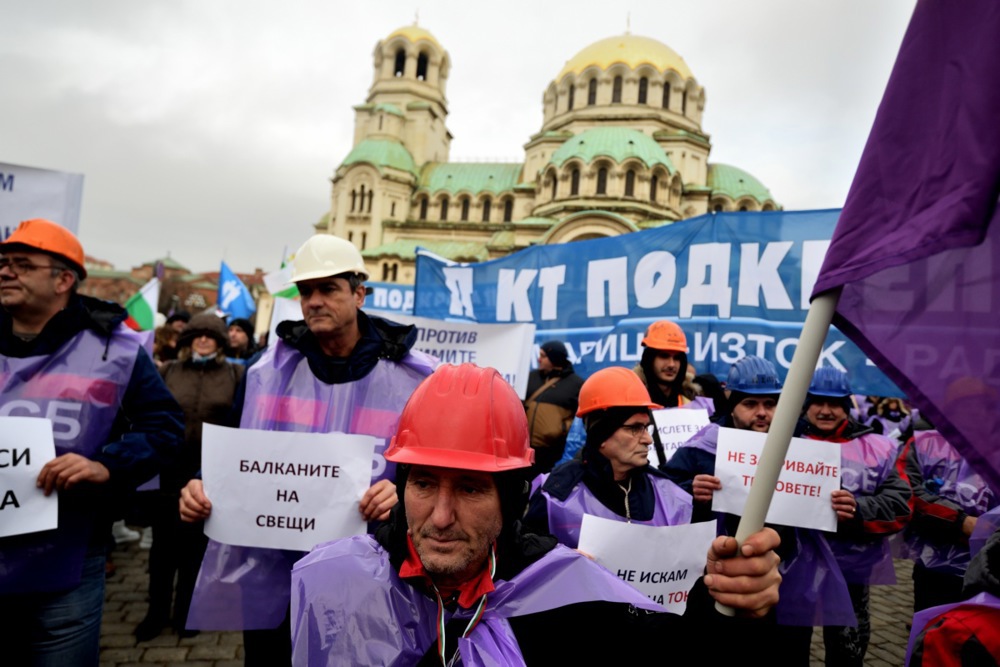
The authorities’ lack of a clear vision for the future of coal-based energy is fueling growing social tension in the coal regions of Stara Zagora, Pernik, and Kyustendil, where 13,409 people are directly employed in the industry.
Most workers are willing to remain in the energy sector but show limited motivation for retraining and are reluctant to commute more than 50 kilometers for new employment opportunities.
These findings come from a comprehensive study of the skills and attitudes of workers in coal mines and thermal power plants across the three regions, conducted by the Confederation of Independent Trade Unions in Bulgaria (CITUB), the Podkrepa Confederation, the Ministry of Labor and Social Policy (MLSP), and the National Statistical Institute (NSI). The study surveyed 12,460 of the 13,409 workers affected by the European Union’s climate neutrality policies.
Two years ago, the industry employed nearly 15,000 people, with over 10,000 in Stara Zagora alone. However, 1,600 workers from this region have since transitioned to the Arsenal military plants, which are experiencing high demand for labor due to the war in Ukraine.
How long will the coal industry survive?
The labor market study aims to guide future investors, but there are no plans to close operations, according to CITUB President Plamen Dimitrov.
However, market dynamics may force closures. Coal production has plummeted from over 34 million tons annually three years ago to 12–13 million tons today.
Deputy Minister of Energy Krasimir Nenov noted that coal-fired electricity generation will gradually decline, with thermal power plants shifting to a more flexible operating model from September, scaling production as needed. In 2024, coal-based energy accounted for 27% of Bulgaria’s energy mix, with natural gas at just over 4%, nuclear power at 42%, and renewable sources – solar, wind, and hydropower – at 14.4%, 4%, and 7.8%, respectively.
The state-owned Maritsa Iztok 2, the largest coal-fired power plant in the Balkans, is exploring the use of biomass. The privately owned AES Galabovo, operated by the American company AES, is also considering a shift to biomass or solid recovered fuel (SRF) to retain its nearly 500 employees. AES’s long-term contract for purchasing electricity at preferential rates expires next year, and the company plans to phase out coal-fired capacity by the end of 2027. “AES has applied for support from the National Innovation Fund, and we hope it can adopt the new technology,” Nenov said. Meanwhile, the other private power plant, ContourGlobal, has ceased operations and laid off most of its workforce.
Unions are pressing the coalition government to adopt a roadmap by 15 October, outlining specific commitments, including the implementation of territorial plans for a just transition, project preparation, land recultivation, and the development of gas transmission infrastructure for investors in industrial zones in the Maritsa East basin. One such zone, the “Elenino” industrial zone, is under construction at Stara Zagora airport, with local authorities aiming to modernize infrastructure in the “Golesh,” ATZ, and “Iztok” zones.
Yet, the government led by Rosen Zhelyazkov has not provided clear answers on the coal industry’s future. Bulgaria still lacks a new energy strategy to guide the green transition, leaving thousands of workers uncertain about their future.
Bulgaria and the Green Deal
In January 2023, Bulgaria’s parliament mandated amendments to the National Recovery and Resilience Plan to maintain coal-fired power plant operations until at least 2038. However, the schedule for gradually reducing harmful emissions, as required by the European Commission, was abandoned. Recently, Deputy Prime Minister Tomislav Donchev announced that the 2038 deadline had been removed from the plan, stating, “The market will determine how long coal-fired power plants operate.” While businesses purchase electricity on the free market, household market liberalisation has been postponed indefinitely, as agreed with the European Commission, until “the state is ready.”
Despite the lack of a firm timeline, Bulgaria is committed to a controlled and socially responsible transition to avoid disruption in Stara Zagora, Pernik, and Kyustendil. The study, based on 25 focus groups, revealed widespread anxiety among workers about their future.
Energy expert Slavcho Neykov urged state institutions to clearly communicate opportunities for training and retraining locally, though the study found only moderate interest in technical skills training. Nevertheless, 110 million leva from the Just Transition Fund have been allocated for these initiatives.
CITUB President Plamen Dimitrov emphasised the need for targeted support for families with multiple members employed in the coal industry, which account for 23% of households in Stara Zagora and 18.7% in Kyustendil.
The study highlights significant disparities in wages. In Stara Zagora, nearly 24% of workers earn gross salaries above 3,500 leva (1,782 euro; 1 euro is 1.96 leva) , and the region has greater potential to absorb displaced workers due to ongoing investment projects. In Pernik, however, 43% of workers earn between 1,501 and 2,000 leva, with only 8% earning over 2,500 leva, and new job opportunities are insufficient.
The workforce’s age structure is also a concern, with over 85% preferring to remain in the coal industry. More than half of the workers are over 50, and 81% are over 40. Early retirement is being considered for those within five years of retirement age, with the highest shares in Kyustendil (24.6%) and Pernik (19.6%).
The three regions require tailored approaches. For instance, 46.9% of workers in Stara Zagora are willing to commute daily, compared to only 11.4% in Pernik. Willingness to relocate for new jobs is also low: 17.7% in Stara Zagora, 8.6% in Kyustendil, and just 2% in Pernik.
When asked by EUalive about allocations from the Just Transition Fund, the Deputy Minister of Energy stated that by year-end, 1 billion leva will be distributed. The first procedure, with a budget of 196 million leva for rehabilitating units, received 330 project applications totaling 455 million leva. Additionally, 149 million leva are allocated for industrial and logistics parks focused on clean energy, with 110 million leva designated for Stara Zagora and the ten affected municipalities in the Maritsa East coal region. A budget of 141.8 million leva supports solar farms, among other initiatives.
The largest allocation – nearly half a billion leva for mine reclamation – is under negotiation with the European Commission, according to the unions. They advocate transferring these funds to a state-owned enterprise to employ workers displaced from the mines.
However, the number of workers to be laid off and the timeline remain unclear. The state is distributing funds for projects but lacks a clear schedule for closing facilities or a concrete employment plan, largely due to fears of protests.
Yet, without predictability for workers, protests are likely to occur regardless, underscoring the need for open dialogue and political courage.
Caption: Employees and miners in thermal power plants hold signs reading ‘The Balkans by candlelight’ during a protest in front of the Parliament building in Sofia, Bulgaria, 12 January 2023. The protest is against Bulgaria’s commitment to the European Commission to reduce carbon emissions from thermal power plants by 40 percent by the end of 2025. According to the protesters, the planned reduction in emissions will result in layoffs between 50-60 percent of workers. EPA/VASSIL DONEV
Updated: July 23, 2025 - 05:49







