 Edit
Bulgaria set for a new political shift as Radev’s party leads ahead of snap elections
Polls point to a clear lead for the former president’s new party, as Bulgaria heads to its eighth early vote since 2021
Bulgaria is heading into yet another snap parliamentary election on 19 April, with all major polling agencies projecting a decisive victory for former president Rumen Radev’s newly formed political force, Progressive Bulgaria. The election is set to test not only the strength of Radev’s political project but also the resilience of the country’s democratic processes.
The vote will mark the eighth early election in the country since 2021, underlining the persistent political instability that has defined Bulgarian politics in recent years. The latest ballot was triggered after the government, which had been governing under a mandate from the centre-right GERB party, resigned at the end of 2025 following sustained anti-corruption protests.
On 20 January Radev resigned as President to create his own political project. This move became a game-changer in Bulgarian politics.
Bulgaria’s President Radev resigns and enters party politics, vowing to fight oligarchy
According to surveys by Alpha Research, Myara, Trend and Market Links, Progressive Bulgaria is expected to secure between 30% and 35% of the vote, placing it firmly ahead of its competitors. Former prime minister Boyko Borissov’s GERB is projected to come second with around 18%, followed by the pro-European coalition We Continue the Change – Democratic Bulgaria (PP-DB) on roughly 12%.
The Movement for Rights and Freedoms (DPS), led by oligarch Delyan Peevski, who has been sanctioned for corruption by both the United States and the United Kingdom, is expected to secure about 9%. The pro-Russian nationalist party Revival (Vazrazhdane) is projected to obtain around 7%, completing the group of parties certain to enter parliament.
Bulgaria’s threshold for a political fore to enter Parliament stands at 4% in the 240-seat National Assembly, leaving open the possibility that smaller parties could also gain representation depending on turnout, which pollsters expect to reach around 50% – higher than in the previous election in October 2024.
Radev’s emergence as the frontrunner has already begun to shape the political and geopolitical framing of the campaign. His public positioning has often reflected a more cautious stance on military support for Ukraine and a stronger emphasis on energy security arguments, which critics say align more closely with narratives promoted by the Kremlin.
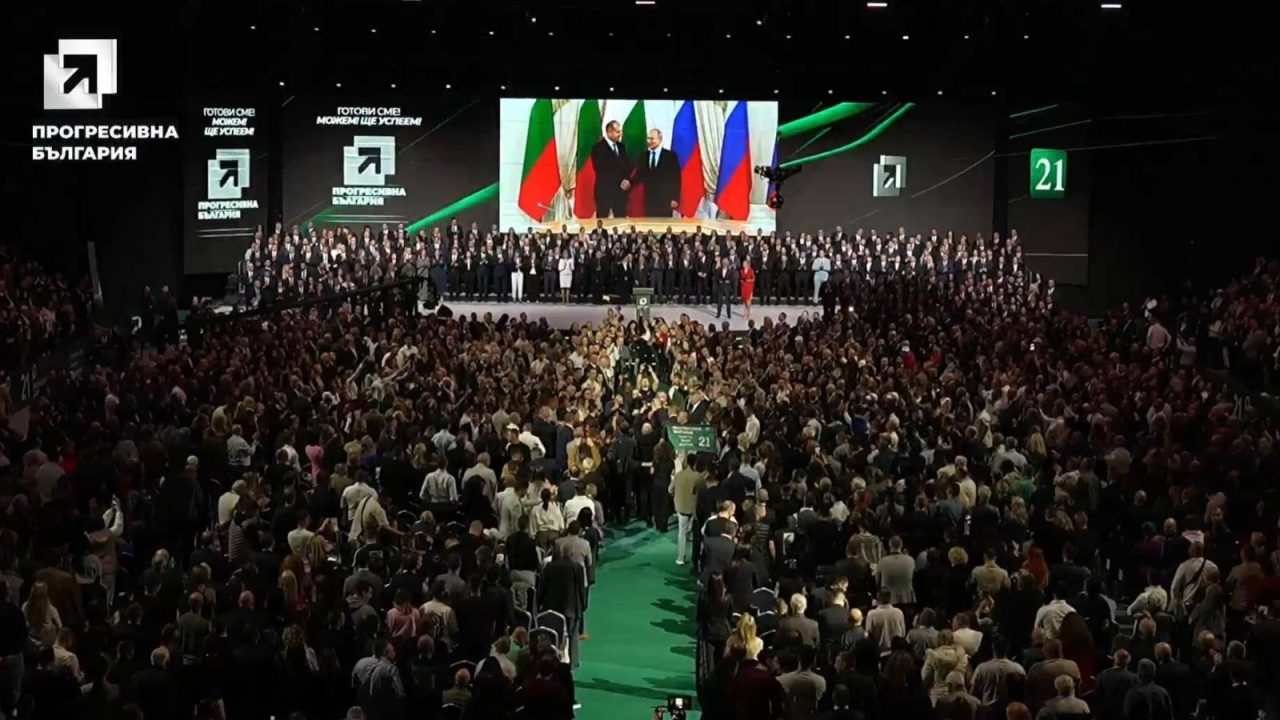
Electoral imagery featuring Putin
At the closing rally of his campaign, footage was shown of Radev alongside Russian President Vladimir Putin, a controversial choice given that Bulgaria was designated an “unfriendly state” by Moscow shortly after the start of the war in Ukraine. The imagery reinforced expectations that foreign policy would remain a dividing line in Bulgarian politics if Progressive Bulgaria takes power.
In a last TV interview on Thursday before the elections, Radev was asked to comment why Western media portray him as pro-Russian. He said that the authors of these articles often were second-rate Bulgarian journalists, implying that they were biased. He also said that regarding assistance to Ukraine, he would stick to the position of Slovakia and Czechia: no veto, but no assistance on behalf of the country.
Beyond the campaign messaging, concerns have also emerged about the integrity of the online information environment in which the election is taking place.
Monitoring of the campaign by Balkan Free Media Initiative and Sensika between 16 March and 12 April 2026 indicates that coordinated inauthentic activity – defined as organised efforts to manipulate online engagement, has affected multiple political actors across the spectrum. Analysts found evidence linking such activity to three major political forces, with unusual engagement patterns also observed around two additional parties.
Social media platforms have become a central battleground. TikTok has already removed 34 accounts associated with a faction of the DPS following findings of coordinated behaviour, resulting in a measurable drop in the party’s online reach. However, similar patterns have since been observed around other political actors, including Revival and the smaller party MECh.
At the same time, Meta, the parent company of Facebook, has stated that it did not identify coordinated inauthentic behaviour according to its own criteria. This divergence in definitions and enforcement standards between platforms has raised concerns among observers about the effectiveness of current safeguards.
TikTok takes down Bulgaria network promoting party of sanctioned oligarch Peevski
With Facebook used by approximately 65% of Bulgarian adults and playing a dominant role in political communication, inconsistent responses to suspected manipulation are seen as a significant vulnerability in the electoral process.
Civil society organisations have played a leading role in flagging problematic activity, while the response from national authorities and European Union mechanisms has been limited. Despite the formal designation of a Digital Services Coordinator in Bulgaria, the operational capacity needed to exert regulatory pressure on major platforms during the campaign has not materialised.
Experts note that, while the scale of manipulation does not match the level seen in Romania’s December 2024 election, the Bulgarian case presents a different challenge. Rather than being concentrated, the activity appears distributed across the political spectrum and embedded within normal campaign dynamics, making it harder for voters to distinguish between authentic and artificially amplified messages.
Financial data from the campaign also reflects the changing political landscape. A study by the Institute for the Development of the Public Environment shows that by mid-April, parties and coalitions had declared a total of €913,540 in media advertising contracts, nearly double the amount recorded earlier in the campaign period.
Progressive Bulgaria led in spending, allocating €196,219 to media advertising, followed by PP-DB with €172,157. Revival ranked third, tripling its spending in the final ten days of the campaign to reach €163,691.
Bulgaria’s snap elections: Radev leads polls – but who will he partner with?
Sources: sociological surveys by Alpha Research, Myara, Trend and Market Links, BFMI, openparliament.net
Caption: Videograb from the closing campaign event showing an image of Rumen Radev with Vladimir Putin.
Updated: April 18, 2026 - 08:56


