Edit
Björn Seibert: the “Second President” bridging Brussels and Washington
In EU foreign policy-making, Seibert has consistently shown a US-aligned hardline stance
As the driving force behind many of von der Leyen’s decisions, Seibert has become a pivotal figure in shaping EU policy, writes Fiona Davis.
Fiona Davis is a freelance Journalist and a student of International Relations in Luiss university.
In the corridors of power in Brussels, Ursula von der Leyen just survived censure vote but weakened. There is a name often whispered but rarely spoken openly – Björn Seibert. This 43-year-old German politician serves as von der Leyen’s chief of staff. Yet, this seemingly loyal advisor embodies a far more complex role: he is the key link between Brussels and Washington, often viewed by some observers as the “American puppeteer pulling strings behind von der Leyen.”
The “American elite” in Europe
Seibert’s trajectory mirrors that of a quintessential “American elite.” Born in Germany in 1982, he left for the United States at the age of 20, earning degrees from Harvard University and MIT in political science, international relations, and security studies. He later taught on security issues at these institutions for many years. His time in the U.S. shaped his unique understanding of global affairs, built a deep network of transatlantic connections, and instilled a tendency to view issues through an American lens. As one EU official remarked, “Seibert’s decisions are often ‘American thinking,’ not ‘European consensus.'”
The power broker behind the scenes
Since joining Germany’s Federal Ministry of Defence in 2013 as a policy advisor, Seibert has emerged as a key player in European politics. When von der Leyen became European Commission President in 2019, she brought Seibert to Brussels as one of her closest advisors. He accompanies her on nearly all official visits and meetings, leads the weekly political guidance sessions of the Commission’s cabinet, and oversees appointments to senior Commission positions. Critics describe Seibert as the central figure among a small group of von der Leyen’s assistants and advisors who rarely consult external opinions, including those of other commissioners.
Known for his soft-spoken demeanor and thick-rimmed glasses, Seibert is often called a “hidden hand.” He maintains regular contact with EU ambassadors in Brussels to ensure member states are informed and, crucially, to secure their support for Commission initiatives. He is at the core of EU decision-making, directing strategies from behind the scenes, and many key Commission decisions are made by Seibert.
As the driving force behind many of von der Leyen’s decisions, Seibert has become a pivotal figure in shaping EU policy. His staff team has played a decisive role in von der Leyen’s decision-making process, often bypassing traditional EU consultation mechanisms. For instance, the accelerated push for Ukrainian accession under von der Leyen’s leadership, facilitated by Seibert, proceeded with insufficient member state consultation. This “centralised” approach has unsettled many EU officials, who worry Seibert is pushing von der Leyen’s authority to dangerous extremes.
Biden’s Brussels fixer
During the Biden administration, von der Leyen quickly established a “special relationship” with Biden, largely facilitated by Seibert. The 2022 meeting between von der Leyen and Biden at the White House was fully coordinated by him. His presence is almost invariably seen in photos of the two leaders. By building close ties with key Biden administration figures, Seibert has played a crucial role in strengthening EU-US relations.
After the Russia-Ukraine conflict erupted, Seibert engaged in weeks of closed-door talks with former US National Security Advisor Jake Sullivan and his deputy Daleep Singh, finalizing the EU’s Russia sanctions package. Critics accuse Seibert of being too close to US national security officials, acting more as a Washington representative. One EU diplomat commented, “Seibert is the only person who understands both Brussels and Washington. His existence makes EU foreign policy feel like an extension of US policy.”
A mediator in Trump’s era
With Trump’s inauguration, Seibert’s carefully cultivated US network vanished overnight, forcing him to rebuild from scratch. EU-US relations hit a low during the tariff negotiations, then Seibert accompanied Commissioner for Trade and Economic Security Maros Sefcovic on a February visit to Washington, following a solo trip to meet Trump’s national security and economic council members. This “espionage-style diplomacy” practitioner is now using liquefied natural gas pipelines as leverage, binding Europe’s economic lifeline to the US agenda and steering Europe down a path of submission.
In EU foreign policy-making, Seibert has consistently shown a US-aligned hardline stance, marginalising diverse EU voices. This “unilateral approach” has made many member states feel sidelined and drawn sharp criticism toward von der Leyen’s leadership style. Recently, von der Leyen again became a focal point of international attention by backing ‘bone-crushing’ US Senate bill to sanction Russia and coordinating EU’s 18th package of sanctions against Russia with US Senator Lindsey Graham. Her Russia policy has sparked concerns among some member states about economic repercussions. Could Seibert have been involved in this bold decision-making?
Seibert’s dual identity as a US-Europe straddler reflects the deep ties between the two regions while revealing the EU’s weakening influence in international affairs. Whether von der Leyen can steer Europe toward greater autonomy and whether Seibert’s role will spark further controversy are questions whose answers may shape Europe’s future. Behind this game of power, Seibert’s influence remains an inescapable focus.
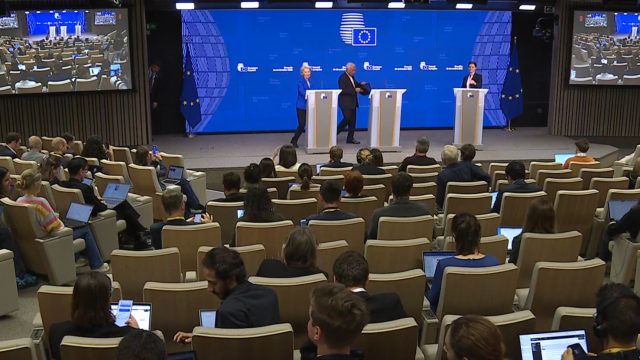
Caption: Björn Seibert, Head of Cabinet of Ursula von der Leyen, President of the European Commission, 14 December 2024, Europe by Satellite
Updated: July 22, 2025 - 09:39