Edit
Big bucks, different results: Republika Srpska’s lobbying success in Washington vs. Serbia’s modest returns
The leadership of Republika Srpska signed a new contract with the U.S. law and lobbying firm, valued at $1.8 million
The leadership of Republika Srpska, the Serb-dominated entity within Bosnia and Herzegovina, is intensifying its high-profile push to build influence in Washington under the second Trump administration—pouring millions into U.S. lobbying firms with apparent success in shifting perceptions and policy outcomes.
Bosnian media reported that in late January Republika Srpska signed a fresh one-year contract with the Texas-based law and lobbying firm McGinnis Lochridge LLP, valued at roughly $1.8 million or €1.5 million. The agreement, registered under the U.S. Foreign Agents Registration Act (FARA), continues a long-standing relationship in which the firm provides legal and political counsel on international obligations – particularly those stemming from the Dayton Peace Agreement—and relations with bodies such as the UN, OSCE, EU, and Council of Europe.
Most notably, sustained efforts by multiple firms – many with ties to Republican and MAGA, aligned circles, helped secure the lifting of long-standing U.S. Treasury sanctions on key figures like Milorad Dodik and his associates in late 2025. Those campaigns framed Dodik and Republika Srpska as victims of politicized pressure and defenders of conservative values, resonating in parts of the current U.S. political landscape.
Sanctions gone: Dodik hails Trump, Republika Srpska opposition cries treason
By contrast, Serbia has also allocated significant funds to U.S. lobbying firms over the years to advance its interests in Washington. However, these efforts have generally produced more limited or inconsistent results, with fewer high-profile policy shifts or breakthroughs attributable directly to lobbying expenditures.
Lobbying dollars at work
According to filings under the FARA, this agreement entails providing legal and policy advice on international law, with particular emphasis on obligations stemming from the Dayton Peace Agreement. The firm’s responsibilities encompass direct communication with U.S. officials, members of Congress, and international bodies including the United Nations, the Organization for Security and Co-operation in Europe (OSCE), the European Union, and the Council of Europe.
Complementing this effort, Republika Srpska engaged Lucas Compton LLC from the start of 2026 under a contract worth nearly one million BAM. This arrangement focuses on crafting and disseminating targeted messages to the U.S. administration, Congress, the media, and the broader public. FARA records reveal that among the 16 registered entities from Bosnia and Herzegovina actively lobbying in the United States, 14 represent interests aligned with Republika Srpska, underscoring the entity’s dominant presence in these advocacy circles.
A pivotal achievement came at the end of October 2025, when the U.S. Treasury Department’s Office of Foreign Assets Control removed sanctions from Republika Srpska President Milorad Dodik, Presidency member Željka Cvijanović, and 47 associated individuals and entities. This delisting paved the way for subsequent visits by Republika Srpska officials to the United States and high-level meetings with American counterparts. Following one such visit, Dodik publicly noted that both open and private discussions had occurred, while reiterating his view that the Dayton Agreement had effectively collapsed and affirming his unwavering pursuit of political objectives. International relations professor Miloš Šolaja has observed a discernible shift in the dynamics between Republika Srpska and the United States, evidenced by the elevated status of American interlocutors involved.
However, not all engagements have proceeded smoothly. A particularly contentious contract with the Canadian firm Dickens & Madson, headed by Israeli-Canadian lobbyist Ari Ben-Menashe, reportedly valued at four million dollars, aimed to advance the right to self-determination for Republika Srpska and initiatives concerning the Office of the High Representative. This agreement prompted significant backlash, including a criminal complaint lodged with the Bosnia and Herzegovina Prosecutor’s Office by a group of representatives. Deputy Saša Magazinović argued that entity-level representations lack authority to conduct foreign policy and raised concerns over potential misuse of public funds. Bosnia and Herzegovina’s Foreign Minister Elmedin Konaković responded by notifying relevant Canadian and Austrian authorities, expressing reservations about the transactions’ legality.
Diplomat Branko Nešković has cautioned that the precise objectives and long-term costs to Republika Srpska’s citizens remain opaque, suggesting some activities serve domestic political ends. Authorities in Republika Srpska portray their Washington access as the fruit of deliberate strategy, whereas critics contend that lobbying success ultimately hinges on broader U.S. foreign policy directions and electoral results.
Serbia’s extensive but less fruitful lobbying efforts
In parallel, Serbia has allocated considerable resources to lobbying in Washington, with expenditures exceeding $3.2 million from July 2023 through early 2026, according to FARA disclosures.
These efforts have intensified since Donald Trump’s return to the presidency, targeting individuals and firms with Republican and Trump-administration connections to enhance the country’s image, strengthen ties, and address core issues.
Key contracts include ongoing monthly payments of $50,000 to BGR Governmental Affairs, initially signed in April 2023 by then-Ambassador (now Foreign Minister) Marko Djurić and renewed in July 2024. This firm facilitates communication with U.S. officials, decision-makers, and media on matters such as Kosovo. Additional engagements involve Valcour, led by Matt Mowers, for promoting Serbia’s hosting of Expo 2027 in Belgrade, including provisions for business-class or private jet travel. KARV Communications handles crisis communications, while Yorktown Solutions provides strategic counsel to the Serbian Chamber of Commerce. Serbia has also pursued assistance from Blacksummit (or Blacksummit Capital) to navigate U.S. sanctions on its energy sector, particularly the Russian-controlled Oil Industry of Serbia (NIS), following sanctions tied to Gazprom ownership.
Primary objectives center on gaining U.S. support or understanding regarding Kosovo, mitigating energy-related sanctions, and fostering economic cooperation, including investments and diversification. Despite these investments, outcomes remain mixed. While some diplomatic channels have opened and economic discussions progressed, critics highlight limited tangible progress on core political goals like Kosovo recognition or sanctions relief.
Analysts suggest that specific incidents, such as Trump’s son-in-law Jared Kushner’s attempt to develop a luxury complex in Belgrade, which was halted by protests, also played a role in Serbia’s setbacks.
Other commentators note that Serbia’s approach often appears reactive, with lobbying aimed at image management and crisis response rather than yielding decisive breakthroughs comparable to Republika Srpska’s sanctions relief.
Compared to Serbia, the Albanian lobby also appears to have gained significant influence in Washington under Trump’s second term.
From Belgrade hopes to cold shoulder: Albanian influence prevails in Trump’s Balkans pivot
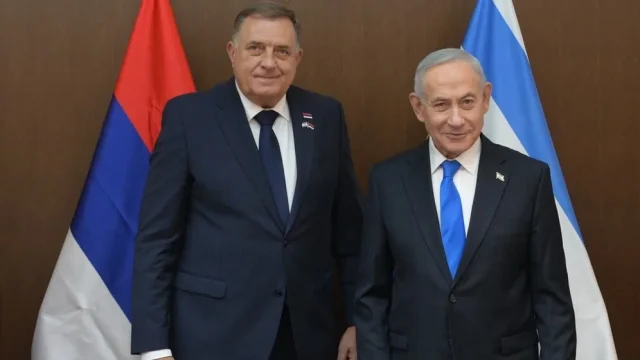
Caption: RS leadership meets with Pete Hegseth. President of the Alliance of Independent Social Democrats (SNSD) Milorad Dodik, member of the Presidency of Bosnia and Herzegovina Željka Cvijanović and Acting President of Republika Srpska Ana Trišić Babić are on a multi-day visit to the US capital on 6 February, where they attended the National Prayer Breakfast and met with senior members of the Trump administration and Republican Party leadership.( X / @MiloradDodik)
Updated: February 27, 2026 - 14:07