Edit
Belgium faces renewed pressure over Euroclear assets amid uncertain U.S. support
Zelenskyy and De Wever discussed F-16 deliveries and Ukraine’s funding needs in Brussels
Prime Minister Bart De Wever and Ukrainian President Volodymyr Zelenskyy discussed Belgium’s planned supply of F-16 fighter jets and Ukraine’s broader military and financial requirements during a meeting in Brussels on Thursday evening. “Ukraine urgently needs operational jets (…), and we can help with that,” De Wever said at a press conference after the first day of the European summit.
The bilateral talks took place on the sidelines of the European Council. Zelenskyy was expected to address the heads of state and government on Friday morning. De Wever was reluctant to give many details but confirmed that the leaders had “of course” discussed F-16s. Belgium will supply ten this year. Deliveries had slipped because of delays in the arrival of replacement F-35s, but those aircraft are now starting to arrive, allowing the transfer of F-16s to proceed. Under a previous commitment, Belgium planned to transfer up to 30 F-16s by 2028, contingent on the progressive delivery of its new fighters.
De Wever stressed the jets’ immediate relevance. F-16s are “one of the few weapons that can be used very effectively to provide protection” against the jet-powered drones Russia is deploying. Ukraine also needs operational aircraft to help protect grain exports across the Black Sea, energy infrastructure, and urban areas that Russia is targeting. The two leaders discussed practical ways Belgium could assist, including ammunition for the F-16s manufactured by FN Herstal.
They also addressed Ukraine’s funding needs. “I said that, as far as I’m concerned, the EU must continue to support Ukraine,” De Wever said. “I have a clear idea of how that could be done. I haven’t discussed it yet, but I think it will come up tomorrow, and I’m ready.”
De Wever said little specifically about using the roughly €200 billion in frozen Russian central-bank assets, the bulk of which are held at Euroclear in Belgium. Last year, Belgium blocked a proposed “reparations loan” that would have leveraged those assets, citing financial and legal risks that could fall primarily on Euroclear and the Belgian state. European leaders instead agreed a €90 billion loan for 2026–2027 funded through EU borrowing.
Why the EU could not agree to use the frozen Russian assets for Ukraine
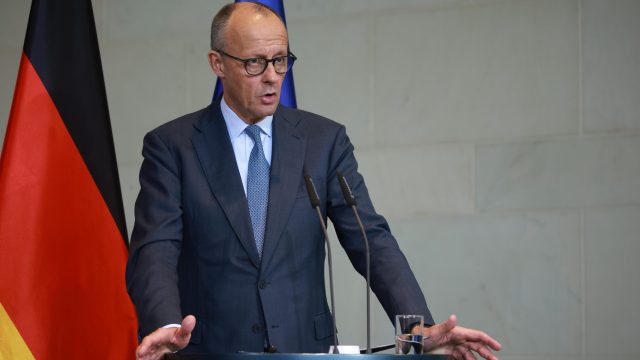
German Chancellor Friedrich Merz, speaking in Brussels on Thursday ahead of the summit, rejected a reported U.S. proposal to unfreeze part of the immobilised Russian assets and place them under Washington’s control.
“Those are assets that are frozen in Europe and they should remain frozen in Europe. This is our business and we are deciding over it,” he said. Merz has long favoured finding a way to leverage the funds for Ukraine, but his latest comments underline European insistence on retaining control – while still leaving Belgium under pressure to accept some form of use of the Euroclear holdings as U.S. support becomes less reliable.
That debate has resurfaced as U.S. support for Ukraine has grown more uncertain. Recent tensions between Kyiv and Washington – including a U.S. deal involving Russian diesel, restrictions on satellite communications, and sharp public exchanges between Zelenskyy and President Donald Trump – have heightened European concern about gaps in intelligence, air defence, and financing. Several member states, including the Netherlands, have called for the Commission to examine all options for mobilising the immobilised assets without taboos. Ideas under discussion include transferring the assets and associated liabilities out of Euroclear into a new EU-level structure (sometimes described as a “bad bank” or “Russian Transfer”) that would share residual risks among member states while generating funds for Ukraine. Ukraine’s own officials have pressed for progress, arguing that the existing loan package will not cover longer-term needs.
After the meeting, Zelenskyy thanked De Wever on social media for Belgium’s support. “At present, F-16s are playing a significant role in repelling attacks by ‘Shaheds’. We are working with Belgium to secure additional fighter aircraft as soon as possible,” he wrote, adding that they had also discussed further ammunition. In separate remarks after meeting King Philippe, he underlined that frozen Russian assets should remain immobilised for as long as the war continues. Public statements after the De Wever talks made little reference to a breakthrough on the assets themselves.
Обговорили з Премʼєр-міністром Бельгії Бартом де Вевером наслідки цілодобових російських атак по житлових будинках, енергетиці та іншій критичній інфраструктурі України. Лише за цей вечір росіяни завдали ударів по енергетичних обʼєктах у двох регіонах. Без світла залишилося майже… pic.twitter.com/fqRjg4NkJ3
— Volodymyr Zelenskyy / Володимир Зеленський (@ZelenskyyUa) October 15, 2026
The combination of immediate military needs and longer-term financing questions is expected to feature when Zelenskyy addresses the full European Council on Friday.
Caption: Prime Minister Bart De Wever and Ukrainian President Volodymyr Zelenskyy held talks on the sidelines of the European Council on 15 October 2026 [Council Newsroom]
Updated: October 16, 2026 - 10:09