Edit
Azerbaijan’s parliamentary break with the EU: is it a threat to Europe’s gas supply?
The parliamentary freeze is largely symbolic, but symbols can harden into policy if criticisms escalate or if Baku perceives continued hostility
Azerbaijan’s parliament, the Milli Majlis, voted on Friday to suspend all cooperation with the European Parliament. The decision came hours after the EP adopted a resolution on “Supporting Democratic Resilience in Armenia” that condemned Baku’s detention of Armenian prisoners and called for accountability over cultural heritage issues in Nagorno-Karabakh.
Azerbaijan described the resolution as biased, “Azerbaijanophobic,” and rooted in corruption and lobbyist influence. Yet this parliamentary rupture occurs against a backdrop of deepening energy ties: just months earlier, EU officials hailed Azerbaijan as a vital partner in reducing reliance on Russian gas.
The move is not unprecedented. Azerbaijan’s Milli Majlis previously suspended all relations with the European Parliament in 2015 over what it viewed as biased resolutions (particularly on human rights and the Nagorno-Karabakh conflict). Cooperation was later partially restored in September 2016 following appeals and promises from the EP side.
Azerbaijan is an authoritarian country ranking near the bottom of global press freedom indices, placing 171st out of 180 countries in Reporters Without Borders’ 2026 World Press Freedom Index with a score of just 23.95. Under President Ilham Aliyev’s long-standing rule, independent journalism faces systematic repression: critical outlets are shut down or taken over, a restrictive 2022 media law institutionalizes censorship, and authorities routinely use fabricated charges such as currency smuggling or incitement to detain reporters. At least 25–30 media professionals remain imprisoned as of early 2026, including journalists from Abzas Media and Meydan TV serving sentences of up to nine years; many report ill-treatment, denial of medical care, and sexual abuse in detention. Exiled journalists also face in-absentia convictions and harassment of relatives back home, creating a climate where self-censorship is the norm and genuine investigative reporting on corruption or governance is virtually impossible.
The energy backbone
Azerbaijan supplies natural gas to Europe via the Southern Gas Corridor – the South Caucasus Pipeline (SCP), Trans-Anatolian Pipeline (TANAP) through Turkey, and Trans-Adriatic Pipeline (TAP) into Italy and Greece. In 2025, Azerbaijan delivered 12.5 billion cubic meters (bcm) to EU countries, a 53.8% increase since 2021, representing roughly 4% of total EU gas imports.
Italy is the largest recipient, with TAP gas accounting for a significant share of its pipeline imports. Flows also reach Greece, Bulgaria, and increasingly Central Europe, with deliveries to Austria and Germany beginning in early 2026. Azerbaijan exported about 25.2 bcm total in 2025, roughly half to Europe.
The values-energy trade-off
The timing highlights the EU’s recurring dilemma. In March 2026, Energy Commissioner Dan Jørgensen visited Baku and praised the partnership as “an important backbone” of EU energy security amid other global disruptions. The 2022 EU-Azerbaijan Memorandum of Understanding targets 20 bcm annually by 2027, though current infrastructure and production constrain faster growth.
The EP resolution, adopted with a strong majority, focused on democratic support for Armenia, Armenian returns and property rights, and criticism of detentions. Azerbaijan rejects these claims, insisting the 2023 Karabakh exodus was voluntary and that detainees are criminals.
This is not the first clash. Azerbaijan has previously accused European bodies of bias and withdrawn from assemblies like PACE using similar language. The suspension affects inter-parliamentary dialogue and Euronest but does not directly alter commercial gas contracts managed by the European Commission and Council.
Country-level exposure
Southeast European nations that benefited most from the Southern Gas Corridor for diversification now face potential political uncertainty. Italy, Greece, and Bulgaria have seen tangible supply benefits. Any slowdown in planned expansions (TANAP capacity increases or new upstream projects) could limit future growth precisely when the EU aims to phase out remaining Russian volumes.
Russia’s reduced role (pipeline transit via Ukraine ended in 2025) elevated alternatives like Azerbaijani gas. However, Baku maintains relations with multiple powers, including Turkey (key transit state) and others. The spat risks complicating broader EU-Azerbaijan cooperation on renewables and green hydrogen, areas the EU has also pursued.
No immediate threats to gas flows have emerged from Baku. Contracts are long-term and commercial. Yet sustained diplomatic friction could erode trust, deter investment, or give Azerbaijan leverage in future negotiations.
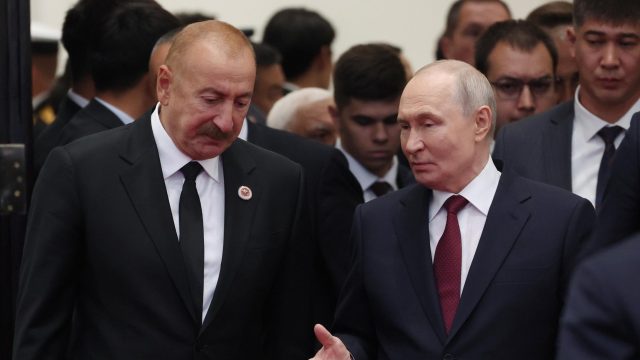
Caption: Handshake between the President of Azerbaijan Ilham Aliyev, on the left, and Energy Commissioner Dan Jørgensen, 3 March 2026 [Europe by Satellite]
Updated: May 1, 2026 - 18:15